

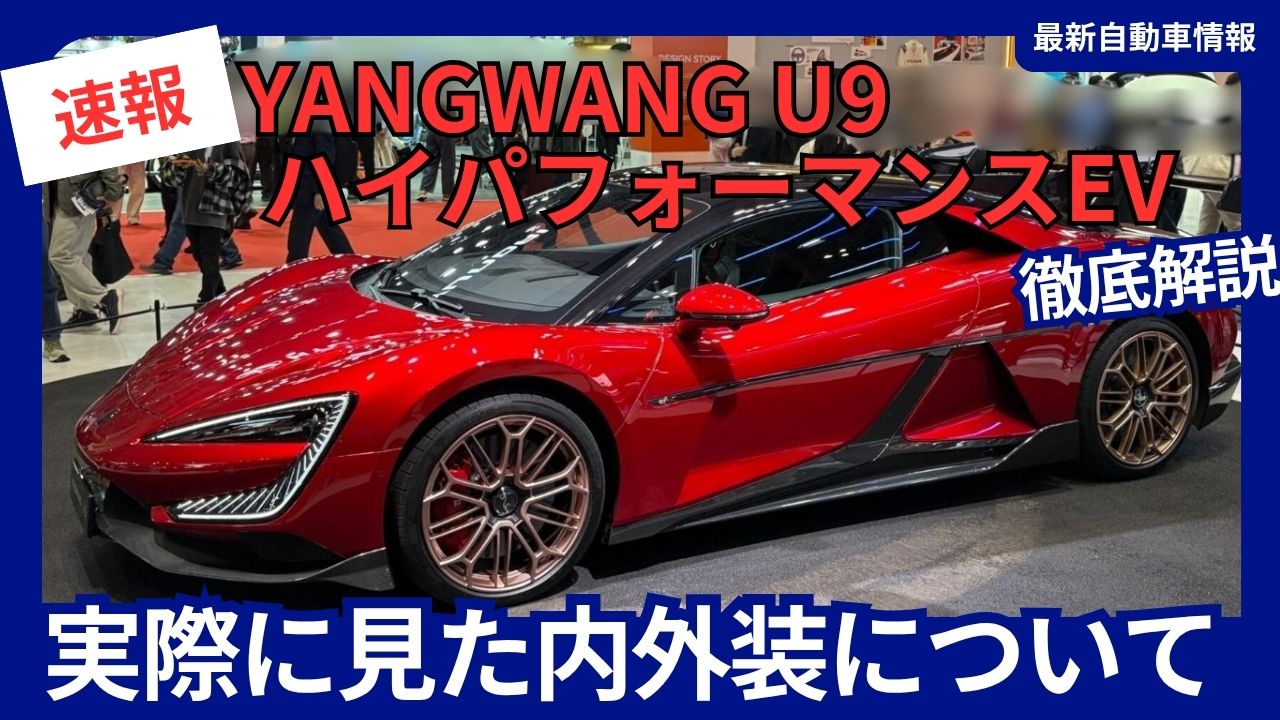
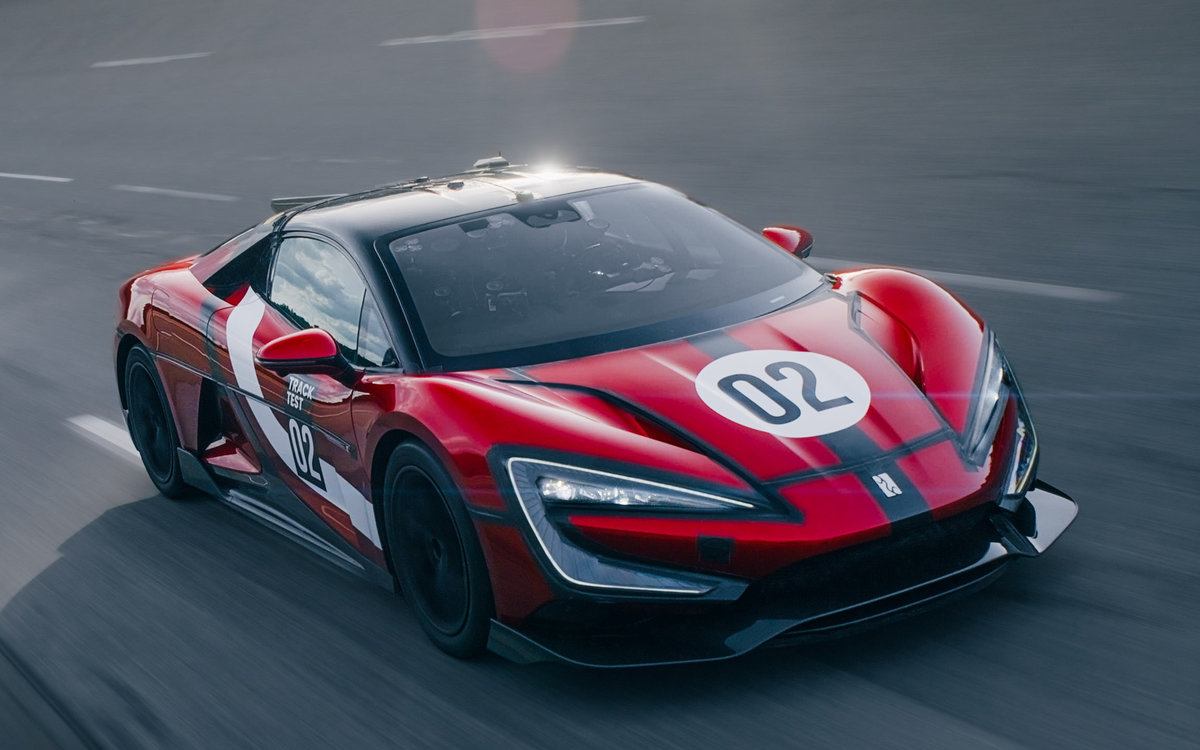
The electric supercar “U9,” created by BYD’s high-end brand “YANGWANG,” made its Japanese debut at the 2025 Japan Mobility Show, sending shock waves through the automotive industry. The retail price in China is 1.68 million yuan (approximately 35 million yen), and the limited edition circuit-spec model “U9 Xtreme” is priced at over 100 million yen.
Ultra-luxury EV supercar arrives in Japan
The YANGWANG U9 is set to set a new standard for EV supercars, a groundbreaking model that directly challenges conventional gasoline supercars.
The appeal of the exterior design
Styling that embodies the aesthetics of a supercar

YANGWANG U9
The exterior design of the YANGWANG U9 was led by Wolfgang Egger, former chief designer of Alfa Romeo and Lamborghini. With dimensions of 4,966mm in length, 2,029mm in width, and 1,311mm in height, it achieves the ideal proportions of a supercar.
The elegant, streamlined body lines reminiscent of a mid-engine car minimize air resistance while creating an aggressive, futuristic impression. While the car has a look reminiscent of European supercars such as Lamborghini and McLaren, it exudes its own unique personality.
Carbon fiber and aerodynamics

YANGWANG U9
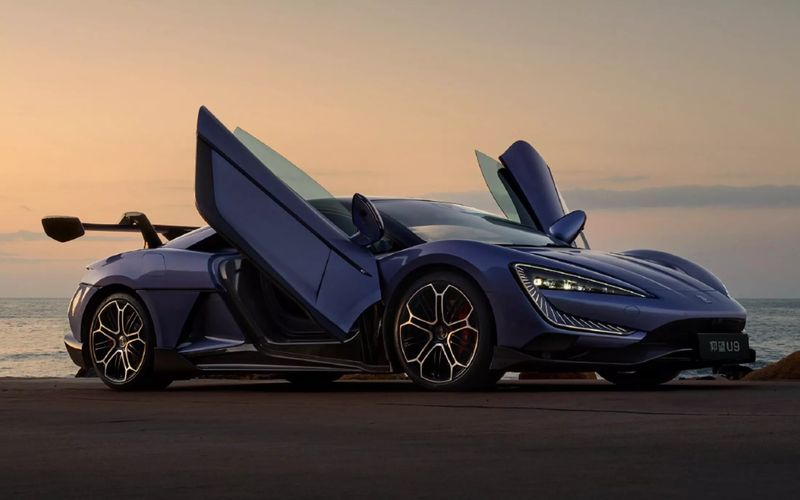
A large carbon fibre wing is fitted to the rear to generate downforce at high speeds, and the U9 Xtreme also features a carbon fibre front splitter for further aerodynamic enhancements.
The combination of ultra-low profile large diameter tires and special semi-slick tires (GitiSport e-GTR PRO) is proof that the car has pursued the limits of performance on the circuit.
The dramatic effect of scissor doors

YANGWANG U9
The adoption of scissor doors that flip up allows for dramatic effects when getting in and out. At the Japan Mobility Show, the electrically operated scissor doors were unveiled, attracting the attention of many visitors.
Interior Design and Technology
A simple yet functional cockpit
BYD Yangwang U9
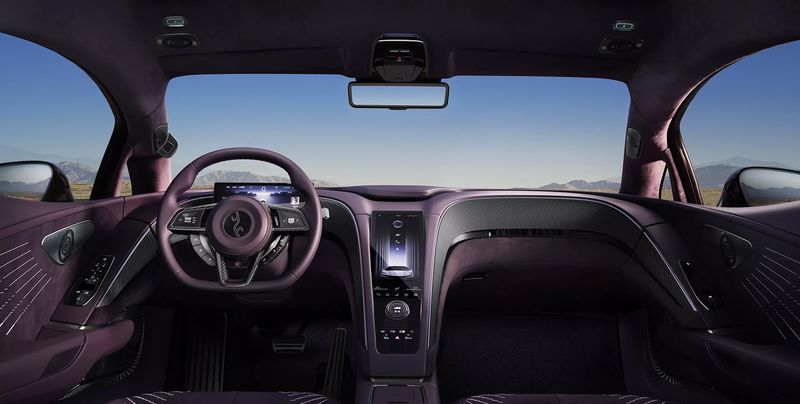
The interior is simple and functional, reminiscent of Lamborghini and McLaren, and the two-seater cockpit is designed with the driver in mind.
Many operating functions are concentrated on a large infotainment monitor located in the center, and by minimizing physical switches, a modern and sophisticated space is created.
Premium materials used
BYD Yangwang U9
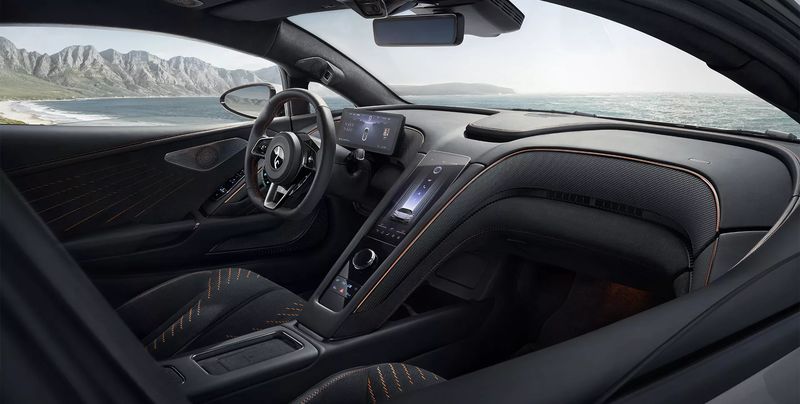
As befits a luxury supercar, the U9 Xtreme is adorned with premium materials such as carbon fiber and premium leather, and the car makes extensive use of 3D printing technology to reduce weight and optimize structural components.
Overwhelming performance
Innovation of the e⁴ Platform
The YANGWANG U9’s greatest feature is its unique four-motor drive system known as the “e⁴ platform.” Each of the four wheels is equipped with a high-performance motor boasting a maximum output of 30,000 rpm, and the torque of each wheel is independently controlled at a frequency of over 100 Hz.
The standard model delivers a maximum output of 960 kW (approximately 1,306 PS) and a maximum torque of 1,680 Nm, accelerating from 0 to 100 km/h in just 2.36 seconds – the pinnacle of performance for a modern supercar.
U9 Xtreme breaks world record
The YANGWANG U9 Xtreme, designed specifically for the circuit, delivers even more incredible performance.
In September 2025, the car recorded a top speed
of 496.22 km/h at the ATP Automotive Testing Papenburg proving ground in Germany, setting a new world record for an EV. This surpasses the previous record of 490.48 km/h set by the Bugatti Chiron Super Sports 300+, making it the fastest production car in history.
Even more impressive is the intermediate acceleration: the Chiron takes 400 to 490.5 km/h in 48 seconds, while the U9 Xtreme accelerates from 400 to 496 km/h in just 18 seconds.
Nürburgring Nordschleife Record:
In 2025, the car recorded a time of 6 minutes 59.157 seconds on the Nürburgring Nordschleife in Germany, the fastest time for a mass-produced EV. This is an astonishing time that is more than five seconds faster than the 7 minutes 4.957 seconds set by the Xiaomi SU7 Ultra.
1200V Ultra High Voltage Platform
The U9 Xtreme is equipped with the world’s first mass-produced 1,200V ultra-high voltage platform, delivering a total power output of over 3,000 PS and an astounding power-to-weight ratio of 1,217 PS/tonne.
Innovative DiSus-X vehicle control system
Movements that transcend the laws of physics
The YANGWANG U9 is notable for its DiSus-X intelligent vehicle control system, which uses an advanced active suspension system that combines air and hydraulic pressure to achieve vehicle control that goes far beyond the concept of conventional air suspension.
Dance performance attracts attention
A dance performance utilizing the DiSus-X system was unveiled at the Japan Mobility Show 2025, which became a hot topic on social media. The performance featured movements that made it appear as if the car was dancing, with one wheel floating in the air and all four wheels jumping at the same time.
In response to the positive response to this performance, BYD is holding a dealer caravan at four locations across the country (Saitama Shintoshin, Nagoya Kita, Tokyo Bay Shinonome, and Shiga), showcasing the actual vehicle and dance performance.
Practicality on the track
The DiSus-X system is not just for show: it instantly controls the suspension during acceleration, deceleration and cornering, suppressing roll and pitch and optimizing tire contact with the road.
In the future, it will be possible to link with ADAS (Advanced Driver Assistance Systems) and automatically switch to the optimal settings based on the position on the course using GPS. For example, it will be possible to automatically switch to a maximum speed mode on a straight line and a cornering mode before a corner.
Battery and powertrain innovation
Advantages of LFP batteries
The YANGWANG U9 uses BYD’s proprietary LFP (lithium iron phosphate) battery. NMC (nickel manganese cobalt) batteries are generally considered to have higher performance, but BYD’s technical director has an interesting perspective.
LFP benefits for track use:
- Capable of handling extreme discharge rates up to 30C
- High temperature resistance and stable performance even at high temperatures
- Stable performance even under low SOC conditions
- High resistance to physical vibrations and deformation
- Energy density at pack level is comparable to NMC
The U9 Xtreme uses LFP battery cells designed specifically for racing circuits and a battery pack with a dual-layer cooling structure, achieving a maximum discharge rate of 30C.
30,000rpm high performance motor
The 30,000 rpm motors installed on each wheel are high-performance units developed in-house by BYD. The secret to their mid-range acceleration is that they can maintain powerful acceleration up to high rpm ranges without using gear changes.
While Porsche and Mercedes use two-speed transmissions to improve acceleration at high speeds, the U9 achieves overwhelming performance despite being a single-speed.
The true purpose of 4-motor drive
The two 555kW motors mounted on the front are not just for improving power performance. Normal friction brakes are not enough to provide braking force for heavy EVs, so ultra-powerful regenerative braking is necessary. The four-motor drive system ensures the braking performance required for circuit driving.
Advantages
1. Overwhelming power performance
With acceleration from 0 to 100 km/h in 2.36 seconds and a top speed of 496.22 km/h (Xtreme), it is at the pinnacle of modern supercars.
2. Innovative vehicle control technology
The vehicle posture control provided by the DiSus-X system is a unique feature not found in other manufacturers’ supercars.
3. Track-proven performance
Its capabilities have been proven by setting a new record for the fastest production EV on the Nürburgring Nordschleife.
4. Technical capabilities through vertical integration
BYD has developed the motor, power semiconductors, battery, brake system, and suspension system in-house, achieving optimal packaging.
5. Incredible cost performance
The price of approximately 35 million yen (standard model) is a bargain compared to European supercars with similar performance. The Bugatti Chiron costs over 300 million yen, and the top models of Ferrari and Lamborghini cost from several tens of millions to over 100 million yen.
6. Future-oriented design
The design by Wolfgang Egger respects the aesthetics of traditional supercars while expressing the advanced features unique to EVs.
7. Development of tires specifically for the circuit
The special semi-slick tires, developed in collaboration with Giti Tire, provide stable grip even at speeds of over 500 km/h.
Disappointments
1. Range limitations
The standard model has a driving range of approximately 450 km (Chinese standard) on a single charge. While this is sufficient for a supercar, it has limitations for everyday use. The range on a circuit will likely be even shorter.
2. Uncertainty about Japan’s introduction
At present, there is no official announcement of a release date in Japan. Depending on the reaction at the Japan Mobility Show, introduction may be considered, but there is no guarantee.
3. Vehicle weight
The vehicle weight of 2,475 kg is standard for an EV, but is at a disadvantage compared to lighter gasoline supercars. The DiSus-X system mechanism also contributes to the weight increase.
4. Charging Infrastructure Issues
Even with fast charging, it still takes longer than refueling with gasoline. There are also concerns about the strain that fast charging after driving on a circuit may put on the battery.
5. Brand image building in progress
Compared to established supercar brands such as Ferrari, Lamborghini, and McLaren, YANGWANG is still an emerging brand, and there is uncertainty about its resale value and asset value.
6. Lack of interior information
The interior was not revealed at the Japan Mobility Show, so the detailed texture and equipment contents could not be confirmed. From the outside, it appears to have a simple design, but it is unclear whether it is luxurious enough to justify the 35 million yen price tag.
7. After-sales service system
Since it is not officially sold in Japan, the maintenance, repair, and parts supply systems are unclear. For the U9 Xtreme, which is limited to 30 units, the support system is even more of a concern.
8. Complexity of Thermal Management Systems
The thermal management systems required to achieve ultimate performance are sophisticated and complex. Long-term reliability and maintenance costs require observation of actual results after the product is released into the market.
A car that predicts the future of EV supercars
The YANGWANG U9 is an iconic model that ushers in a new era of electric supercars. With acceleration that surpasses the limits of gasoline engines, an innovative vehicle control system, and a top speed record that defies conventional wisdom, it proves that EVs can take center stage in the supercar world.
As BYD’s technical director explains, the new approach of “software-centric vehicle tuning” points the way to future automobile development. Based on the latest hardware (e⁴ platform and DiSus-X), the method of improving performance through software updates is a unique advantage of EVs.
Furthermore, traditional German sports car manufacturers such as Porsche and Mercedes-Benz are also concerned about the rapid growth of Chinese automakers and have announced plans to launch new high-performance EVs after 2026. With the arrival of the YANGWANG U9, there is no doubt that competition in the EV supercar market will intensify.
Although there are no official sales dates for the car in Japan, judging from the reaction at the dealer caravan and the spread of the car on social media at the mobility show, there is certainly potential demand. This is a model to keep an eye on in the future.
summary
The YANGWANG U9 has reached unprecedented heights as a Chinese-made EV supercar. While it boasts outstanding dynamic performance, innovative technology, and incredible cost performance, it also faces challenges such as building a brand image, introducing it to the Japanese market, and ensuring long-term reliability.
However, its world speed record and achievements on the Nürburgring Nordschleife speak volumes about its technological prowess. As a pioneer that opens up a new era of EV supercars, the YANGWANG U9 will be a model that will leave its mark in automotive history.