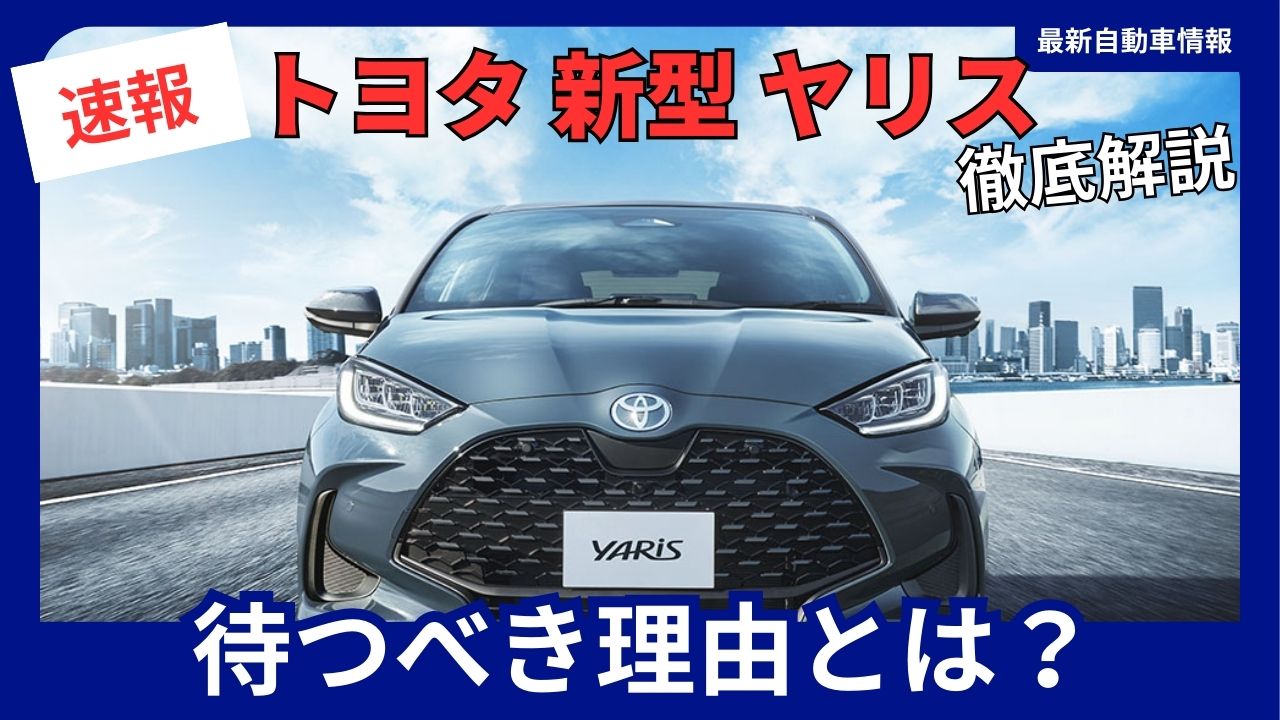

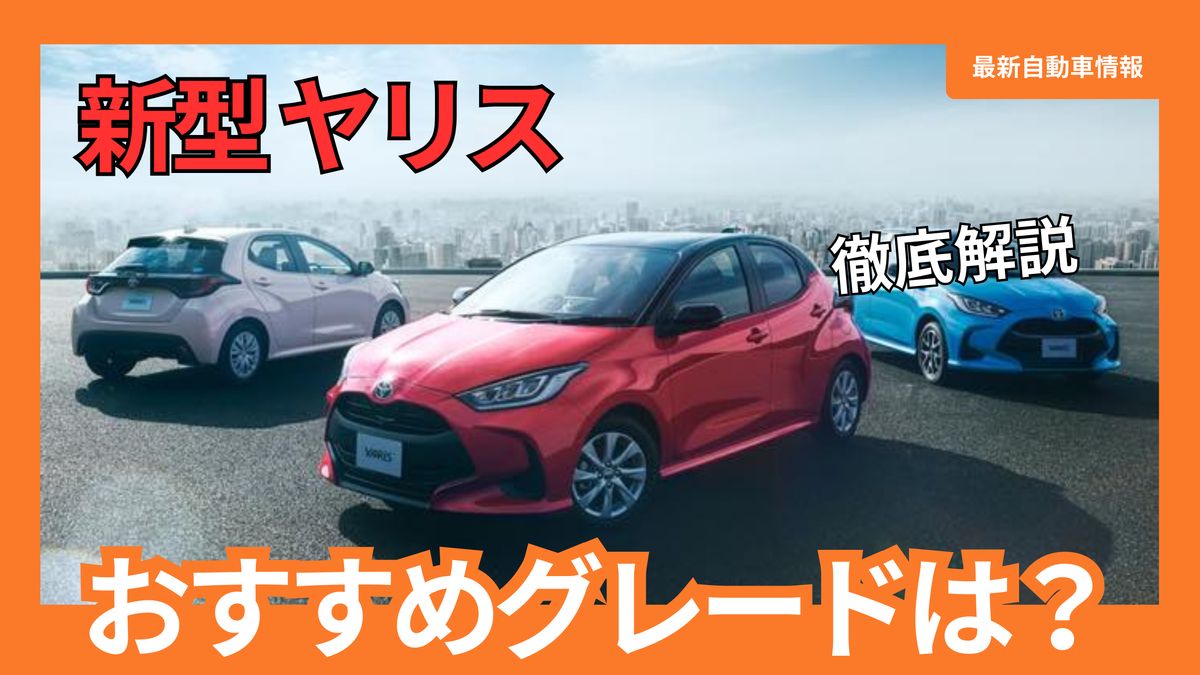
This time, we’ll take a closer look at the recommended grades of the new Yaris . We’ll provide helpful information for those who find the catalog confusing or are considering purchasing one. There are many grades of the Yaris, so you might be unsure which one is the best value. We’ve looked into the differences between hybrid and gasoline-powered vehicles, and which of the various grades is the most recommended. We hope this article will be helpful when considering purchasing a Yaris.
About the new Yaris
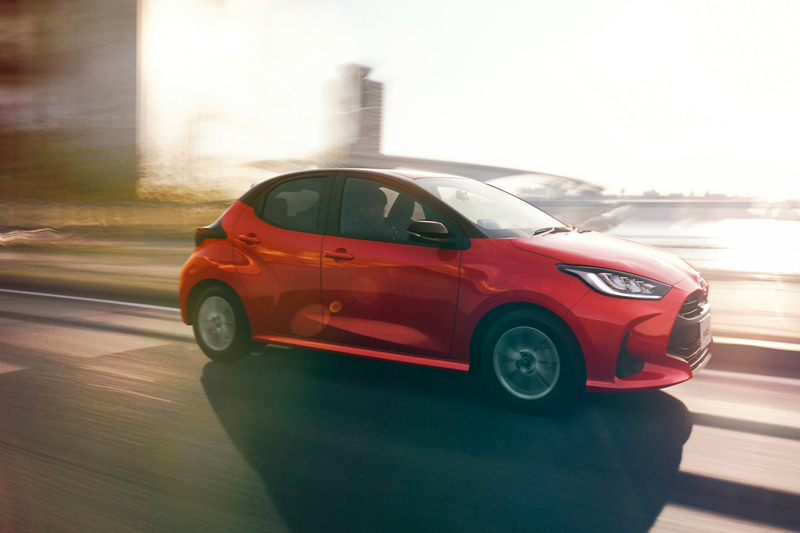
There are three engines to choose from, two gasoline and one hybrid. There are also three grades: X, G and Z. The first thing that will be most difficult to decide is which engine to choose. There are 14 different options.
What grade is the new Yaris?
You can choose from grades “X”, “G” and “Z”.
- X: Entry grade
- G: Intermediate grade
- Z: High grade
X-grade features
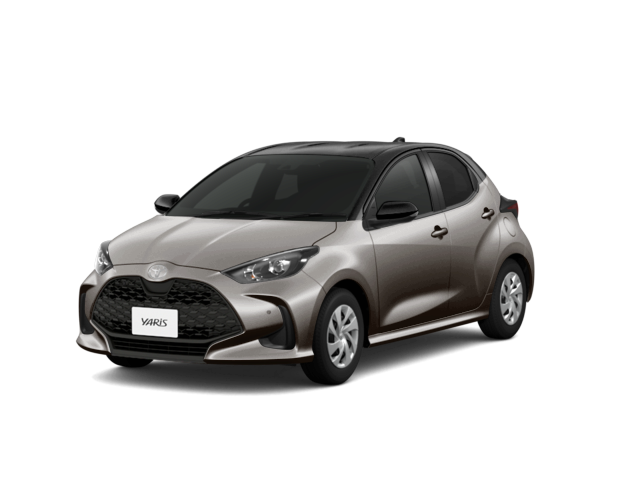
Yaris Grade X
The X grade is the entry-level model and is the cheapest.
If you choose the X grade gasoline version of the Yaris, you can purchase it for as little as 1,655,000 yen. The exterior features halogen headlights and 14-inch wheels. The interior features an analog instrument panel, fabric seats, and a single color finish. It also comes with a 7-inch display, but does not include optional comfort features such as heated seats.
G grade features
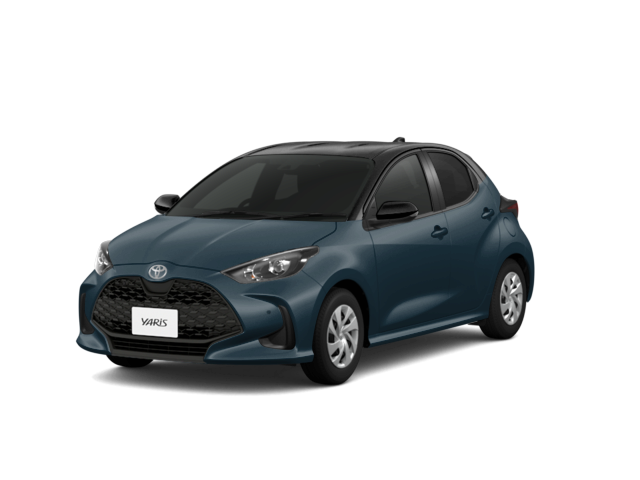
Yaris Grade G
The G grade is a mid-range model that offers a good deal. If you choose the gasoline G grade, you can purchase it from 1,953,000 yen . Unlike the X grade, the exterior features LED headlights that can be changed to 15-inch. In addition, 15-inch aluminum wheels are used, and the interior has been significantly changed, with a digital instrument panel, an 8-inch display, and a backup guide monitor as standard equipment, and heated seats are optional.
Z grade characteristics
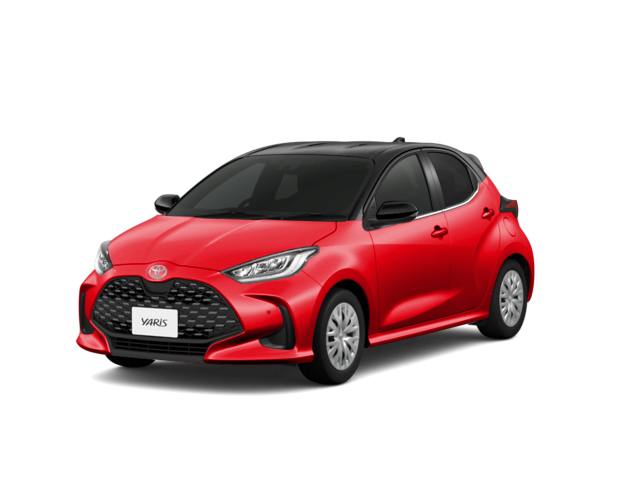
Yaris Grade Z
The Z grade is a premium model, and some may find it a little pricey. However, if you select the gasoline Z grade, you can purchase it from 2,154,000 yen , which is in the 2 million yen range. However, the exterior design allows you to select 16-inch aluminum wheels exclusive to the Z grade, and LED headlights make it clear that it is a Z grade.
The interior comes with a combination of genuine leather and fabric seats as standard, seat heaters, and the option to install a color head-up display, so you’ll notice the difference when you’re in the car.
Hybrid vehicles
The new Yaris employs a new, downsized THS II in the new-generation “inline 3-cylinder 1.5L direct-injection Dynamic Force Engine M15A type.” This improves the engine’s thermal efficiency and the transmission’s transmission efficiency while reducing overall mass. As a result, the fuel economy of the entire powertrain system (engine and transmission) has improved by approximately 25%, and power performance by more than 15%. This system has dramatically improved fuel economy, achieving a low fuel consumption of 36.0 km/L in WLTC mode.
In addition, the E-Four (4WD) model also features a newly developed rear suspension specifically for 4WD, making it the first Toyota compact car to use a double wishbone system. This will almost certainly re-establish the car’s reputation as the “world’s most fuel-efficient passenger car.”
Gasoline vehicles
Meanwhile, the gasoline-powered vehicle also features the new generation “inline 3-cylinder 1.5L direct injection Dynamic Force Engine M15A type.” By combining this with a “Direct Shift-CVT” or “6MT” with a launch gear, high driving performance is achieved. Furthermore, an “inline 3-cylinder 1.0L engine” model has also been added to the lineup.
| grade | engine | transmission |
Drive system |
Price (10%) |
|---|---|---|---|---|
| X | Inline 3-cylinder 1.0L engine (1KR) |
CVT | 2WD | 1,501,000 yen |
| G | 1,799,000 yen | |||
| X | Inline 3-cylinder 1.5L direct injection engine (M15A) |
Direct Shift- CVT |
2WD | 1,655,000 yen |
| 4WD | 1,888,000 yen | |||
| G | 2WD | 1,953,000 yen | ||
| 4WD | 2,151,000 yen | |||
| Z | 2WD | 2,154,000 yen | ||
| 4WD | 2,352,000 yen | |||
| X | 6-speed manual transmission | 2WD | 1,579,000 yen | |
| G | 1,877,000 yen | |||
| Z | 2,050,000 yen | |||
| HYBRID X | Inline 3-cylinder 1.5L direct injection engine (M15A) + motor (THS II) |
Electric continuously variable transmission |
2WD | 2,044,000 yen |
| 4WD | 2,287,000 yen | |||
| HYBRID G | 2WD | 2,299,000 yen | ||
| 4WD | 2,507,000 yen | |||
| HYBRID Z | 2WD | 2,496,000 yen | ||
| 4WD | 2,694,000 yen |
New Yaris specs
| Specifications | New Yaris Hybrid |
New Yaris gasoline vehicle |
New Yaris gasoline vehicle |
|---|---|---|---|
| full length | 3,940mm | 3,940mm | 3,940mm |
| Overall width | 1,695mm | 1,695mm | 1,695mm |
| Overall height | 1,500mm (2WD) 1,515mm (4WD) |
1,500mm (2WD) 1,515mm (4WD) |
1,500mm (2WD) 1,515mm (4WD) |
| Wheelbase |
2,550mm | 2,550mm | 2,550mm |
| engine | Inline 3 1.5L + motor M15A-FXE type |
In-line 3-cylinder 1.5L engine M15A-FKS type |
Inline 3-cylinder 1.0L engine 1KR type |
| Maximum power | 67kW (91ps) / 5500rpm |
88kW (120ps) / 6600rpm |
51kW (69ps) / 6000rpm |
| Maximum torque | 120Nm (12.2kgfm) / 3800-4800rpm |
145Nm (14.8kgfm) / 4800-5200rpm |
92Nm (9.4kgfm) / 4400rpm |
| Motor maximum output |
Front: 59kW (80ps) Rear: 3.9kW (5.3ps) |
– | – |
| Motor Max Torque |
Front: 141Nm (14.4kgm) Rear: 52Nm (5.3kgm) |
– | – |
| WLCT mode fuel economy |
36.0-35.4km/L (2WD) 30.2km/L (4WD) |
21.4-21.6km/L 19.2km/L |
19.6-20.2km/L |
| Drive system | 2WD/4WD (E-Four) |
2WD/4WD | 2WD |
| Passenger capacity | 5 people | 5 people | 5 people |
| Minimum turning radius |
4.8m to 5.1m | 4.8m to 5.1m | 4.8m to 5.1m |
transmission |
Electric continuously variable transmission |
Direct Shift- CVT 6-speed MT |
CVT |
Until the new Yaris Hybrid pays off
In the WLTC mode, which is close to standard fuel economy, hybrid vehicles have a fuel economy of 36.0 to 35.4 km/L (28 km/L), while gasoline vehicles have a fuel economy of 21.4 to 21.6 km/L (14 km/L), which is a very troubling issue when you consider the price.
Comparing both grades, “G” 2WD, the gasoline model is 1,953,000 yen and the hybrid model is 2,299,000 yen, a difference of 346,000 yen . Furthermore, taking into account tax breaks, the hybrid model is about 30,000 yen more expensive, for a total difference of 311,600 yen . Now, we’ll calculate the cost of gasoline, and examine how much driving you need to do to make up for the gasoline cost of about 310,000 yen.
If gasoline price is 170 yen per liter
- Gasoline model 10,000km = 121,429 yen
- Hybrid car 10,000km = 60,714 yen
The difference is only 60,715 yen after driving 10,000 km, so even if you drive 50,000 km, the difference is only 303,575 yen . You will need to drive about 60,000 km to make up the difference…
conclusion
Considering resale value, it is better to choose a hybrid car. The author particularly recommends the hybrid car for the new Yaris. Here are the reasons why.
First, the “Advanced Park” advanced parking assistance system (a first for Toyota) is only available on hybrid vehicles. Furthermore, the new generation “in-line 3-cylinder 1.5L direct injection Dynamic Force Engine M15A” adds motor output to engine output compared to gasoline vehicles, resulting in a more agile ride and improved comfort in everyday life.
Also, even if you sell your car after driving 50,000 km, hybrid cars have a high resale value, so you can make up for the difference of 40,000 yen. For these reasons, we especially recommend the “HYBRID G” grade.
For more information on the new Yaris, click here
Toyota News Release
https://global.toyota/jp/newsroom/toyota/30486400.html
Yaris