
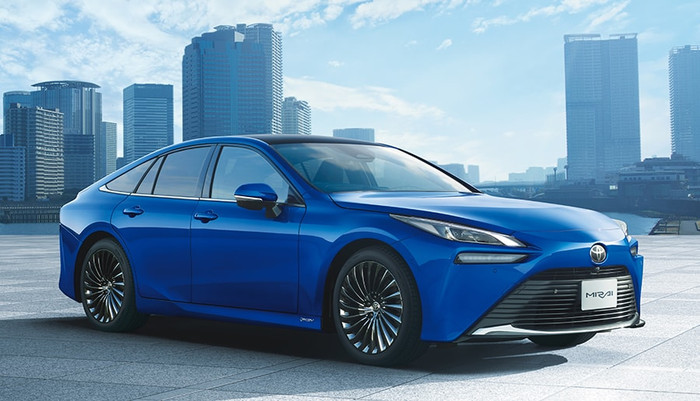
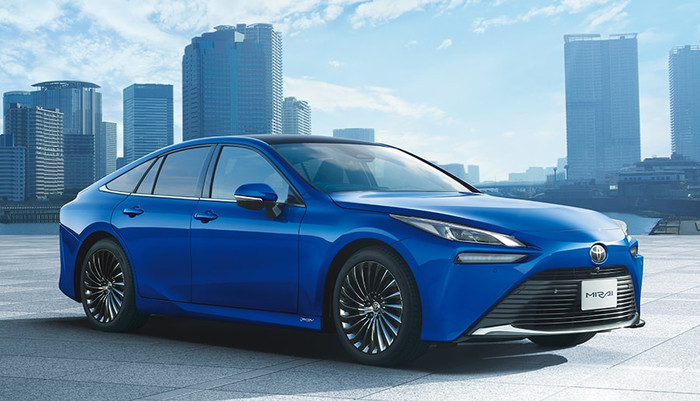
Toyota Motor Corporation has made some improvements to its fuel cell vehicle (FCEV) “MIRAI” and began selling it on December 18, 2024.
Toyota’s new MIRAI partial improvement
To commemorate the 10th anniversary of the launch of the first-generation MIRAI, the latest improvement includes a new manufacturer package option, the “BLACK PACKAGE,” for the Z grade. It features a stylish design with exterior parts unified in black, including 20-inch aluminum wheels with black sputtering paint that accentuate the car’s bold and sporty personality, as well as the front grille, door handles, and emblem.
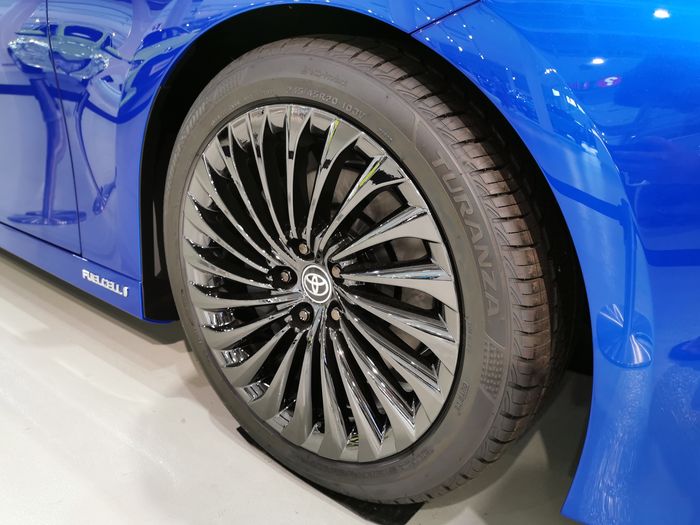
In addition, the grade system has been reorganized into three grades: “Z “Advanced Drive”, “Z”, and “G”, and the 19-inch aluminum wheels that come as standard on all grades are finished with a polished finish and black paint to give the car a more refined look.
Toyota’s new MIRAI 2024 partial improvement: price and grade
| grade | engine | Drive system |
Base price (10%) |
|---|---|---|---|
| G | FC stack |
2WD (FR) |
7,414,000 yen |
| Z | 8,215,900 yen | ||
| Z Advanced Drive | 8,610,800 yen |
Toyota New MIRAI 2023 Partially Improved Price and Grade
| grade | engine | Drive system |
Base price (10%) |
|---|---|---|---|
| G | FC stack |
2WD (FR) |
7,261,000 yen |
| G.A. Package |
7,478,000 yen | ||
| G EXECUTIVE Package |
7,722,000 yen | ||
| Z | 8,022,000 yen | ||
| Z EXECUTIVE Package |
8,172,000 yen | ||
| Z Advanced Drive | 8,460,000 yen | ||
| Z Executive Package Advanced Drive | 8,610,000 yen |
Toyota’s new MIRAI 2023 partial improvement
Toyota will make some improvements to the Mirai and release it on December 18, 2023.
The car is equipped with the latest Toyota Safety Sense, including Proactive Driving Assist, which provides deceleration and steering assistance for vehicles ahead and curves. Toyota Teammate Advanced Drive (traffic jam assistance) and Advanced Park (with remote) are available, reducing the driver’s burden under certain conditions when driving in highway congestion and providing safe and secure parking assistance. The car also features an expanded 12.3-inch TFT color meter for improved visibility, and interior illumination with a total of 64 colors. A drive recorder and a digital key are available as options, allowing you to lock and unlock the doors and start the engine without operating the screen if you have a smartphone with you using the dedicated smartphone app.
Toyota’s new MIRAI 2022 partial improvement
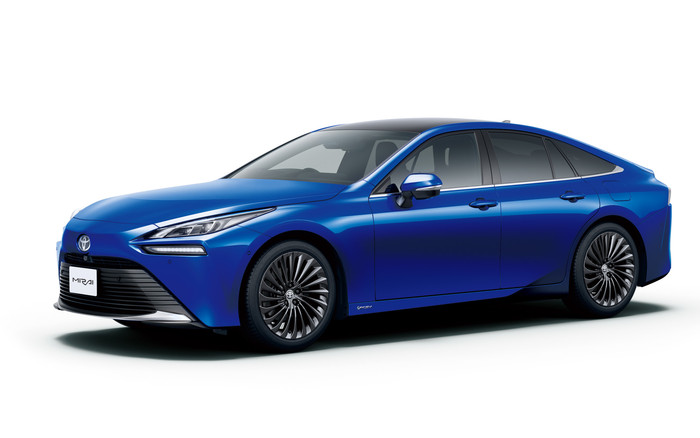
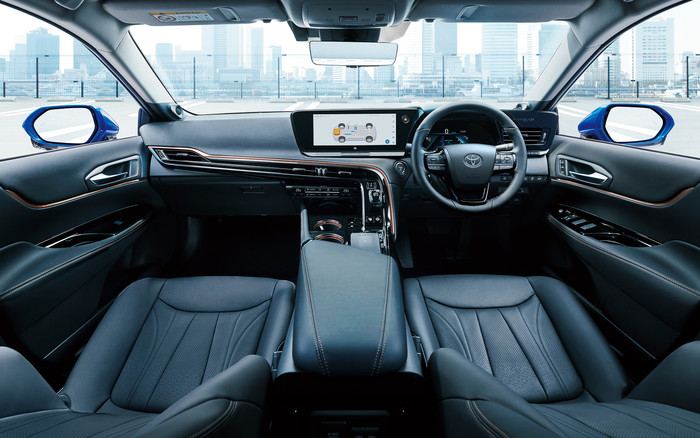
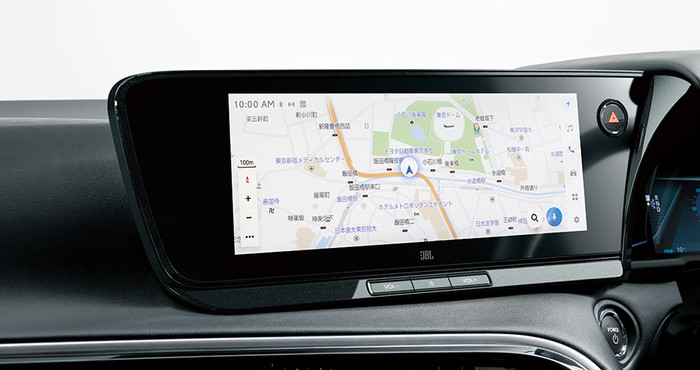
Toyota will make some improvements to the Mirai and release it on December 19, 2022. The new car will be equipped with a high-definition HD widescreen display that allows full-screen display, as well as Display Audio (compatible with connected navigation) Plus, which uses in-car Wi-Fi to turn the car into a Wi-Fi hotspot. The front door glass will also feature IR cut and high sound insulation.
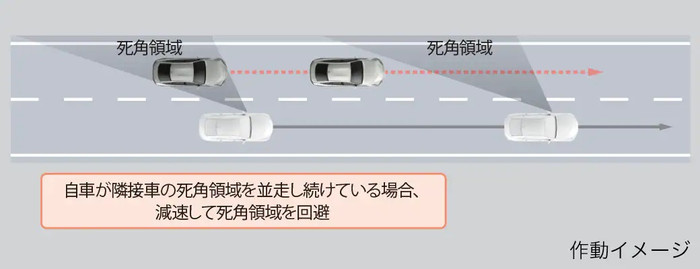
Toyota Teammate [Advanced Drive], an advanced driving assistance technology that detects hazards and supports safe driving, has been enhanced with the addition of a function that allows the driver to drive while taking into consideration the blind spots of other vehicles.
Toyota New MIRAI 2022 Partially Improved Price and Grade
| grade | engine | Drive system |
Base price (10%) |
|---|---|---|---|
| G | FC stack |
2WD (FR) |
7,106,000 yen |
| G.A. Package |
7,356,000 yen | ||
| G EXECUTIVE Package |
7,556,000 yen | ||
| Z | 7,900,000 yen | ||
| Z EXECUTIVE Package |
8,050,000 yen | ||
| Z Advanced Drive | 8,450,000 yen | ||
| Z Executive Package Advanced Drive | 8,600,000 yen |
About the second-generation Toyota Mirai
Toyota released the second-generation Mirai on December 9, 2020, following a full model change. The company led the world with the introduction of the hydrogen-powered Mirai in 2014. Approximately 10,000 units have been sold, and Toyota actively supports the development of hydrogen fueling infrastructure in major markets around the world. The second-generation model marks a new evolution in its advanced zero-emission fuel cell electric vehicle (FCEV) technology.
The new Mirai aims to increase its driving range by 30% through improvements to the fuel cell system and the use of larger on-board hydrogen tanks, with three tanks (one long and two short), increasing fuel capacity by approximately one kilogram compared to the current model, resulting in a range of approximately 850 km (G EXECUTIVE Package, G・A Package, G).
- Aiming to create an emotionally charged car that would be chosen for its styling, the design was crafted around the concept of “SILENT DYNAMISM.”
- The simple, modern space with a warm and comfortable atmosphere adds to the feeling that this is a car that is truly enjoyable to drive and travel in. Key elements include a 12.3-inch center display and a JBL premium sound system (14 speakers).
- It uses the newly developed “GL-L platform” called TNGA (Toyota New Global Architecture) FR.
- Developed packaging specifically for FCVs. Improved fuel cell systems and completely redesigned systems. Improved efficiency has resulted in improved output and fuel economy, while also increasing tank capacity. Additionally, the vehicle’s performance as an FCV has been significantly improved, with features such as an air purification function that cleans the air taken in while driving, resulting in a cruising range of approximately 850km.
- The second-generation Toyota Safety Sense is standard on all vehicles.
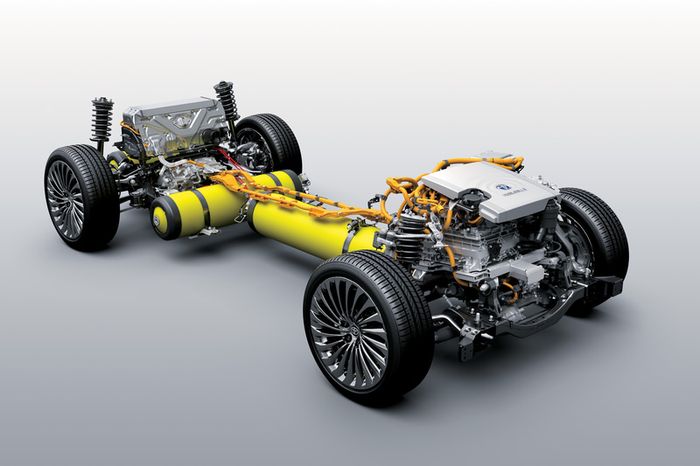
The new MIRAI adopts the newly developed GL-L platform, known as the TNGA (Toyota New Global Architecture) FR, giving it a larger interior space than the previous model. Its overall height is slightly lower than the previous model, further lowering the center of gravity. Laser screw welding (LSW), which increases joint rigidity, and an expanded bonding area for structural adhesives improve driving performance and body rigidity. Both the new MIRAI and the new Crown share the same wheelbase and platform, and while the exterior design has been changed, the basic structure is the same. Ideal weight distribution has been achieved by optimizing the layout of the power unit and high-pressure hydrogen tank, shortening the front overhang, and positioning the center of gravity in the center, resulting in a 50:50 front-to-rear weight balance.
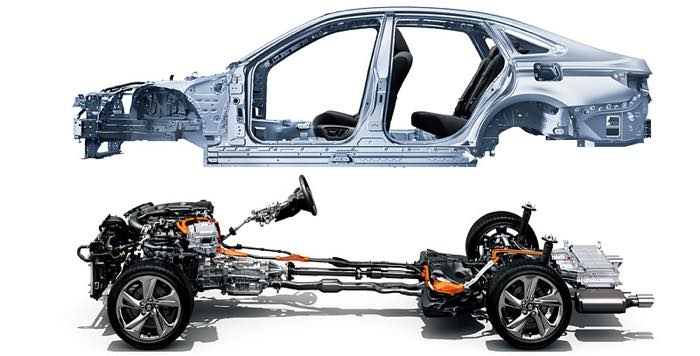
TNGA FR platform
The front suspension is a high-mount multi-ring type, while the rear suspension is a low-mount multi-ring type, and both have been carefully tuned.
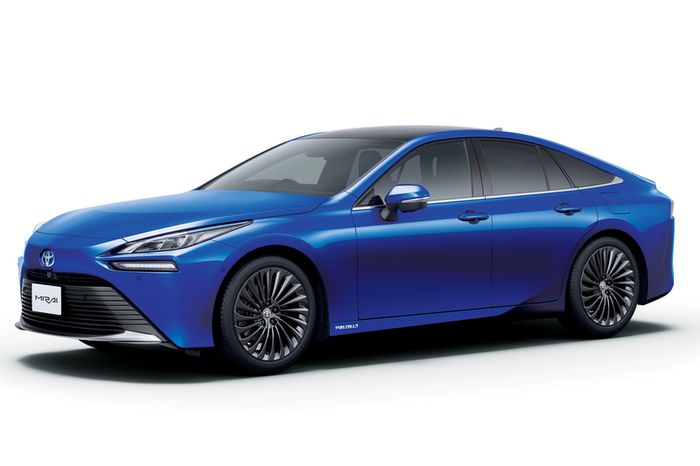
Second generation Toyota Mirai exterior
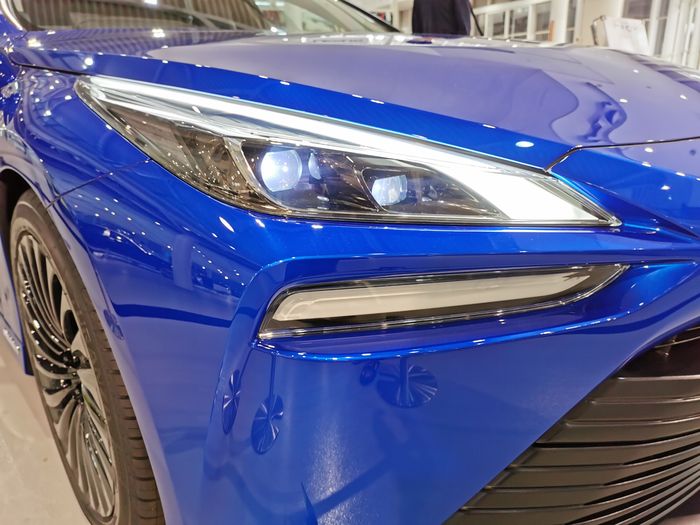
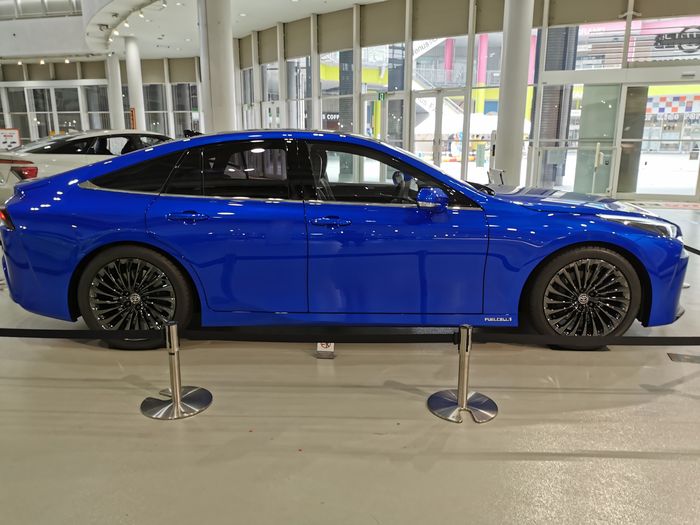
The exterior design features low lines, elegant proportions, smooth and taut bodywork, and large 20-inch wheels for a powerful and distinctive appearance. The headlights are equipped with “Bi-Beam LED headlights (with auto-leveling function) + LED clearance lamps (with daytime running lamp function)”.
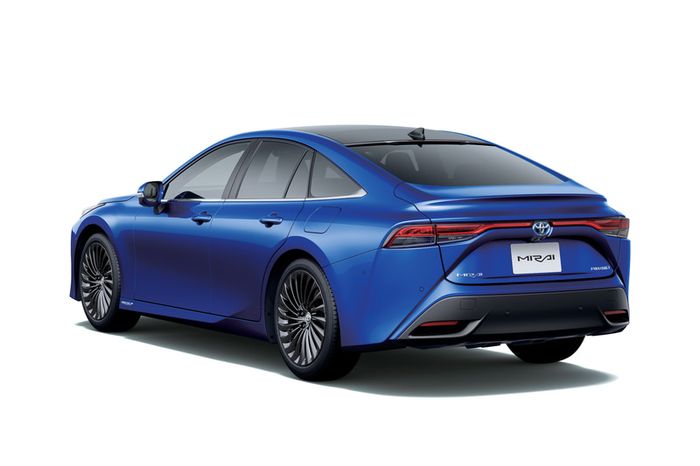
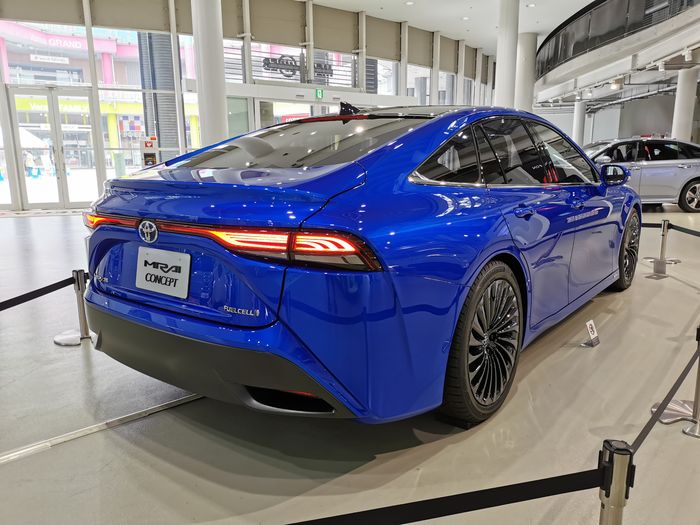
The rear features LED rear combination lamps, which are thin and sharp, stretching horizontally.
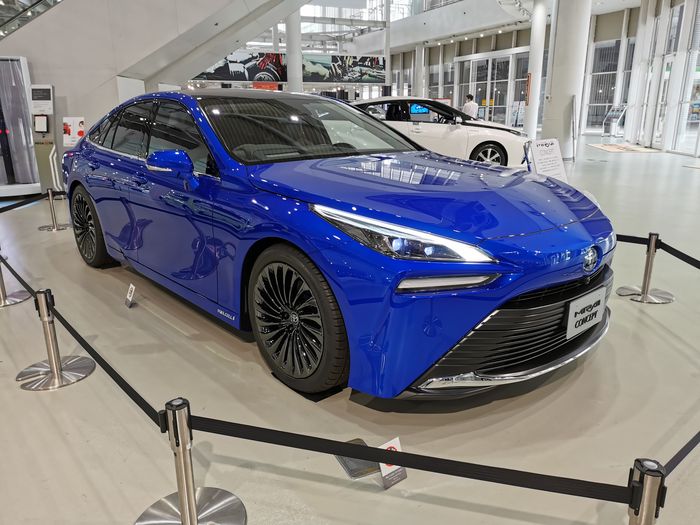
The specifications are the same as those of the MIRAI Concept , a model in the final stages of development for the next-generation MIRAI, unveiled at the Tokyo Motor Show 2019 .
Toyota’s new Mirai, fully redesigned for Europe, to be released in 2020
Second generation Toyota Mirai interior
The interior is a simple, modern space with a warm and comfortable atmosphere, adding to the feeling that this is a truly enjoyable car to drive and travel in. Key elements include a 12.3-inch center display, a JBL premium sound system (14 speakers), and an instrument panel surrounding the driver. The platform and intelligent package allow for a five-seater configuration, up from the previous Mirai’s four-seat configuration.
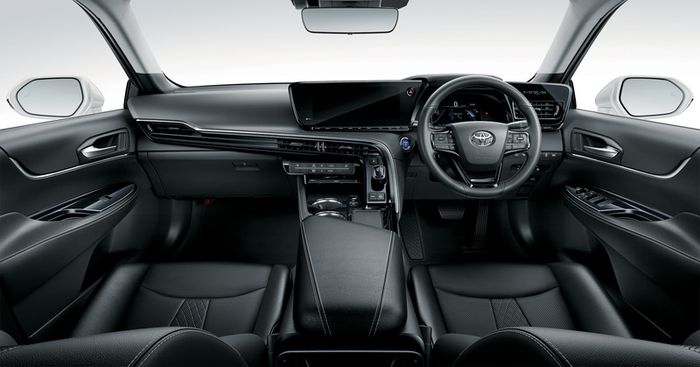
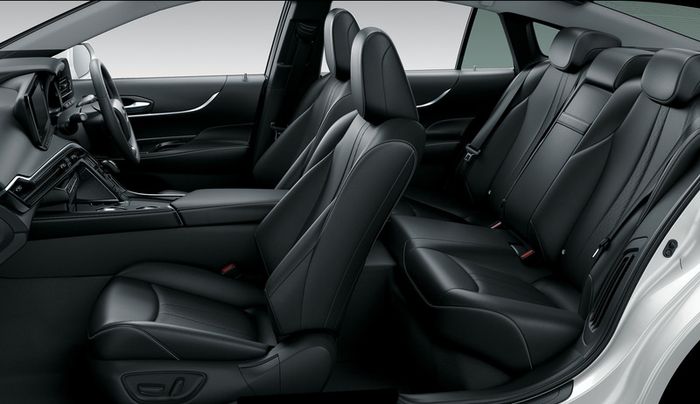
The biggest change is that the number of passengers will increase to five. The interior has a similar feel to the previous Crown, but it also features a large information display and other features, making it a design exclusive to the new MIRAI.
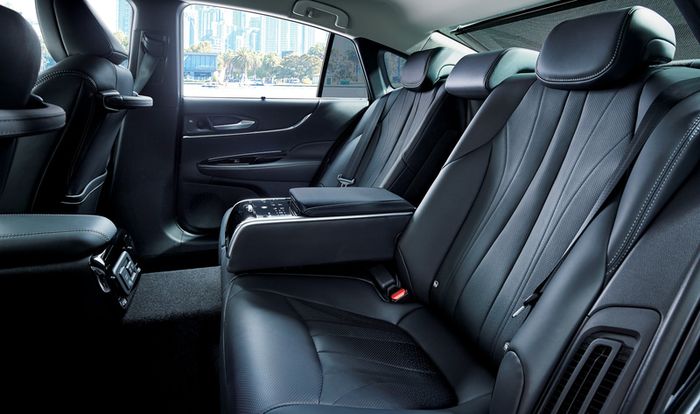
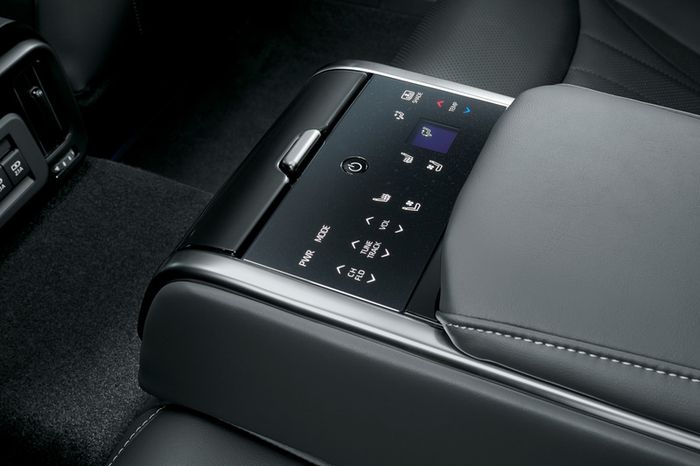
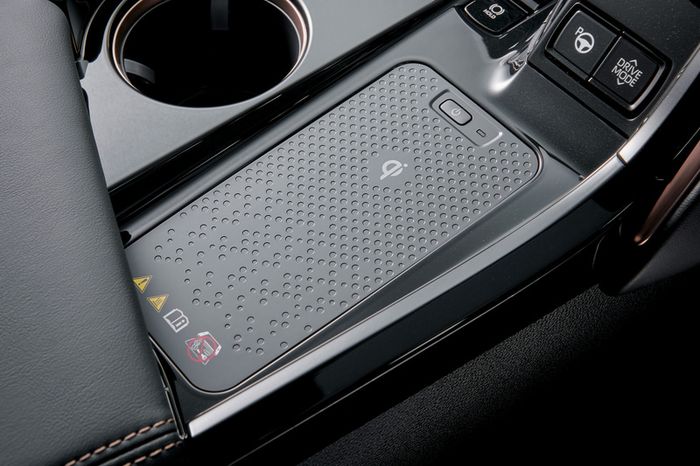
Touch-type control panel (console box)
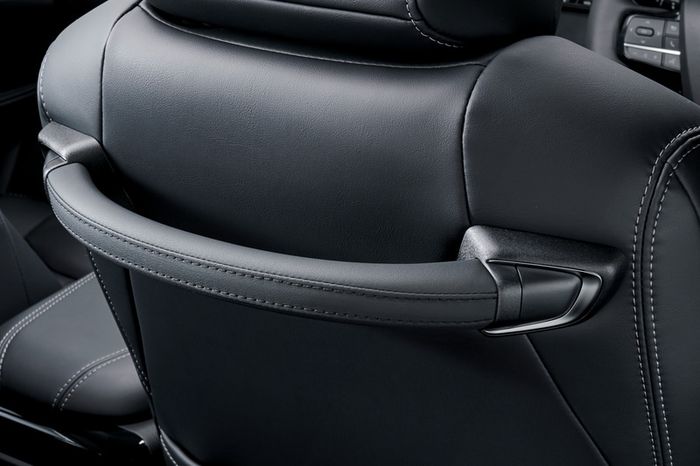
Seatback assist grip (driver’s seat and passenger seat)
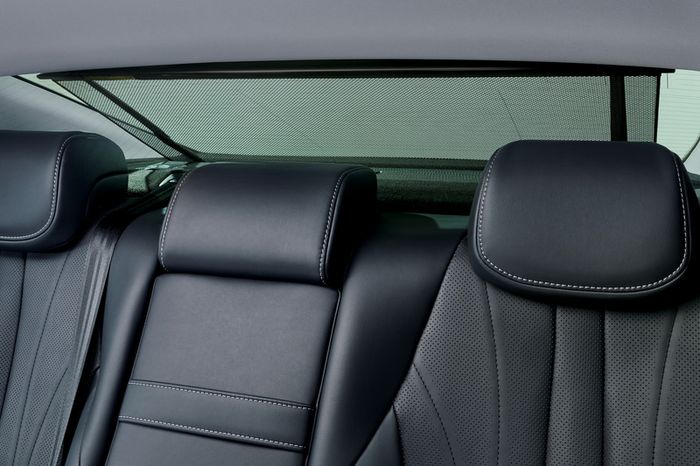
Electric rear sunshade & manual rear sunshade
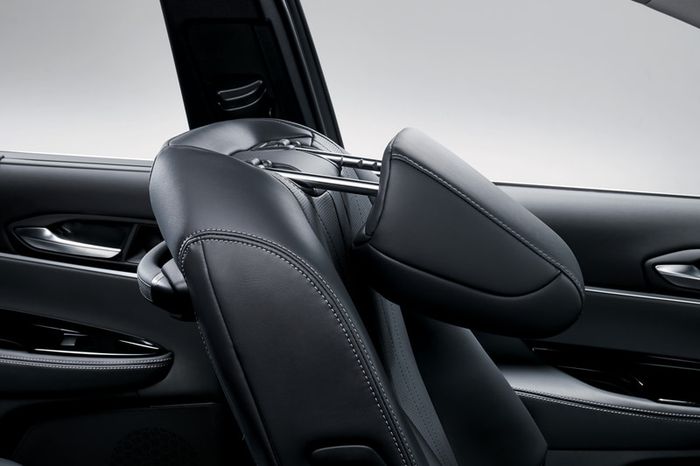
Folding headrest (passenger seat)
Second-generation Toyota Mirai body color options: all eight colors
Force Blue Multiple Layers Newly Developed Color <8Y7>
Dark Blue Mica <8S6>
Emotional Red II <3U5>
Black <202>
Precious Black Pearl <219>
Precious White Pearl <090>
Precious Silver <1J6>
Precious Metal <1L5>
Second-generation Toyota MIRAI Second-generation next-generation Toyota Safety Sense standard on all vehicles
All vehicles will come standard with the second-generation Toyota Safety Sense, the same as the new Crown . It uses laser radar and cameras to ensure excellent recognition performance and reliability, and also includes the collision avoidance support PCS, LDA, and AHB. It ensures collision avoidance support and damage mitigation performance that is compatible even at high speeds. New functions have been added to Pre-Crash Safety and Radar Cruise Control. A Driver Abnormality Response System has also been added.
Pre-crash Safety (PCS) with pedestrian detection function: This system uses millimeter-wave radar and a camera to detect vehicles and pedestrians ahead, and provides warnings, brake assist, and automatic braking to help avoid collisions and mitigate damage. The automatic braking system operates at speeds between 10 and 80 km/h for pedestrians. For example, if the speed difference between the vehicle and the pedestrian is 30 km/h, the system will slow down the vehicle by approximately 30 km/h to help avoid a collision. It also operates at a wide speed range for vehicles, from 10 km/h to the maximum speed. For example, if the vehicle is traveling at 40 km/h toward a stopped vehicle, the system can slow down the vehicle by approximately 40 km/h. It also adds features such as “low-speed acceleration suppression,” “detection of oncoming vehicles and pedestrians when turning right at an intersection,” and ” emergency steering avoidance support.”
- The “Low Speed Acceleration Suppression Function” detects pedestrians, cyclists, and vehicles immediately in front of the vehicle at low speeds and suppresses acceleration.
- It can also detect oncoming vehicles going straight when turning right at an intersection, as well as pedestrians crossing from the opposite direction when turning right or left.
- The ” Emergency Steering Avoidance Assist Function” assists steering when the driver attempts to steer to avoid an emergency.
The Road Sign Assist (RSA) has expanded its detection targets, and now also reads major roadside traffic signs such as “speed limit,” “stop sign,” “no entry,” and “no crossing” and displays them on the instrument panel.
The Lane Departure Alert (LDA) camera recognizes the white and yellow lines in the driving lane, and if it detects the possibility of lane departure, it alerts the driver with a buzzer and a visual display, helping to avoid collisions caused by lane departure.
The Automatic High Beam (AHB) camera detects the headlights of oncoming vehicles or the taillights of vehicles ahead and automatically switches between high and low beams, reducing glare for drivers of other vehicles and helping to ensure forward visibility at night.
Radar Cruise Control : The radar cruise control system uses millimeter-wave radar to detect the distance between the vehicle and the vehicle ahead, and adjusts the speed to match the speed of the vehicle ahead within the set speed range, allowing the vehicle to follow while maintaining a certain distance. The millimeter-wave radar and camera detect lane changes by the vehicle ahead, allowing for smoother acceleration and deceleration control. When driving around a curve, if the system determines that speed control is necessary, it will begin speed control when the steering wheel is first turned and end speed control when the steering wheel is turned back.
Lane Tracing Assist (LTA) When driving on a highway or expressway, turning on the Lane Tracing Assist (LTA) switch while the radar cruise control is activated will provide steering assistance necessary to maintain the lane. A curve speed suppression function has been added. Driver Abnormality Response System A function has been added that detects driver abnormalities and contributes to life-saving rescue.
Leading vehicle departure notification function If you are stopped behind a vehicle in front of you at a traffic light or in a traffic jam and do not notice the vehicle in front of you starting to move, a buzzer will sound and a message will appear on the display to notify you.
Aiming to achieve “zero traffic fatalities and injuries,” the ultimate goal of a mobility society, Toyota is researching and developing various safety equipment and systems based on its “Integrated Safety Concept,” striving to “develop safer vehicles and technologies,” and strengthening its wide-ranging efforts toward traffic safety through “participation in traffic environment improvement” and “traffic safety awareness activities for people.”
Advanced Safety
New features added: Intelligent Parking Assist 2 (with collision warning function + back guide monitor function + voice guidance function) .
Intelligent Clearance Sonar (Parking Support Brake) is a system that helps mitigate collisions caused by accidentally pressing the accelerator or pressing it too hard, thereby reducing damage. The “Clearance Sonar” displays and sounds a buzzer when approaching stationary objects while parking, and now has an added function to mitigate contact with stationary objects. The sonar can also accurately detect glass at convenience stores and other locations. When driving at low speeds (below 15km/h), if a stationary object is detected in the direction of travel, the hybrid system output is reduced, and if the distance becomes even shorter, the brakes are applied automatically.
Rear Cross Traffic Auto Brake: Detects blind spots when reversing and alerts the driver. If there is a risk of collision, the system automatically applies the brakes to help mitigate damage from a collision with an approaching vehicle.
Blind Spot Monitor (BSM) uses radar to detect vehicles in adjacent lanes. If a vehicle enters your blind spot, an LED indicator mounted on the door mirror will light up.
Drive Start Control This suppresses sudden acceleration when shifting, helping to reduce damage in the event of a collision.
Emergency brake signal (hazard lights flashing type) When you apply the brakes suddenly, the hazard lights will automatically flash.
Digital inner mirror: Images from a camera mounted on the rear of the vehicle are displayed on the rearview mirror.
If the driver does not operate the Lane Tracing Assist system due to a sudden change in their physical condition while it is in operation, the system will gradually slow down the vehicle and assist in bringing it to a safe stop.
Panoramic view monitor (with see-through view function) Displays an image of the vehicle as if seen from above on the navigation screen.
Advanced Park Advanced Drive (equipped vehicles scheduled for release in 2021) When parking, the system monitors the entire surroundings under the driver’s supervision, combining cameras and ultrasonic sensors to provide appropriate support for recognition, judgment, and operation. The vehicle assists with all operations, including steering, acceleration, braking, and gear changes, and constantly displays blind spots around the vehicle and the target parking position on an overhead video, ensuring safe, secure, and smooth parking.
Toyota Connected T-Connect DCM Package
Equipped with a T-Connect SD navigation system and DCM, it offers three years of free car monitoring, map-on-demand, agent, and operator services .
Maps on Demand (free for 3 years) automatically updates with new road information.
Agent (voice dialogue service) Just talk to the agent and they will find your destination.
Agent (predictive information guidance service) predicts your destination and provides useful information.
LINE My Car Account Use LINE to register your navigation destination and check the weather, distance, travel time, whether or not you need to refuel, and departure time.
Operator Service: A dedicated operator operates the navigation system 24 hours a day, 365 days a year. My Car Security [Alarm notification / Vehicle location tracking / Security guard dispatch / Engine start notification / Car finder (check parking location) / Accident notification / Remote confirmation] If your vehicle is stolen or broken into, if you forget to lock the doors, or if you want to check the location of your vehicle, you can take appropriate action via email or smartphone.
HelpNet (one-touch type) [with dedicated button inside the vehicle] In the event of a sudden accident or sudden illness, a specialized operator will connect you to the police or fire department and quickly arrange for an emergency vehicle to be dispatched.
Remote maintenance service [eCare (Driving Advice)] If a warning light comes on and you contact your dealer, or if a Toyota dealer contacts you, appropriate advice can be provided based on information sent from the car. [eCare (Health Check Report)] You can check the condition of your car’s battery, the status of warning lights, and more using the T-Connect smartphone app. Toyota dealers can also provide optimal maintenance advice based on information sent from the car. [My Car Customization] Some vehicle customization items can be remotely configured using the T-Connect smartphone app.
A new concept that makes the air cleaner the more you drive
Taking advantage of the unique feature of FCVs, which take in and expel air while driving to generate electricity, an air purification system has been introduced that cleans the air that is taken in and then expelled. Specifically, the air cleaner element (dust filter) captures fine particles up to the PM2.5 level, while the chemical filter removes harmful chemicals and suppresses the generation of PM2.5. In addition, the amount of air purified while driving is displayed clearly on the air purification meter on the center display.
Power supply function
FCVs can generate large amounts of electricity through a chemical reaction between oxygen and hydrogen, making them useful as a power source in emergencies such as power outages caused by natural disasters. The new MIRAI comes equipped with two types of power supply functions as standard.
DC external power supply system
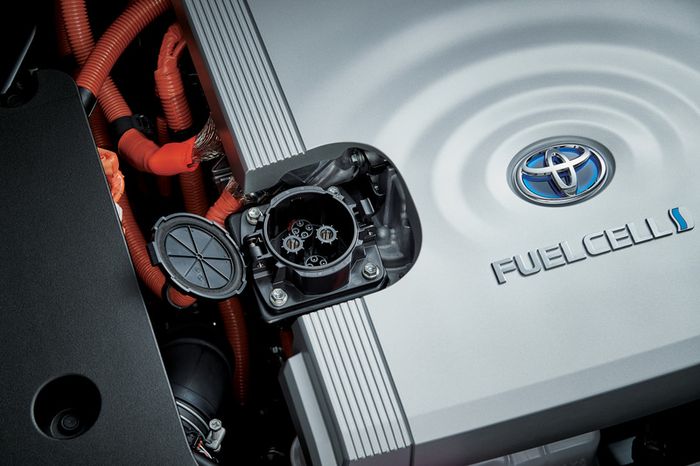
In emergencies such as disasters, connecting an external power supply (sold separately) can supply high-output power to homes and electrical appliances. The external power supply outlet is located in a compartment under the hood and can supply up to 9kW of power.
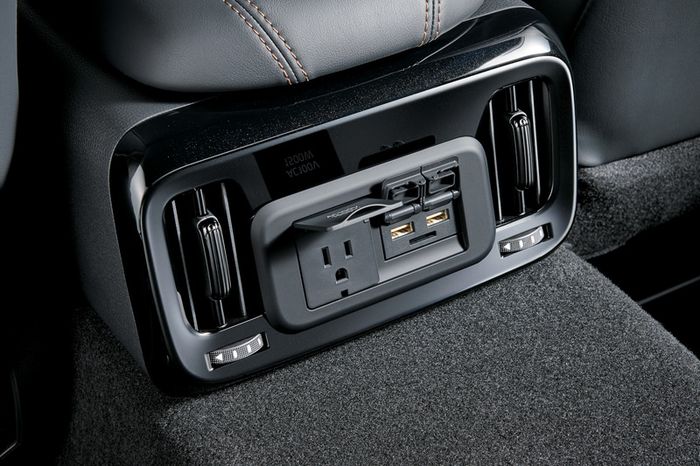
Accessory outlet (with emergency power supply system)
Two accessory outlets (AC100V 1500W) allow you to use electrical appliances. This emergency power supply system can supply power to an average household for approximately four days.
Second-generation Toyota Mirai price and grade
| grade | engine | Drive system |
Base price (10%) |
Total preferential amount |
|---|---|---|---|---|
| G | FC stack |
2WD (FR) |
7,100,000 yen | Approximately 1,395,700 yen |
| G.A. Package |
7,350,000 yen | Approximately 1,401,800 yen | ||
| G EXECUTIVE Package |
7,550,000 yen | Approximately 1,406,800 yen | ||
| Z | 7,900,000 yen | Approximately 1,415,300 yen | ||
| Z EXECUTIVE Package |
8,050,000 yen | Approximately 1,419,000 yen |
Second generation Toyota Mirai specs
| Specifications | New MIRAI |
|---|---|
| full length | 4,975mm |
| Overall width | 1,885mm |
| Overall height | 1,470mm |
| Wheelbase | 2,920mm |
| FC stack | FCB130 Solid polymer compressed hydrogen: 3 bottles |
| Maximum power | 128kW (174ps) |
| Motor maximum output | 134kW (182ps) / 6,940rpm |
| Motor Max Torque | 300Nm/(30.6kgm)/ 0~3,267rpm |
| Drive battery | Lithium-ion 4.0Ah |
| Drive system | rear-wheel drive |
| Passenger capacity | 5 people |
| Range | Approximately 30% longer : 750km to 850km (compared to conventional models) |
Comparison of specs between the new and old MIRAI models
| Specifications | MIRAI | New MIRAI |
|---|---|---|
| full length | 4,890mm | 4,975mm |
| Overall width | 1,815mm | 1,885mm |
| Overall height | 1,535mm | 1,470mm |
| Wheelbase | 2,780mm | 2,920mm |
| Drive system | FF front-wheel drive | FR rear-wheel drive |
| Passenger capacity | 4 people | 5 people |
| JC08 mode range |
650km | Approximately 30% longer (compared to conventional models) |
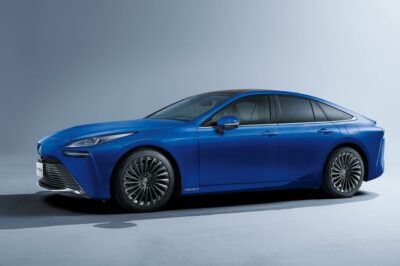
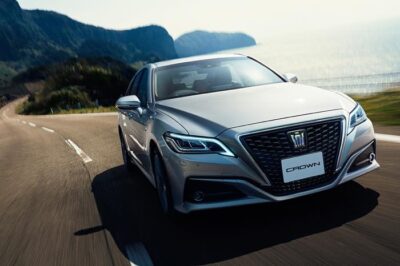
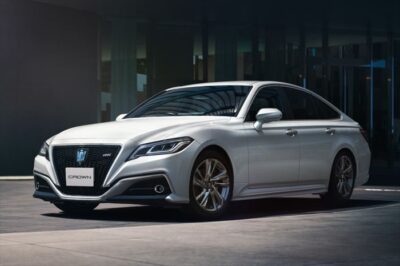
Toyota ‘s new MIRAI undergoes a full model change. The second generation model is based on the Crown.
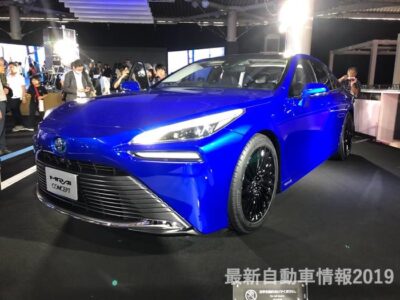
▶ Thinking about the full model change of Toyota’s new MIRAI from the “MIRAI Concept”!
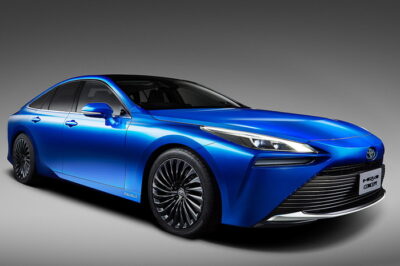
▶ Toyota’s new MIRAI full model change “MIRAI Concept” world premiere at Tokyo Motor Show 2019
New “MIRAI” vs. New “Crown” size comparison
| Specifications | New Crown | New MIRAI |
|---|---|---|
| full length | 4,910mm | 4,975mm |
| Overall width | 1,800mm | 1,885mm |
| Overall height | 1,455mm | 1,470mm |
| Wheelbase | 2,920mm | 2,920mm |
| Drive system | FR rear-wheel drive | FR rear-wheel drive |
| Passenger capacity | 5 people | 5 people |
MIRAI