


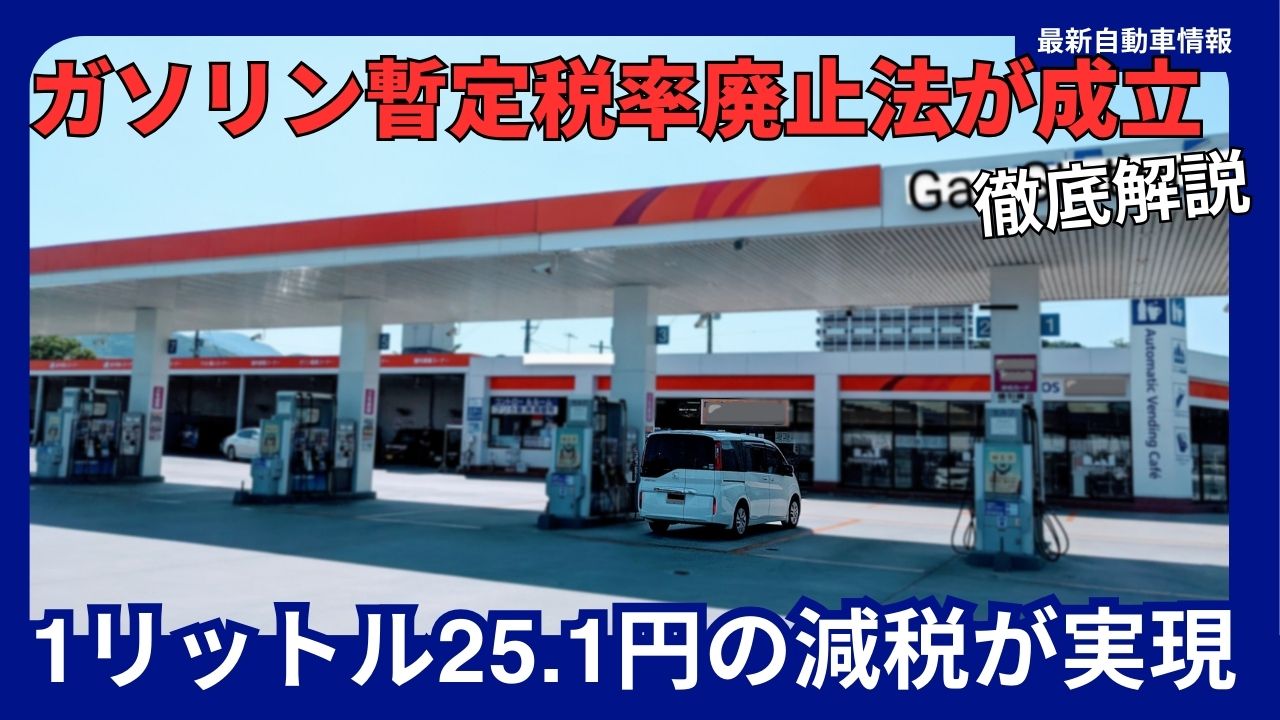
On the morning of November 28, 2025, the House of Councilors unanimously passed a bill to abolish the “old provisional tax rate” added to the gasoline tax. This officially decided that the provisional tax rate system, which has been in place for over 50 years since its introduction in 1974, will be abolished on December 31, 2025. (Nihon Keizai Shimbun )
This bill was formally agreed upon by six ruling and opposition parties – the Liberal Democratic Party, Japan Restoration Party, Constitutional Democratic Party, Democratic Party for the People, Komeito, and the Communist Party – and amends the gasoline tax reduction bill that was submitted to the Diet by the seven opposition parties at the time in August 2025. It aims to reduce the burden on households as a measure against rising prices.
What is the provisional gasoline tax rate? A “temporary” tax system with a 50-year history
Origin and background of the provisional tax rate
The provisional gasoline tax rate was a tax increase measure introduced under the Kakuei Tanaka cabinet in 1974. The direct reason for its introduction was the shortage of funds for road construction caused by the first oil crisis in 1973.
It was initially introduced as a temporary, provisional measure to secure funding for the Seventh Five-Year Road Development Plan (1973-1977) , but was subsequently extended repeatedly, becoming essentially permanent and continuing to this day.
Provisional tax rate structure
Gasoline tax is officially composed of a “gasoline tax” and a “local gasoline tax,” and has the following structure.
[Gasoline tax breakdown]
- Standard tax rate : 28.7 yen/liter
- Gasoline tax: 24.3 yen
- Local gasoline tax: 4.4 yen
- Old provisional tax rate (additional amount) : 25.1 yen/liter
- Total : 53.8 yen/liter
In other words, about 47% of the tax levied on each liter of gasoline was a “provisional” surcharge . This provisional tax rate will be abolished on December 31, 2025, and the gasoline tax will return to the standard rate of 28.7 yen.
The diesel oil collection tax will also be abolished on April 1, 2026.
This legal revision will abolish not only gasoline but also the provisional tax rate (17.1 yen/liter) on diesel . However, because diesel is a prefectural tax, the abolition date has been set for April 1, 2026 , out of consideration for local governments.
This is expected to have a major impact on the transportation and logistics industries, which use trucks, buses and diesel vehicles.
Mitigation measures for sudden price fluctuations: Suppressing price fluctuations through gradual expansion of subsidies
Government Transition Strategy
In order to avoid confusion at gas stations and sudden price fluctuations due to the sudden abolition of the temporary tax rate, the government is implementing gradual measures to mitigate the sudden changes .
[Subsidy expansion schedule]
- November 13, 2025: Increase from 10 yen to 15 yen/liter
- November 27, 2025: Increase from 15 yen to 20 yen/liter
- December 11, 2025: Increase from 20 yen to 25.1 yen/liter (same as the provisional tax rate)
This measure will enable consumers to purchase gasoline at prices essentially equivalent to those that would result from the abolition of the temporary tax rate from around mid-December .
Seamless transition from subsidies to tax cuts
After the provisional tax rate is officially abolished on December 31, the subsidy will be gradually reduced and terminated, which will enable a smooth transition from subsidies to tax cuts while preventing sudden price fluctuations.
Impact on household finances: Annual reduction of approximately 10,000 yen
How much cheaper will it actually be?
The abolition of the provisional tax rate will reduce the tax burden by 25.1 yen per liter of gasoline . Furthermore, because gasoline prices are subject to consumption tax, when the reduction in consumption tax due to the abolition of the provisional tax rate is taken into account, the actual price reduction is estimated to be around 27 to 28 yen per liter .
[Estimated impact on household finances]
- If you use 40 liters of gasoline per month: Save approximately 1,000 yen per month
- If you use 480 liters per year: Save approximately 12,000 yen per year
This will be a significant reduction in the burden, especially for people living in rural areas who use their cars frequently and for families who use their cars to commute to work.
Regional differences in benefits
However, expert analysis shows that the benefits of gasoline tax cuts vary by region . The benefits are greater in rural areas where car use is more frequent, but relatively smaller in urban areas where public transportation is well developed.
For example, it is estimated that in a car-oriented society like Tottori Prefecture, the benefits will be about five times greater than in Tokyo. Also, the higher your income and the more frequently you use your car, the greater the tax reduction effect tends to be.
The biggest challenge: How to secure the 1.5 trillion yen in funding
National and local tax revenues fall by 1.5 trillion yen annually
The abolition of the old provisional tax rates on gasoline and diesel is expected to result in a loss of tax revenue of approximately 1.5 trillion yen per year for both national and local governments . How to secure this huge financial resource is the biggest challenge.
[Breakdown of revenue decrease]
- National revenue loss: Approximately 1 trillion yen
- Local government revenue loss: Approximately 500 billion yen
There are concerns that this will have a serious impact on local governments in particular, as they will lose important financial resources for road construction and public transportation maintenance.
Policy for considering alternative funding sources
The enacted law clearly outlines the policy for securing future financial resources.
[Financial resource securing measures stipulated in the law]
- **Assuming “efforts such as thorough review of expenditures”**
- Review of special tax measures for corporate tax
- Increased burden on extremely high-income earners
- A conclusion will be reached by the end of 2025
Furthermore, the government plans to spend the next year or so discussing stable funding sources for infrastructure development such as roads .
Responding to local governments
Regarding the loss of revenue for local governments, the bill states that “continue to consider specific measures and reach a conclusion promptly,” and includes a provision that “appropriate measures” will be taken to ensure no disruption occurs until then.
Prime Minister Sanae Takaichi has stated that “we will take full consideration of local areas and secure the necessary general financial resources,” but specific measures to secure these funds have not yet been made clear.
Contradiction between environmental impacts and decarbonization policies
Criticism of “retrograde measures” just before the COP
While gasoline tax cuts have been praised as a way to support households, they have also been criticized from an environmental policy perspective , as lowering gasoline prices could encourage fuel consumption and lead to increased greenhouse gas emissions.
While the international trend is to raise carbon prices and promote decarbonization, some experts point out that Japan’s reduction of gasoline tax is a backward step just before the COP (Conference of the Parties to the United Nations Framework Convention on Climate Change) .
Consistency with long-term energy policies
The temporary gasoline tax rate has unintentionally functioned as a “hidden carbon price,” and there are concerns that its abolition could weaken incentives to switch to electric vehicles.
History and transition of the road specific revenue system
What is the Road Specific Fund System?
The gasoline tax was once the core of the road-specific revenue system , which is based on the principle of beneficiary pays and polluter pays , meaning that car users are responsible for the costs of road maintenance and repairs.
Since its establishment in 1953, it has served as an important source of funds to support road construction during the period of high economic growth.
General revenue source in 2009
However, as road construction spread across the country, it became a problem that expressways were being built even in areas where they were not needed. In order to eliminate this problem, the road-specific revenue system was abolished in 2009 and replaced with general revenue.
This meant that gasoline tax revenue could now be used for any expenses, not just road construction. However, the provisional tax rate itself continued to exist as a “tax rate for the time being.”
Looking back at the 2008 “Gasoline Diet”
Temporary tax rate expires for one month
The provisional gasoline tax rate was also a major political issue in 2008. The then Liberal Democratic Party cabinet under Prime Minister Yasuo Fukuda sought to extend the provisional tax rate, but was unable to do so due to strong opposition from the opposition parties, which held a majority in the House of Councillors. The provisional tax rate temporarily expired on March 31, 2008.
As a result, gasoline prices fell sharply in April 2008, but the bill was subsequently re-passed in the Diet, causing confusion when the provisional tax rate was reinstated just one month later.
Differences from this time
Unlike the previous abolition, this one is being abolished with the agreement of six ruling and opposition parties , and is being implemented as a policy decision rather than as a result of political conflict, which is a major difference.
Reactions from various sectors and future prospects
Concerns of the National Governors’ Association
On November 5, 2025, the National Governors’ Association requested the government and ruling party to secure permanent, stable financial resources to replace the loss of local revenue resulting from the abolition of the old provisional tax rates on gasoline and light oil .
For example, Aichi Prefecture is expected to see a decrease in tax revenue of approximately 30 billion yen, and Fukuoka Prefecture is expected to see a decrease of approximately 20.9 billion yen, raising concerns about the serious impact on the financial management of local governments.
Impact on the logistics industry
The abolition of the temporary diesel tax rate is great news for the trucking industry. Fuel costs account for a large portion of transportation costs, and a reduction in diesel prices will lead to a reduction in logistics costs.
However, since the abolition date is set to April 1, 2026, which is later than gasoline, it will take some time before you can actually see the benefits.
Upcoming schedule and highlights
[Important upcoming schedule]
- December 11, 2025 : Subsidy reaches 25.1 yen/liter
- December 31, 2025 : The provisional gasoline tax rate will be officially abolished.
- By the end of 2025 : Conclusion on specific measures for alternative funding sources
- April 1, 2026 : Provisional diesel tax rate will be abolished
- Within 2026 : Discuss stable funding sources for road infrastructure development
Of particular interest will be the concrete measures for alternative revenue sources that will be presented by the end of 2025. The focus will be on what measures will be put forward to secure revenue sources, such as reviewing special corporate tax measures and strengthening taxation on the wealthy.
Summary: The key is to balance household support and fiscal soundness
The Act to Abolish the Temporary Gasoline Tax Rate, enacted on November 28, 2025, is a historic tax reform, the first in half a century . While it will reduce the annual burden of households struggling with rising prices by approximately 10,000 yen, it also poses a major challenge: national and local governments will see a 1.5 trillion yen annual reduction in tax revenue.
[Key points of this article]
- The provisional gasoline tax rate (25.1 yen/liter) will be abolished on December 31, 2025.
- The provisional diesel tax rate (17.1 yen/liter) will be abolished on April 1, 2026.
- Mitigate price shocks through gradual expansion of subsidies
- Households are expected to see a reduction in their burden of approximately 10,000 yen per year
- National and local governments will experience a decrease in tax revenue of approximately 1.5 trillion yen per year
- Securing alternative sources of funding is the biggest challenge
- Consistency with environmental policies also in question
Going forward, attention will be focused on how the government will secure alternative revenue sources to support local government finances, and how it will ensure consistency with environmental policies. The success or failure of this policy will depend on how well it strikes a balance between supporting household finances, fiscal soundness, and environmental policies.
[Related Articles]