
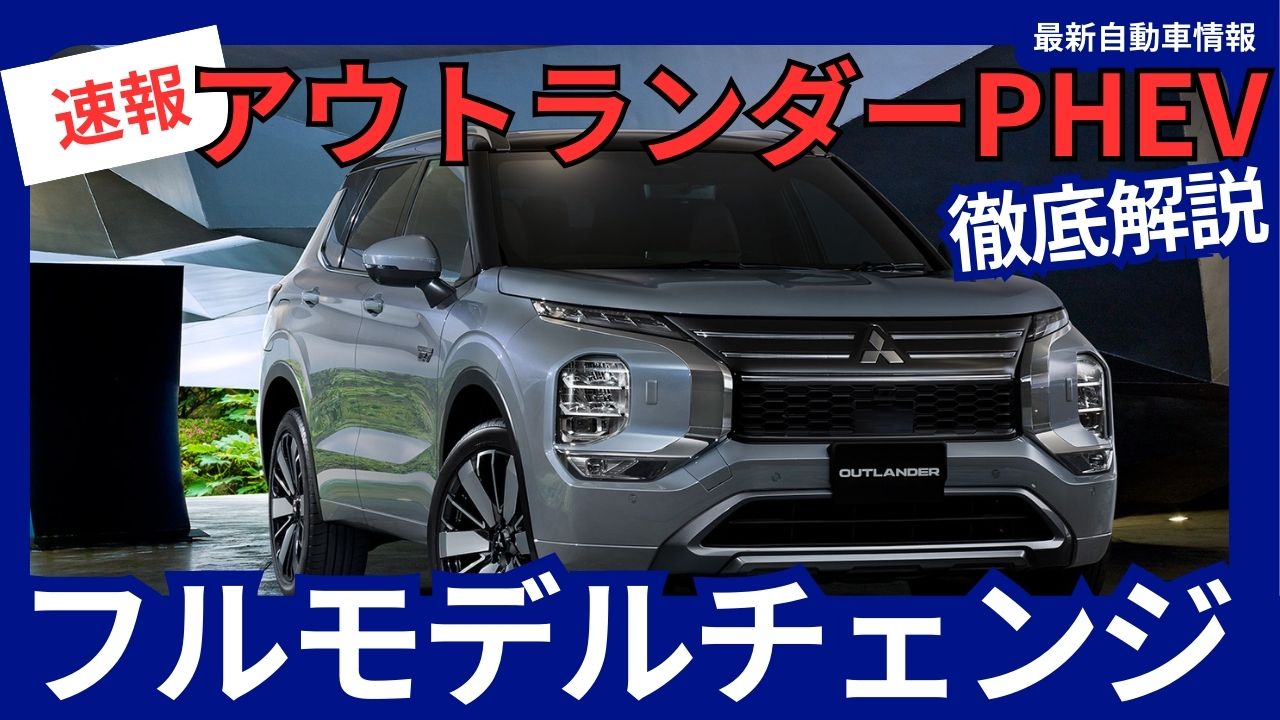
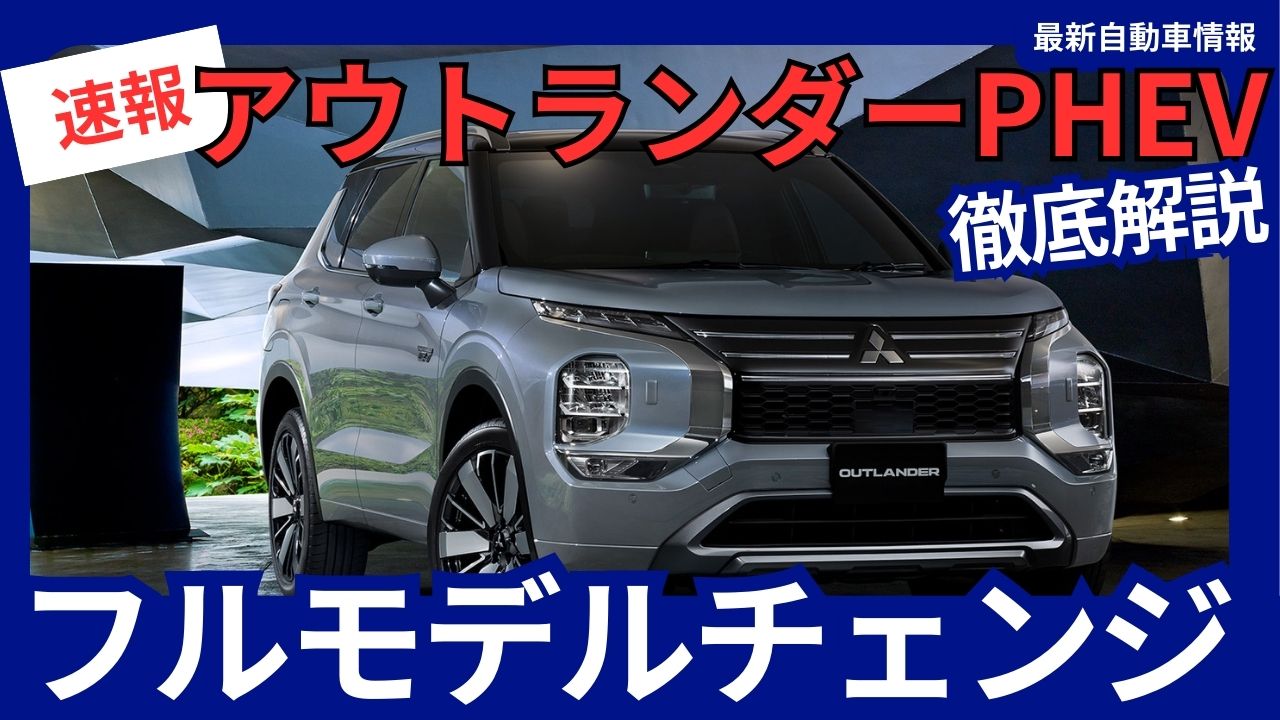
Mitsubishi Motors is planning to fully redesign its mid-size SUV, the Outlander PHEV, and release it around 2027.
As the global SUV boom continues, plug-in hybrid vehicles (PHEVs) are becoming increasingly prominent alongside growing environmental awareness. Mitsubishi Motors’ Outlander PHEV has established a solid position as a pioneer in the PHEV SUV category, not only in the Japanese market but also in the global market. The current model (GN0W type) was released in 2021 and has been highly praised for its high level of perfection, but market interest is already turning to the next evolution.
The success of the current Outlander PHEV (GN0W type) and the groundwork for the next generation
First, let’s review the unwavering success of the current Outlander PHEV. The current model, which was unveiled globally in 2021 and introduced to the Japanese market, has made dramatic advancements in every aspect, including a design that embodies “majesty,” a significantly improved EV range (over 80km *WLTC mode), Mitsubishi’s unique Super-All-Wheel Control (S-AWC) integrated vehicle dynamics control system centered around its twin-motor 4WD, and the availability of a practical, three-row, seven-passenger model. As a flagship model that brings together Mitsubishi Motors’ proud electrification and four-wheel control technologies, it has set a new standard for PHEV SUVs and has earned high praise both at home and abroad.
Given this brilliant success, expectations for the next-generation model are naturally high. Technological innovation across the automotive industry, particularly in battery technology, software, and driver assistance systems, is progressing at an astonishing pace, and the competitive environment is becoming increasingly tougher every day. Given the rapid pace of technological innovation and the competitive environment in recent years, 2027 , calculated from the launch of the current model (2021), is being seen as a likely candidate for the next full model change. In order for Mitsubishi Motors to maintain and further solidify its leadership in the PHEV category, it is entirely possible that this is the time to plan a next-generation model that incorporates a generous amount of the latest technology. While the specific year ” 2027 ” has not yet been officially announced, it is becoming widely recognized in the market as a likely time for the release of the next-generation model.
Anticipated evolution of the new Outlander PHEV: specs and performance predictions
So, how will the next-generation Outlander PHEV, expected to be released in 2027 , evolve from the current model? Let’s predict what the future will look like, taking into account current technological trends and the actions of the Alliance (Renault-Nissan-Mitsubishi Motors).
The greatest focus will be on further advances in the electrification technology that forms the foundation of the PHEV system. The current model’s combination of a 2.4L engine, high-performance front and rear motors, and a large-capacity 20kWh drive battery is already at a high level, but the next-generation model is expected to surpass this. Battery technology has made remarkable advances, and improvements in energy density could potentially enable even larger capacity in the same or smaller space. This will likely increase the EV range from the current 80km range to over 100km, which will likely become the standard for next-generation PHEVs. If the majority of daily travel can be covered by zero-emission EV driving, economical and environmental performance will improve dramatically.
The motor is also expected to adopt a new unit with improved efficiency and output. This will not only improve the EV’s acceleration performance and quietness, but will also minimize engine (generator) operation, improving the energy efficiency of the entire system. The engine itself may also be optimized specifically for power generation, or it may be revamped with a next-generation, high-efficiency engine developed within the Alliance. As charging infrastructure evolves, we can expect to see shorter standard charging times and improved rapid charging capabilities (including next-generation support for the CHAdeMO standard). Furthermore, energy management functions such as V2H (Vehicle to Home) and V2G (Vehicle to Grid) will likely become more intelligent and easier to use.
Mitsubishi Motors’ world-renowned S-AWC integrated vehicle dynamics control system is set to evolve to a new dimension when integrated with the next-generation PHEV system. By integrating more powerful and responsive twin motors with brake control (AYC: Active Yaw Control), the system delivers safer, more dynamic handling that responds to the driver’s intent on any road surface. Expect control that gives the driver confidence and peace of mind in all aspects, including on-road stability, impressive drivability on snowy and rough roads, and stable behavior during emergency evasion.
Regarding the platform, it is possible that a significant improvement on the current Alliance-shared CMF-C/D platform, or a next-generation platform further optimized for electrification, will be adopted. This will enable a lower center of gravity through ideal placement of the heavy battery, further improvement in body rigidity, and the highest level of crash safety performance.
Design and advanced technology: Further refinement as a flagship model
In terms of design, while retaining core elements such as Mitsubishi Motors’ Dynamic Shield design philosophy and a powerful horizontal stance, it is expected that the styling will be refined and enhanced to enhance its futuristic and high-quality feel. As the pursuit of aerodynamic performance becomes even more important in the era of electrification, a cleaner and more efficient form may be pursued. The unique details that symbolize the advanced nature of a PHEV model will also be used more effectively. In the interior, the driver-centric interface design will be further advanced, with the visibility and operability of information provided by the large display and digital meters improved. Improved material quality and further optimization of the three-row seat layout are also expected to improve the usability of the interior and luggage space.
Advanced driver assistance systems (ADAS) will undergo significant advancements with the proactive adoption of the Alliance’s latest technologies. MI-PILOT, a single-lane highway driving assistance technology, is likely to evolve to include hands-off functionality, expanded application range, and more natural, human-like control. Advances in sensors and AI technology will improve prediction accuracy, assist with turning and crossing collisions at intersections, and include more advanced automated parking functions (MI-PILOT Parking), providing powerful support for safer and more secure driving. Connectivity features will also be significantly enhanced, enabling the use of real-time information, enhanced entertainment functions, deeper smartphone integration, and over-the-air (OTA) software updates, all of which are sure to make travel more enjoyable and convenient.
Price Range Forecast
Pricing for the next-generation Outlander PHEV, expected to debut in 2027 , remains a matter of speculation at this stage. However, the current model’s price range (approximately ¥4.99 million to ¥6.1 million as of April 2025) serves as a benchmark. Considering the significantly longer EV range, improved PHEV system performance, and more sophisticated advanced driver assistance systems, a price increase is inevitable. Meanwhile, cost reductions and improved production efficiency for electrified components mean that a significant price increase may not occur. Pricing strategies compared to competing models will also be important, so it may be realistic to expect a central price range of around ¥6 million to ¥7 million, based on the current model’s price range but reflecting performance improvements. When considering a purchase, it’s also important to keep an eye on the latest developments in subsidy programs.
The history of the Outlander PHEV and the achievements of the current model
Before we get into predictions for the new model, let’s take a look back at the path the Outlander PHEV has taken so far. The first-generation model was released in 2013. At the time, the combination of an SUV and a plug-in hybrid was very innovative, and it attracted a lot of attention for its advanced features. The ability to charge from a household outlet, the quiet and smooth EV driving, and the guaranteed range of the gasoline engine in case of emergency provided new value to users.
In 2021, the second-generation Outlander PHEV, the current model, was announced. It features a completely new platform and significantly revamped interior and exterior designs. It has evolved in every way, including an extended EV driving range, powerful driving performance thanks to its twin motors, and the adoption of S-AWC 4WD control technology developed in collaboration with Mitsubishi Motors. Its high-quality interior and exterior, as well as the availability of a seven-seater model, have earned it support from a wide range of users, particularly families.
It is no exaggeration to say that the success of the current model has established a new market for plug-in hybrid SUVs. With growing environmental awareness, demand for electrified vehicles is on the rise, and the Outlander PHEV has played a leading role in this trend.
Key to electrification strategy: Evolution of the Outlander PHEV
First, let’s take a deeper look at the full model change of the Outlander PHEV, a pioneer of plug-in hybrid SUVs. Since the launch of the first-generation model, it has pioneered the market with its innovative concept of combining an SUV with a plug-in hybrid, and the current model has captivated many users with its high quality and electric performance.
The full model change, expected in August 2027, is expected to incorporate Nissan’s latest electrification technologies. The significant extension of EV driving range through advances in battery technology will broaden the scope of zero-emission driving for everyday use, making contributions to reducing environmental impact more accessible to more users. Improved motor output will lead to further improvements in acceleration performance and off-road capability, enhancing the car’s appeal as an SUV.
The design will also incorporate the next-generation Nissan design philosophy, and is expected to evolve into a more refined and powerful style. The interior will also see an improvement in quality, and advanced technology will be generously incorporated to provide a space that is more comfortable and convenient. Expectations are also high for an evolved infotainment system with a large display, and enhanced functionality for the latest driver assistance system, ProPilot.
The full model change of the Outlander PHEV goes beyond a simple model change; as a vehicle that symbolizes Nissan’s electrification strategy, it will play an important role in demonstrating its technological capabilities and vision for the future.
The evolution of a full-fledged SUV: the full model change of the X-Trail
Meanwhile, the X-Trail, which has firmly established itself as a full-fledged SUV, is likely to undergo a full model change in August 2027. With its tough styling, excellent driving performance, and ease of use, the X-Trail has gained support from a wide range of customers, and much attention is being paid to how it will evolve in the next generation model.
The full model change of the X-Trail will likely retain its traditional SUV appeal while being equipped with a new powertrain incorporating electrification technology. An evolved version of Nissan’s electrification technology “e-POWER” or a plug-in hybrid system may be installed to achieve both fuel efficiency and driving performance. This is expected to respond to growing awareness of environmental performance while maintaining the powerful off-road capabilities that are unique to the X-Trail.
In terms of design, it is likely to evolve into a more modern and sophisticated SUV style. Based on the powerful feel of the current model, it may have a more urban and sophisticated exterior that incorporates the latest design trends. The interior will also likely feature improved quality, the latest infotainment system, and a design that pursues ease of use.
The full model change of the X-Trail could be a strategic move aimed at attracting new customers by incorporating electrification technology while maintaining its appeal as a full-fledged SUV.
The significance of simultaneous full model changes: Strengthening Nissan’s SUV lineup
It is extremely significant for Nissan that the Outlander PHEV and X-Trail, two important models in the company’s SUV lineup, will undergo full model changes simultaneously in August 2027. This represents Nissan’s strong determination to further increase its presence in the SUV market and play a leading role in the era of electrification.
Each vehicle will share the latest electrification technology and design philosophy, but will also have a distinct personality and cater to different customer needs, which is expected to significantly improve the competitiveness of Nissan’s entire SUV lineup.
With its advanced electric performance and premium interior and exterior, the Outlander PHEV will appeal to environmentally conscious customers seeking a high-quality SUV, while the X-Trail, while incorporating electrification technology, will meet the needs of active lifestyles and those seeking a genuine SUV with its powerful driving performance and ease of use that are the appeal of traditional SUVs.
These two full model changes will be key pillars of Nissan’s electrification strategy and a major step towards achieving its goal of 100% electrification of new vehicles in major markets by the early 2030s.
New options for users: Diversification of electric SUVs
The simultaneous full model changes of the Outlander PHEV and X-TRAIL will benefit customers by greatly expanding their electric SUV options. With the introduction of a new electric powertrain for the X-TRAIL in addition to the plug-in hybrid option, customers will be able to choose the electric SUV that best suits their lifestyle and needs.
For example, for users who mainly commute to work or go shopping short distances and enjoy outdoor leisure activities on weekends, the Outlander PHEV with its extended EV range may be the best choice. On the other hand, for users who often travel long distances and often drive on snowy or rough roads, the powerful driving performance and lack of range concerns of the electrified X-Trail will be appealing.
In this way, diversifying Nissan’s SUV lineup will enable more users to enjoy the benefits of electrified vehicles, and is expected to accelerate the movement toward realizing an electrified society.
Differentiation from competitors: The uniqueness of Nissan SUVs
In the increasingly competitive SUV market, it is extremely important to consider how the new Outlander PHEV and new X-Trail will distinguish themselves from their competitors.
The Outlander PHEV’s long history and proven track record, as well as its advanced plug-in hybrid technology, are advantages that no other car manufacturer can match. Furthermore, if the electric performance is significantly improved with this full model change, this advantage will be further enhanced. The seven-seater model is also a unique attraction that is rare among competing models.
The X-TRAIL’s fusion of its tradition as a full-fledged SUV with its likely new electric powertrain has the potential to create unique value. By adding new value such as quietness and smooth acceleration that come with electrification to the X-TRAIL’s unique appeal, it is expected to become a uniquely attractive SUV.
By further honing the strengths of each vehicle and incorporating the latest technology and design, Nissan believes the new Outlander PHEV and new X-Trail will be able to establish a strong position in the crowded SUV market.
Expectations and Challenges for 2027: The Path to Success
If the Outlander PHEV and X-Trail undergo full model changes simultaneously in August 2027, it will undoubtedly be a year of great progress for Nissan. However, to achieve this success, several challenges must be overcome.
First, we must address supply chain issues facing the entire automotive industry, such as the global shortage of semiconductors and the rising prices of raw materials such as batteries. Building a stable parts supply system and smoothly executing production plans are essential to meeting launch dates and ensuring smooth delivery of vehicles to customers.
Another important issue is the development of charging infrastructure to keep up with the rapid progress of electrification. Governments, local governments, and automakers must work together to expand charging facilities and create an environment in which users can use electric vehicles with peace of mind.
Furthermore, an effective marketing strategy is crucial to maximize the appeal of each new vehicle. Information must be tailored to each vehicle’s target customer base, clearly communicating its revolutionary evolution and Nissan’s vision for electrification.
If Nissan can overcome these challenges and launch the new Outlander PHEV and new X-Trail as attractive products that meet expectations, it will be able to establish a solid leadership position in the electric SUV market.
A word from the editorial department
Although the specific release date of 2027 has not yet been officially confirmed, there is no doubt that Mitsubishi Motors is putting all its efforts into developing the next-generation Outlander PHEV as a front-runner in the PHEV category. Building on the high reputation and trust built up by the current model, we can expect the car to have made steady and significant advancements in all areas, including battery, motor, vehicle control, and advanced safety technology.
The next-generation Outlander PHEV combines impressive EV range, unrestrained driving pleasure, and the highest levels of safety and convenience. As a flagship model that embodies Mitsubishi Motors’ technological capabilities and vision for the future, it will once again lead the global PHEV SUV market. With a stunning blend of environmental friendliness, driving enjoyment, and the practicality unique to SUVs, it is sure to set the standard for the next generation.
We await an official announcement from Mitsubishi Motors, but given the passion the company has poured into PHEV technology and the proven capabilities of the Outlander brand, there’s a good chance that a model will be released that exceeds our expectations. We’ll be keeping a close eye on what kind of innovations the PHEV leader will show us as we head towards 2027 .
Outlander PHEV
https://www.mitsubishi-motors.co.jp/lineup/outlander_phev/index.html