
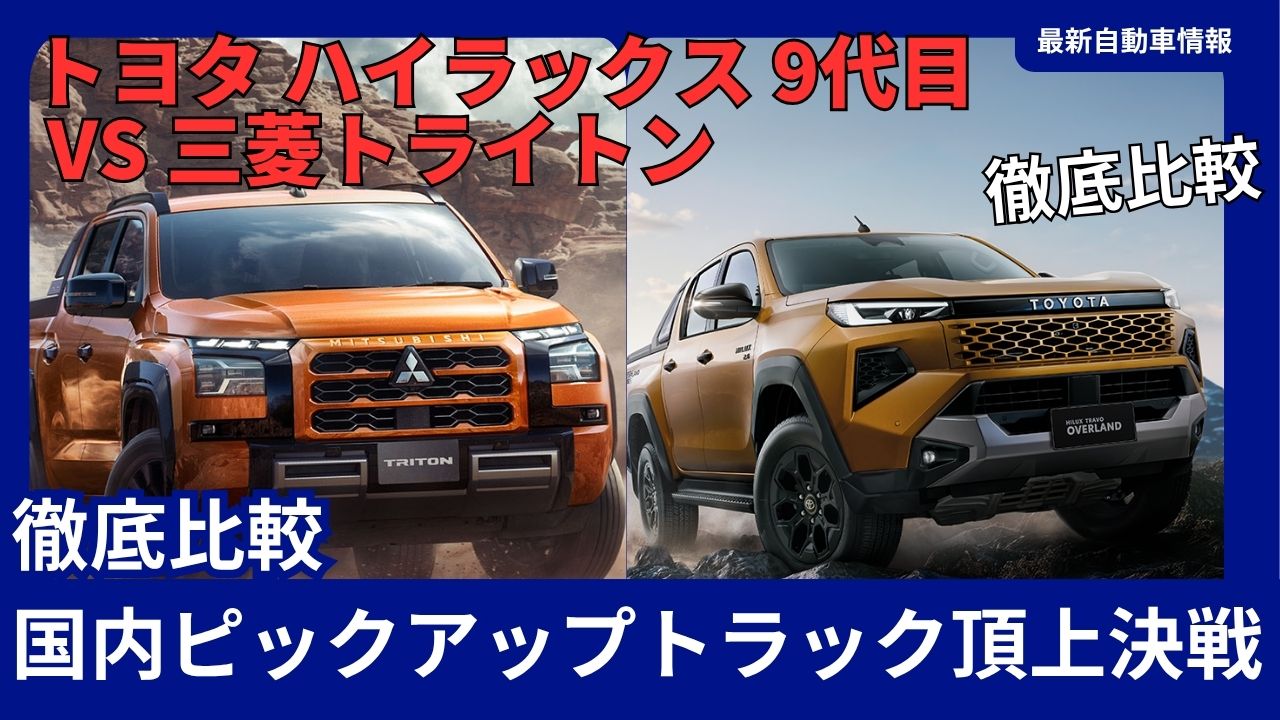
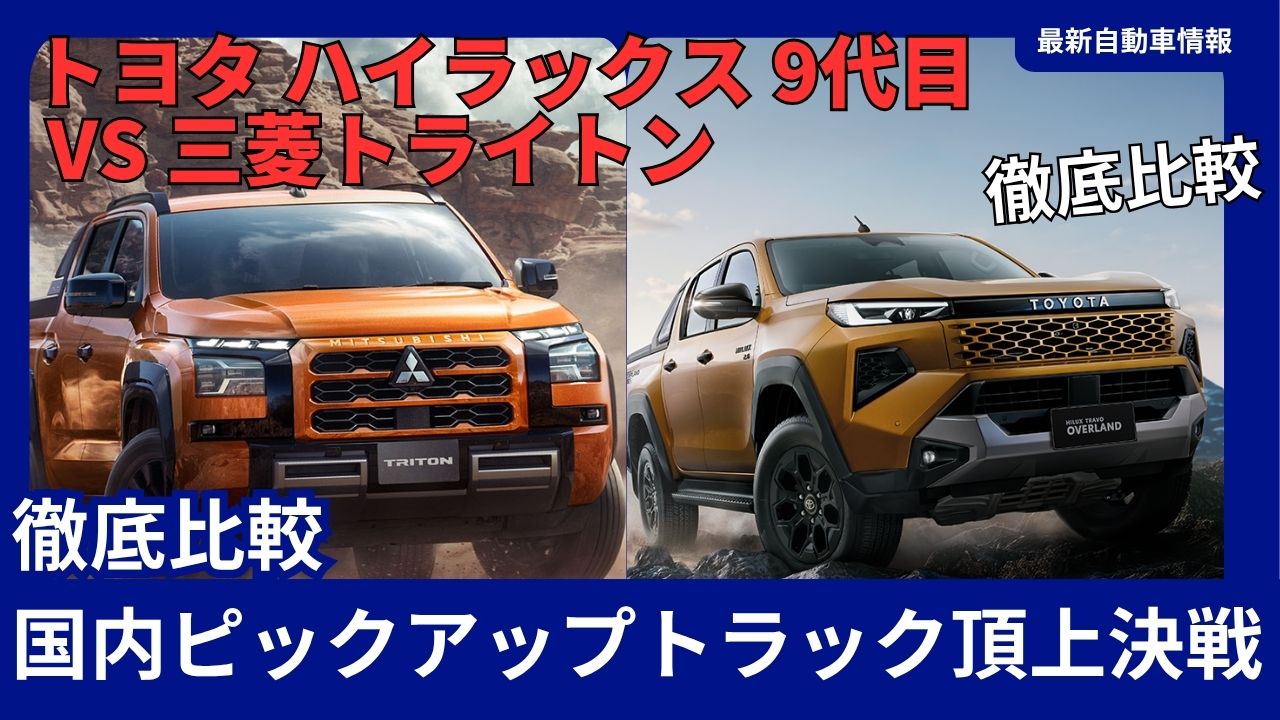
On November 10, 2025, Toyota officially unveiled the long-awaited new 9th generation Hilux in Thailand. Along with this announcement, the car’s release in Japan was also confirmed, with its final launch in the Japanese market in 2026. Currently, the Toyota Hilux and Mitsubishi Triton are the two main full-fledged pickup trucks sold in Japan, and the arrival of the new Hilux will undoubtedly further intensify competition in this market.
A head-to-head battle between the new 9th generation Hilux and the Triton, due to be released in 2026
Of particular note is that the new ninth generation Hilux is equipped with a 2.8L inline 4-cylinder diesel turbo engine that produces a maximum torque of 500Nm , surpassing the Mitsubishi Triton’s 470Nm and putting it in a head-to-head battle in terms of powertrain performance.
In this article, we thoroughly compare the 2026 Toyota Hilux 9th generation with the current Mitsubishi Triton from every angle, including design, performance, equipment, and price. This is a must-read for anyone considering purchasing one, as well as anyone interested in pickup trucks.
1. Exterior Design Comparison – Contrasting Design Philosophies
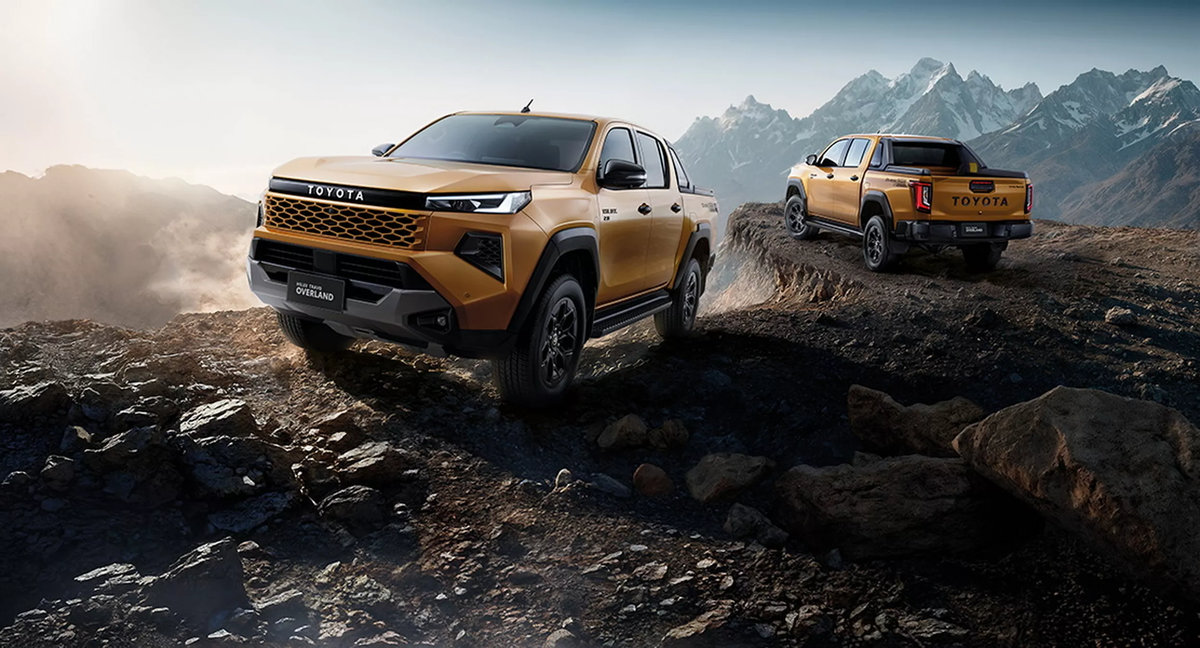
The 9th generation Toyota Hilux: A car with the same determination as a sumo wrestler
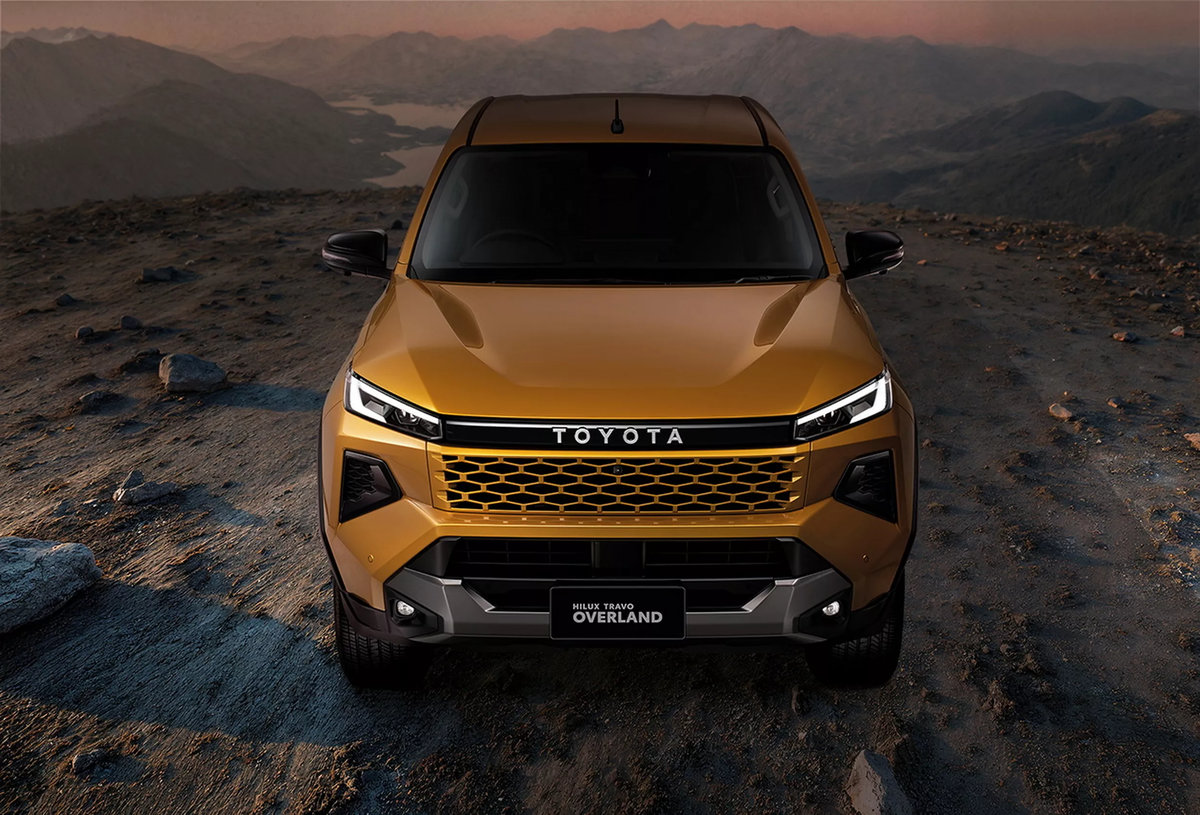
Toyota-Hilux-Travo-Overland-Thailand
The new 9th generation Hilux has evolved significantly from the 8th generation, adopting a more SUV-like design language. Its most distinctive feature is the headlights and grille, which are positioned higher . By raising the center of gravity compared to the previous model, it emphasizes power and a lifted feel.
Design Features:
- Slim LED headlights : Highly positioned and integrated with the horizontal signature lamp
- Body-colored perforated grille : Adopts Toyota’s latest design language, shared with the RAV4 and Corolla Cross
- Sumo wrestler motif : Toyota’s official design concept expresses a sense of determination inspired by the sumo wrestler’s stomp posture.
- Diagonal lines are the keynote : vertical lines are deliberately avoided, and all lines flow diagonally.
- Innovative rear bumper step : Equipped with a step that allows access to the cargo area from the side as well as the rear.
Key point: Balancing cost strategy and design
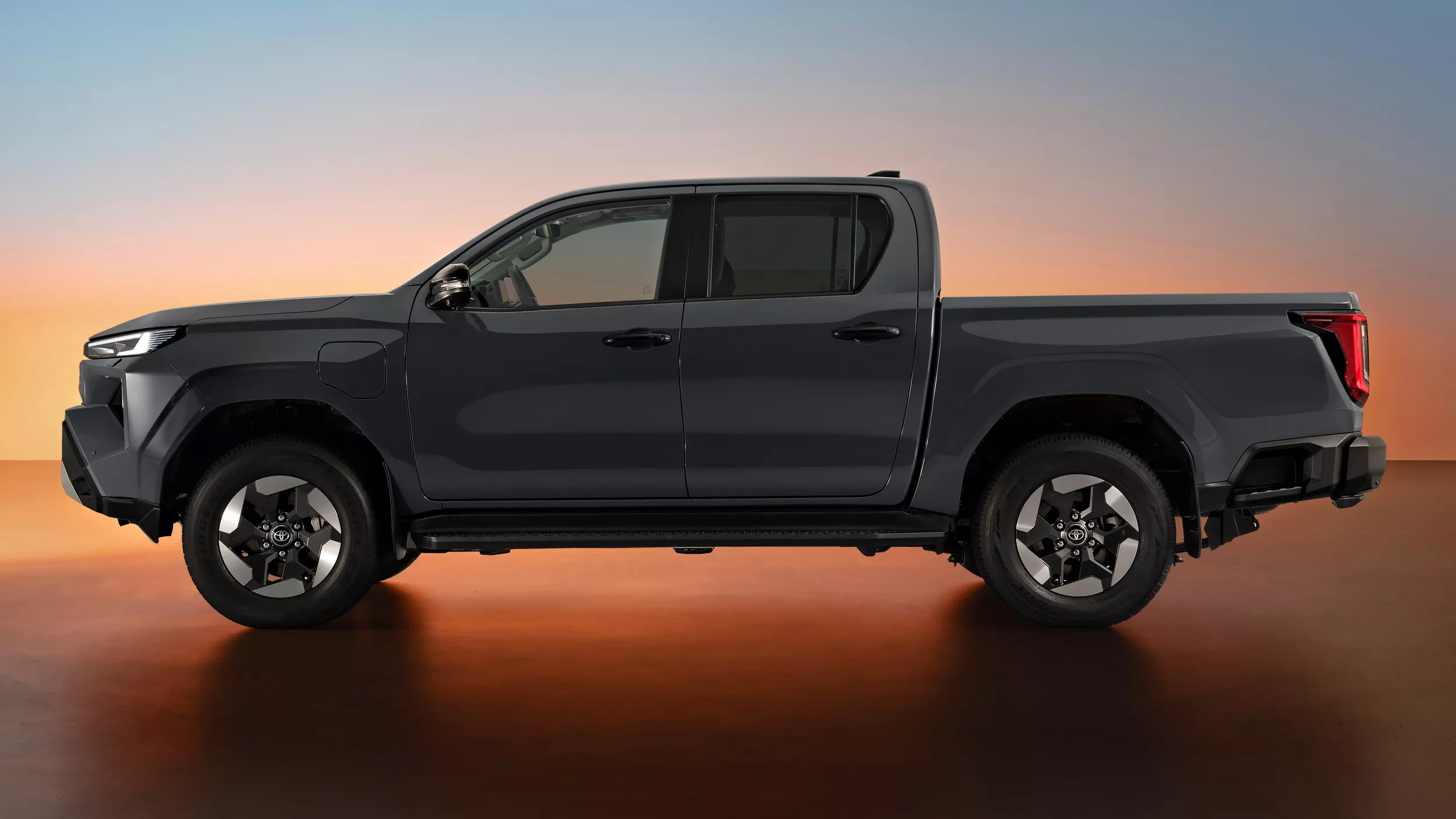
Although the new Hilux is a full model change, the door panels are the same as the eighth generation . This is a wise decision to reduce costs and maintain price competitiveness, but the soft lines remain in the side view, creating a contrast with the rigid expression of the front and rear.
Meanwhile, the face and rear design have been completely revamped, with the rear especially imposing with its mechanical design that makes extensive use of C-surfaces (surfaces with rounded corners) . The innovative idea of extending the side steps from the rear bumper to the sides is an excellent solution that combines practicality and design.
Mitsubishi Triton: A rugged style that pursues beautiful vertical and horizontal lines
Mitsubishi Triton
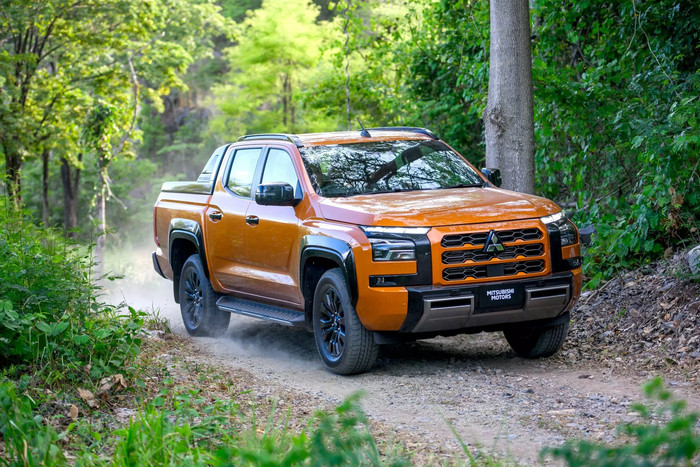
In contrast, the Mitsubishi Triton is characterized by a design that thoroughly emphasizes straight lines both vertically and horizontally .
Design Features:
- Extensive use of vertical and horizontal lines : linear elements are placed on the fenders, grille, and bumper.
- HORIZONTAL AXIS : A horizontal theme that runs from the dashboard to the exterior
- Glossy black overfenders : Create a luxurious and modern look
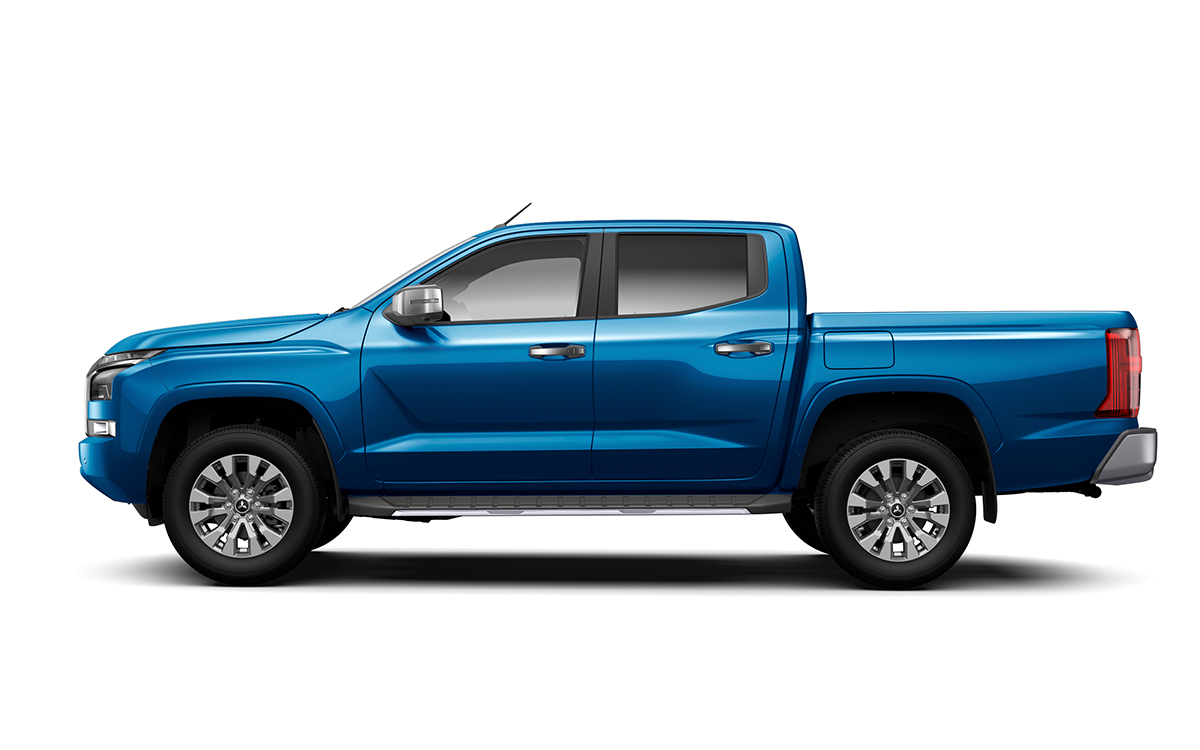
- Completely new door panel design : The side body is also made of a hard, rigid design.
- Square side mirrors : A rugged design that emphasizes the wildness
Design comparison summary:
- Hilux : Diagonal lines, modern and agile, urban SUV elements
- Triton : Vertical and horizontal lines, wild and rugged, a true off-roader
When the two cars are lined up, the difference in their design philosophies becomes clear: the Hilux is a stylish, “aggressive urban vehicle,” while the Triton is a rugged, “serious off-roader.” Analysis by active car designers also clearly points out the difference in their contrasting design philosophies.
2. Body size and packaging comparison – Small differences affect usability
Toyota Hilux 9th generation
Mitsubishi Triton
Body size comparison chart
| item | Toyota Hilux 9th generation | Mitsubishi Triton |
|---|---|---|
| full length | 5,320mm | 5,320mm (GSR) / 5,360mm (GLS) |
| Overall width | 1,855mm | 1,865mm (GSR) / 1,930mm (GLS) |
| Overall height | 1,800mm | 1,795mm (GSR) / 1,815mm (GLS) |
| Wheelbase | 3,085mm | 3,130mm |
| minimum ground clearance | 215mm (estimated) | 220mm |
| Minimum turning radius | 6.4m (estimate) | 6.2m |
| Load capacity | 500kg | 500kg |
| Passenger capacity | 5 people | 5 people |
Size Features:
- Wheelbase : Triton is 45mm longer, which gives it advantages in straight-line stability and livability.
- Minimum turning radius : The Triton is slightly smaller at 6.2m, making it easier to handle.
- Overall width : Triton GLS is wide at 1,930mm, while Hilux is slim at 1,855mm
- Ground clearance : Triton is 220mm, giving it a slight advantage in off-road capability
Packaging differences
Strengths of the 9th generation Hilux:
- Side steps integrated into the rear bumper improve access to the cargo area (an industry first)
- The slimmer body (1,855mm) makes it easier to handle on Japan’s narrow roads.
- With a total height of 1,800mm, there are fewer restrictions on multi-story parking lots.
Triton’s strengths:
- A long wheelbase (3,130 mm) provides a stable ride and spacious interior
- The minimum turning radius is 6.2m, making it surprisingly easy to handle.
- 220mm ground clearance for serious off-road driving
3. Powertrain and Driving Performance Comparison – 500Nm vs 470Nm Torque Battle
Engine spec comparison table
| item | Toyota Hilux 9th generation | Mitsubishi Triton |
|---|---|---|
| Engine model | 2.8L inline 4-cylinder diesel turbo | 2.4L inline 4-cylinder diesel turbo 4N16 |
| Engine displacement | 2,755cc | 2,442cc |
| Maximum power | 150kW (204PS) / 3,000-3,400rpm | 150kW (204PS) / 3,500rpm |
| Maximum torque | 500Nm (51.0kgm) / 1,600-2,800rpm | 470Nm (47.9kgm) / 1,500-2,750rpm |
| transmission | 6 speed AT | 6 speed AT |
| Drive system | Rear-wheel drive / 4WD | 2WD/4WD |
| WLTC fuel economy | 11.3km/L (estimated) | 11.3km/L |
The Hilux has more torque! Overwhelming power of 500Nm
Significant evolution of the new 9th generation Hilux:
The new Hilux’s engine has been upgraded from the previous 2.4L engine to a 2.8L inline 4-cylinder diesel turbo , dramatically improving performance. This 2.8L engine is the same powertrain as the Land Cruiser 250 and Prado, and boasts high reliability and durability.
Performance comparison points:
- Maximum output : Both cars are completely equal at 204 PS
- Maximum torque : Hilux is 500Nm , 30Nm (about 6%) more than Triton’s 470Nm
- Torque band : Hilux: 1,600-2,800 rpm, Triton: 1,500-2,750 rpm
Practical benefits of 500Nm torque
Maximum torque is the most important performance indicator for a pickup truck, and the Hilux’s 500Nm figure is a major advantage in this application.
Practical benefits:
- Acceleration performance when fully loaded with heavy luggage : Easy acceleration even with a 500kg load
- Steep gradeability : Stress-free riding on off-road climbs and mountain trails
- Stability when towing a trailer : Enough torque to make the most of maximum towing capacity
- Low-speed torque for off-road driving : ensuring traction on rocky and muddy terrain
The torque band is also wide, from 1,600-2,800 rpm to 1,200 rpm, making it easy to handle in everyday use and off-road. Torque starts to build up from a rev range 100 rpm higher than the Triton, but in practical use the difference will be barely noticeable.
Strategic significance of adopting the 2.8L engine
The reason why Toyota chose a 2.8L turbo diesel for the 9th generation Hilux is clear:
1. Sharing with the Land Cruiser series:
By using the same 2.8L engine, development costs have been reduced, parts have been standardized, and maintenance has been improved. The reliability and durability proven in the Land Cruiser have been passed down to the Hilux.
2. Strengthening competitiveness in the global market:
Power has been increased to compete with overseas rivals (such as the Ford Ranger 2.0L Turbo and Isuzu D-MAX 3.0L Diesel).
3. A direct challenge to the Triton:
The Triton boasts superior torque compared to Mitsubishi’s high-performance 4N16 engine (204PS/470Nm), ensuring superior performance.
Differences in 4WD systems
Hilux 9th generation:
- Part-time 4WD
- Electronically controlled transfer
- Rear differential lock (high grade)
- Downhill Assist Control
Triton:
- Super Select 4WD-II : Mitsubishi’s traditional high-performance 4WD system
- Switchable between 4H (full-time 4WD), 4HLc (center differential lock 4WD), and 4LLc (low-speed 4WD)
- Equipped with full-time 4WD mode that allows highway driving even in 4WD mode
- Electronically controlled differential lock
Ease of use of the 4WD system:
Triton’s Super Select 4WD-II is an extremely user-friendly system that allows for comfortable full-time 4WD driving on paved roads, and off-road capability by locking the centre differential.
The Hilux’s part-time 4WD is essentially used exclusively for off-road driving when in 4WD mode, but it has the advantage of being simpler, with a lower risk of breakdowns and easier maintenance.
Overall rating of driving performance
- Engine performance : Hilux has a slight advantage in torque
- 4WD system : Triton’s Super Select 4WD-II is superior in terms of ease of use
- Fuel economy : Both cars are expected to be around 11.3km/L
- Reliability : The Hilux and Land Cruiser share a proven engine
4. Interior and equipment comparison – luxury vs practicality
Toyota Hilux 9th generation interior: Inheriting Land Cruiser DNA
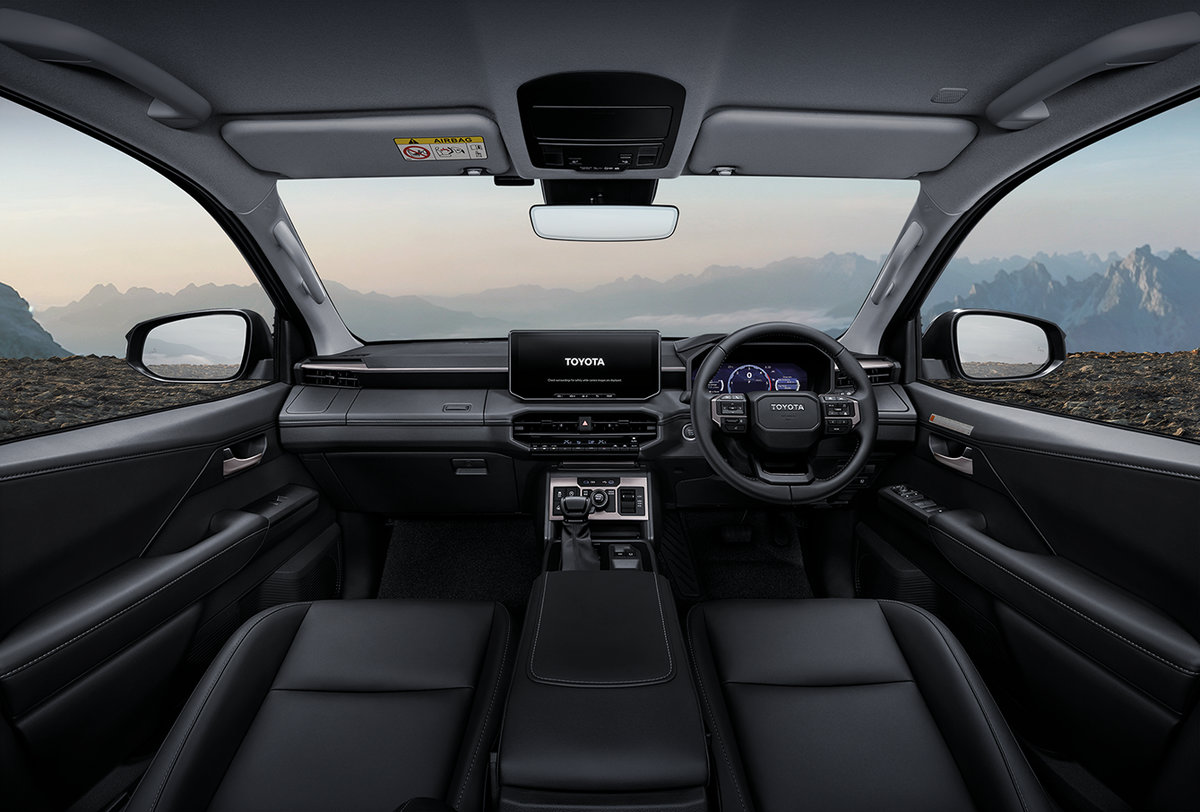
Hilux 9th generation interior
Features:
- 12.3-inch large display audio (estimated)
- 12.3-inch digital meter (estimated)
- Steering wheel and shift knob common to the Land Cruiser 250/Prado
- Octagonal design : A three-dimensional design that makes extensive use of C-faces
- Physical switches : Toggle switches are used that are easy to operate even when wearing gloves
- High, horizontal dashboard : consistent with the exterior design
- Large center console : Combines storage capacity and operability
Design concept: Emphasis on practicality for professional use
Like the Land Cruiser series, the design philosophy is to ensure reliable operation even with gloves on . Electrostatic touch panels have been eliminated as much as possible, and large physical switches have been placed in place. The toggle switches are shaped so that they can be operated not only with the fingertips, but also with the back of the gloved hand.
The interior design theme is linked to the exterior’s concept of a “single horizontal letter placed high up,” and features a horizontal layout that concentrates functions at the top of the dashboard.
Mitsubishi Triton: A rugged texture reminiscent of a metal ingot
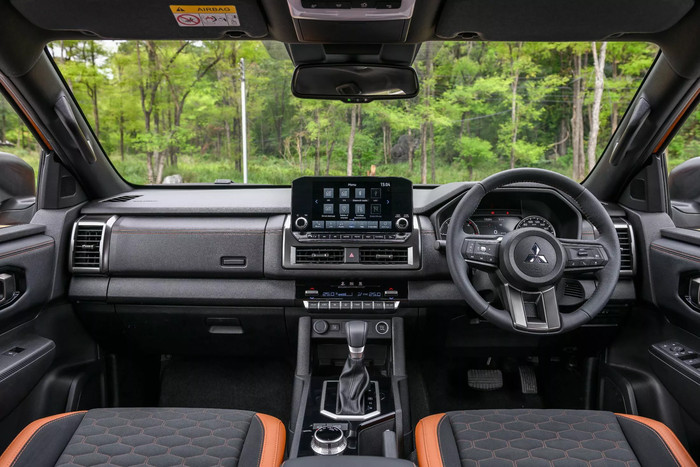
Triton interior
Features:
- 9-inch WVGA display audio (MITSUBISHI TOUCH)
- 7-inch TFT color multi-information display
- Horizontal Axis Design : A dashboard with a unified horizontal theme
- Metal ingot-like texture : hard and rugged design
- Effective use of silver plating : Expressing the beauty of industrial products
- DNA inherited from the Delica : Mitsubishi’s common design language for SUVs and pickups
Design concept: Pursuit of a rugged, masculine look
The Triton’s interior design is characterised by a metallic mass . The centre console in the centre of the dashboard has a presence that makes it seem as if an iron ingot has been placed on it. Plated parts are used effectively to express the beauty of an industrial product.
The steering wheel and shift knob are standard size and are designed to be easy to use for general users, rather than being “specialized for professional use” like the Hilux.
Interior comparison summary
| item | Hilux 9th generation | Triton |
|---|---|---|
| Display size | 12.3 inches (estimated) | 9 inches |
| meter | 12.3-inch digital (estimated) | 7-inch TFT |
| Design Themes | Octagon Modern | Horizontal Brutal |
| texture | Premium SUV-like | Heavy-duty |
| Switches | Large size and emphasis on operability | Standard size |
| Steering | Thick grip common to Land Cruiser | Standard grip |
The division between the two is clear: the Hilux is known for its luxury and advanced features, while the Triton is known for its rugged practicality .
5. Comparison of advanced safety features – Triton is one step ahead
Advanced safety equipment comparison table
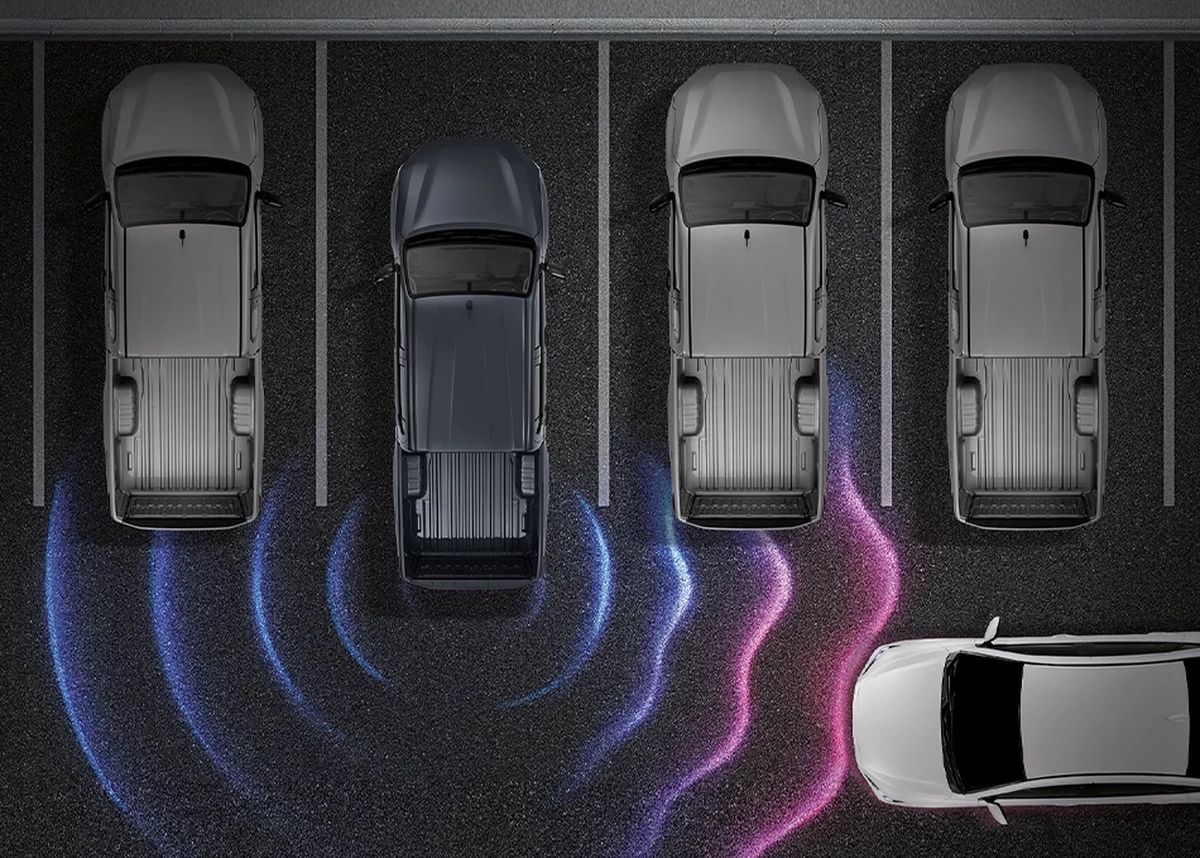
| function | Hilux 9th generation | Triton |
|---|---|---|
| Collision mitigation braking | ○ (Toyota Safety Sense 3.0, estimated) | ○ (FCM) |
| Lane Departure Warning and Assist | ○ | ○ (LDW/LDP) |
| Auto high beam | ○ | ○ (AHB) |
| adaptive cruise control | ○ (Full speed tracking type/prediction) | ○ (0km/h compatible) |
| Blind Spot Monitor | ○ | ○ (BSW/LCA) |
| sign recognition | ○ | ○ (TSR) |
| Reversing vehicle detection warning | ○ | ○ (RCTA) |
| Hill Start Assist | ○ | ○ (HSA) |
| Downhill Assist | ○ | ○ (HDC) |
| Yaw Control | ○ | ○ (ASTC) |
| Connected Features | ○ (T-Connect forecast) | ○ (MITSUBISHI CONNECT) |
Triton’s strengths: ACC 0km/h compatibility is standard equipment
A major advantage of the Mitsubishi Triton is that all grades are equipped with ACC, which can start from 0 km/h . This allows the car to automatically follow the driver when stopping or starting in traffic jams, significantly reducing fatigue on long drives and on highways.
With the April 2025 update, the Triton now comes standard with the following features:
- ACC (Adaptive Cruise Control) 0km/h compatible
- Full-speed tracking function
- Stop-hold function in traffic jams
Toyota Safety Sense 3.0 Evolution (Predictions)
The new Hilux is expected to come equipped with Toyota Safety Sense 3.0 , the same system as the Land Cruiser 250/Prado .
Expected features:
- Proactive Driving Assist (PDA)
- Emergency Steering Assist (ESA)
- Detects oncoming vehicles when turning right at intersections
- Detecting pedestrians crossing the street after turning right or left
- Driver emergency response system
- All-speed ACC (0km/h compatible)
The ACC in the current 8th generation Hilux operates at speeds of approximately 30 km/h or more, but in the 9th generation it will evolve to a full-speed tracking type and is expected to have the same functionality as the Triton.
Overall evaluation of safety equipment
- Current level of completion : Triton (already equipped with 0km/h compatible ACC as standard)
- Future prospects : Hilux (expected to feature an improved version of Toyota Safety Sense 3.0)
- Connected features : Both vehicles can be managed using a dedicated app.
6. Price range comparison – Focus on the price competitiveness of the Hilux
Current model price (reference)
Mitsubishi Triton (2025 model):
- GLS: 4,988,500 yen
- GSR: 5,408,700 yen
Toyota Hilux 8th generation (2023 model):
- Z: 4,072,000 yen
- Z GR SPORT: 4,312,000 yen
The price difference is about 900,000 yen
In the current model, the Triton GSR is priced at approximately 1.09 million yen more than the Hilux Z GR SPORT . The factors behind this price difference are as follows:
Reasons why Triton is expensive:
- Completely new design (all panels newly developed)
- High-performance engine (the Triton outperformed it at the time)
- Adoption of Super Select 4WD-II
- Fully equipped (ACC 0km/h compatible, etc.)
Reasons why the Hilux is cheap:
- Cost-cutting measures such as reusing door panels
- Continued use of existing engine (2.4L engine at the time)
- A strategy that emphasizes maintaining price competitiveness
Estimated price of the new 9th generation Hilux
Expected price range:
- Base grade: 4.3 million to 4.5 million yen
- Mid-range grade (equivalent to GR SPORT): 4.7 million to 4.9 million yen
- High-end grade (equivalent to OVERLAND): 5.2 million to 5.5 million yen
Pricing rationale:
- Cost increase due to 2.8L engine : +200,000 to 300,000 yen
- Adding the latest equipment (two 12.3-inch displays, etc.): +100,000 to 200,000 yen
- Impact of inflation and weak yen : +100,000 yen
- Total : Price increase of approximately 300,000 to 500,000 yen from the current model
Toyota is expected to maintain price competitiveness through cost-cutting measures such as reusing door panels, but with the addition of the 2.8L engine and the latest features, some price hikes are unavoidable.
Competitiveness by price range
4.3 million yen range: The Hilux base grade dominates.
In this price range, it is the only option for a full-size pickup truck. For budget-conscious users, the Hilux is the only choice.
4.7 million to 4.9 million yen: The fiercely competitive
Hilux mid-range model vs. Triton GLS
- Hilux : 500Nm of torque, latest features, Toyota brand
- Triton : Super Select 4WD-II, completely new design, 0km/h compatible ACC as standard equipment
5.2 million to 5.4 million yen: Premium showdown between
the Hilux high-grade and Triton GSR
- Hilux : Luxury and cutting-edge technology directly descended from the Land Cruiser
- Triton : Full-scale off-road performance and highly refined equipment
Cost-effectiveness conclusion
- Absolute cheapest : Hilux (500,000-900,000 yen cheaper)
- Equipment level : Almost equal (Hilux has a larger screen, Triton comes standard with ACC)
- Performance vs. Price : Hilux (500Nm of torque available at a cheaper price)
7. Which one should you choose? User-specific recommendation diagnosis
Who is the 9th generation Toyota Hilux recommended for?
✓ Recommended for:
- Emphasis on the reliability of the Toyota brand and dealer network
- Powerful torque of 500Nm for frequent heavy load transport
- I like urban and stylish designs
- I want to enjoy the latest equipment while keeping the price down.
- Focus on future resale value
- Seeking consistency with the Land Cruiser series
- The advanced large screen display (12.3 inches x 2) is appealing
- I want to enjoy customizing my Toyota (GR parts, etc.)
- Highly rated for its large switches, which are easy to operate even with gloves on
The defining features of the Hilux:
- 500Nm maximum torque : overwhelming power that is 30Nm more than the Triton
- 2.8L engine common to the Land Cruiser : Proven and highly reliable
- Price competitiveness : 500,000 to 900,000 yen cheaper than the Triton (estimated)
- Toyota brand resale value : Can be sold for a high price even after 3 years
- Abundant aftermarket parts : Many options available, including GR parts and TRD customizations
Mitsubishi Triton is recommended for
✓ Recommended for:
- Frequent serious off-road driving
- I’m impressed by the advanced 4WD system of Super Select 4WD-II.
- I want to drive comfortably on paved roads with full-time 4WD
- I like rugged, masculine, linear designs
- I want to use the latest driving assistance features, such as ACC with 0km/h speed limit, right away.
- Evaluating Mitsubishi’s traditional SUV/pickup DNA
- Wanting to make different choices than others (seeking rarity)
- I want to ride the latest model with a completely new design.
- Easy handling with a minimum turning radius of 6.2m
Triton’s defining features:
- Super Select 4WD-II : A high-performance 4WD system directly derived from the Pajero
- 0km/h compatible ACC standard equipment : Full speed tracking that can be used even in traffic jams
- Completely new design : All panels have the latest design and a unified look
- Rugged design : A tough style befitting a pickup truck
- Minimum turning radius: 6.2m : Easier to handle than the Hilux
How to choose by purpose
For work use (construction, landscaping, agriculture, etc.)
→ Hilux : 500Nm torque, reliability, low price, nationwide Toyota dealer network
Mainly for weekend outdoor activities
→ Either is OK : Choose based on your design preference
For serious off-road driving (forest roads, cross-country, etc.)
→ Triton : Super Select 4WD-II is easy to use, with a minimum ground clearance of 220mm
Commuter + leisure
→ Hilux : urban design, slim body (1,855mm)
Do you drive long distances often?
→ Triton : Comfortable ACC with 0km/h speed limit, stability of a long wheelbase
8. Electrification: BEV and FCEV deployment
Hilux electrification strategy: Two pillars: BEV and FCEV
In November 2025, Toyota unveiled the Hilux BEV (battery electric vehicle) model “TRAVO-e” in Thailand.
TRAVO-e (BEV) specifications:
- Battery capacity : 59.2 kWh
- Cruising range : 240km (WLTP) / 300km (NEDC)
- Maximum output : 196ps (144kW)
- Maximum torque : 269Nm
- Drive system : 4WD (eAxle system, front and rear motor drive)
BEV model rating:
The 240km (WLTP) range is disappointing for a pickup truck. This is due to the relatively small battery capacity of 59.2kWh, making it unsuitable for commercial or professional use .
However, this is only an early model, and there is a good chance that models with larger battery capacity or more efficient powertrains will be released in the future.
Planned rollout of FCEV models
Toyota’s true aim is thought to be the FCEV (fuel cell electric vehicle) model .
Potential for FCEV deployment:
- Launch date : Around 2028 (estimated)
- System : Fuel cell system shared with the new MIRAI
- Cruising range : over 500km (estimated)
- Hydrogen filling time : 3 to 5 minutes
Toyota is prioritizing the deployment of FCEVs in commercial vehicles and trucks in order to realize a hydrogen society. The Hilux FCEV is highly promising due to the following advantages:
- Long driving range : Overcoming the weaknesses of BEVs
- Short filling time : practical for commercial use
- Less impact on payload : fuel cells are lightweight and compact
- Environmental performance : Zero CO2 emissions while driving
Will the Triton be electrified?
Mitsubishi Motors has not yet officially announced whether the Triton will be available as a BEV/PHEV, but given Mitsubishi’s electrification strategy, the launch of a PHEV model is the most realistic option.
The potential of the Triton PHEV:
- Launch date : 2027 or later (estimated)
- System : Powertrain shared with Outlander PHEV
- EV driving range : 60-80km (estimated)
- Total range : over 800km (estimated)
By utilizing the technology developed for the Outlander PHEV and equipping it with a PHEV system optimized for pickup trucks, the vehicle can be ideally used by driving on electric power on a daily basis and using the internal combustion engine for long distances and off-road driving .
Comparison of electrification
| item | Hilux | Triton |
|---|---|---|
| BEV | ○ (TRAVO-e already announced) | ? (Unreleased) |
| PHEV | ? | ○ (high possibility) |
| FCEV | ○ (Estimated for around 2028) | × |
| Seriousness about electrification | Very high | moderate |
The Toyota Hilux is one step ahead in terms of responding to electrification . In particular, its strategy for the rollout of FCEVs will give it an advantage in the pickup truck market in the long term.
Overall rating: Who will dominate the pickup truck market in 2026?
The Hilux takes the lead in terms of performance, but the Triton takes the lead in terms of ease of use.
Mitsubishi Triton Victory Points:
- Super Select 4WD-II for superior usability (full-time 4WD possible even on paved roads)
- 0km/h compatible ACC standard equipment (full speed tracking for use in traffic jams)
- A completely new, bold design (all panels have a unified shape)
- Minimum turning radius is 6.2m (better maneuverability than the Hilux)
- 220mm ground clearance (advantageous for off-road performance)
Toyota Hilux 9th Generation Victory Points:
- 2.8L engine with a maximum torque of 500Nm (30Nm more than the Triton)
- Highly reliable powertrain shared with the Land Cruiser series
- Price competitiveness (expected to be 500,000 to 900,000 yen cheaper than the Triton)
- Toyota brand reliability and resale value
- Advanced infotainment (two 12.3-inch displays, expected)
- Future BEV/FCEV deployment (high level of commitment to electrification)
- A wide range of customization parts and the GR lineup
- Nationwide Toyota dealer network (reliable maintenance and service)
2026 conclusion: A true rivalry will emerge
With the new Hilux equipped with a 2.8L engine (500Nm), the powertrain performance is now roughly equal to that of the Triton, but the Hilux surpasses it in torque , taking the competition between the two vehicles to a new level.
Performance advantages and disadvantages:
- Engine torque : Hilux 500Nm > Triton 470Nm
- Usability of 4WD systems : Triton > Hilux
- Driving assistance features (current) : Triton (0km/h compatible ACC standard) ≧ Hilux (expected)
Overall strength:
- Price competitiveness : Hilux >> Triton
- Brand power and resale value : Hilux > Triton
- Design perfection : Triton ≧ Hilux (it’s a shame the doors are reused)
- Response to electrification : Hilux >> Triton
Market Share Forecast
Considering Toyota’s sales power, price advantage, and brand power, the Hilux is expected to dominate in terms of sales volume . The Hilux will be particularly popular among the following demographics:
- Commercial/professional use : Toyota dealer network, low price, 500Nm torque
- Young people’s first Toyota car : A cutting-edge product strategy as an entry point for Toyota
- Resale-conscious demographic : Toyota brand’s high resale value
Meanwhile, the Triton is expected to attract a core fan base, including :
- Serious Off-Roader : Evaluating the Performance of Super Select 4WD-II
- Mitsubishi fans : The only pickup that inherits the Pajero and Delica traditions
- Scarcity seekers : Users who want to make different choices
Final selection criteria
The choice will be determined by the following priorities:
1. If price is your number one priority →
The price difference between the Hilux and the Toyota is 500,000 to 900,000 yen. You can get the same 500Nm torque at a lower price.
2. If ease of use of the 4WD system is your top priority → Triton
Super Select 4WD-II allows you to select the optimal mode for both paved roads and off-road.
3. If brand and resale value are your top priorities → Hilux
The reliability of the Toyota brand and high resale value after three and five years are attractive.
4. If you’re choosing based on design preference → Urban
and stylish Hilux vs. rugged and tough Triton.
5. If you are looking to electrify your vehicle → The Hilux
BEV “TRAVO-e” has already been announced, and a full lineup is expected to include an FCEV in 2028.
Summary: Japan’s pickup truck market will enter its golden age in 2026
With the arrival of the new 9th generation Hilux in 2026, Japan’s pickup truck market will enter its most exciting era in history .
A torque battle between 500Nm and 470Nm , a 2.8L vs 2.4L displacement battle, a brand battle between Toyota and Mitsubishi , a value battle between price and equipment … A true rival showdown will be realized, with both cars closely matched in every aspect.
Whichever you choose, it will still be the best pickup truck sold in Japan . Be sure to compare both vehicles and take a test drive to choose the one that best suits your lifestyle and purpose.
We’ll be keeping a close eye on the pickup truck market in 2026.
Reference links: