
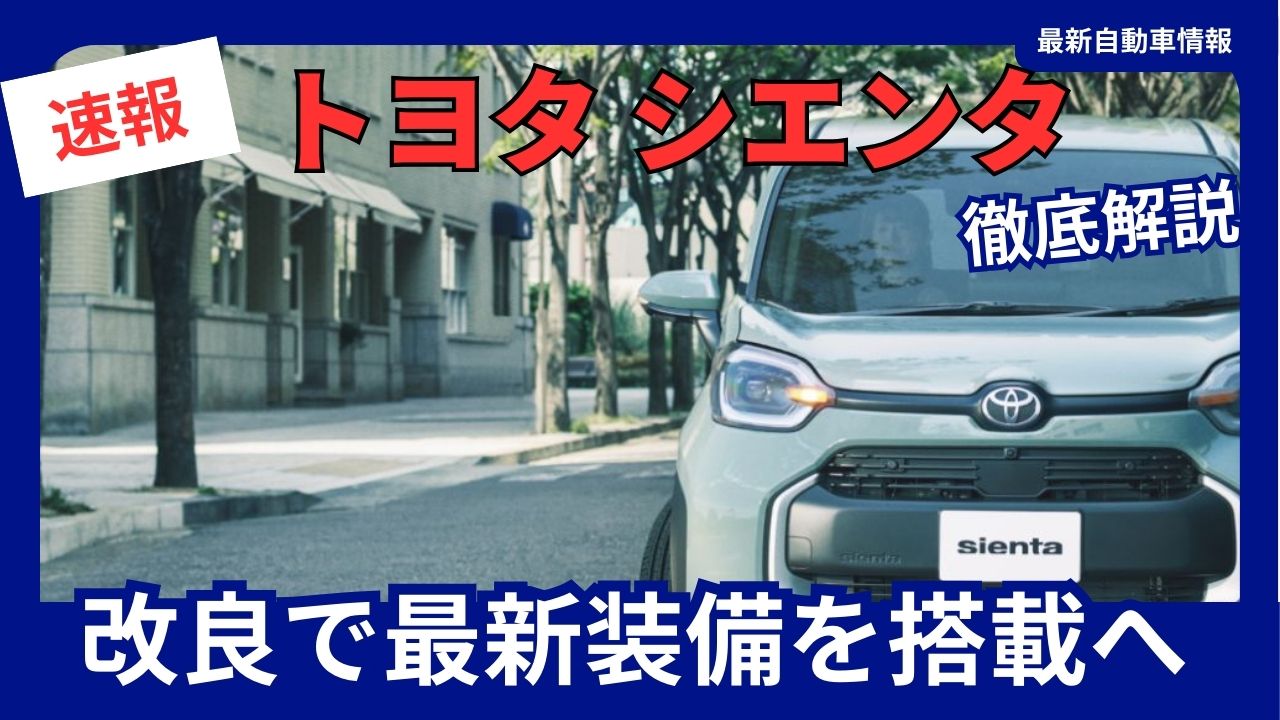
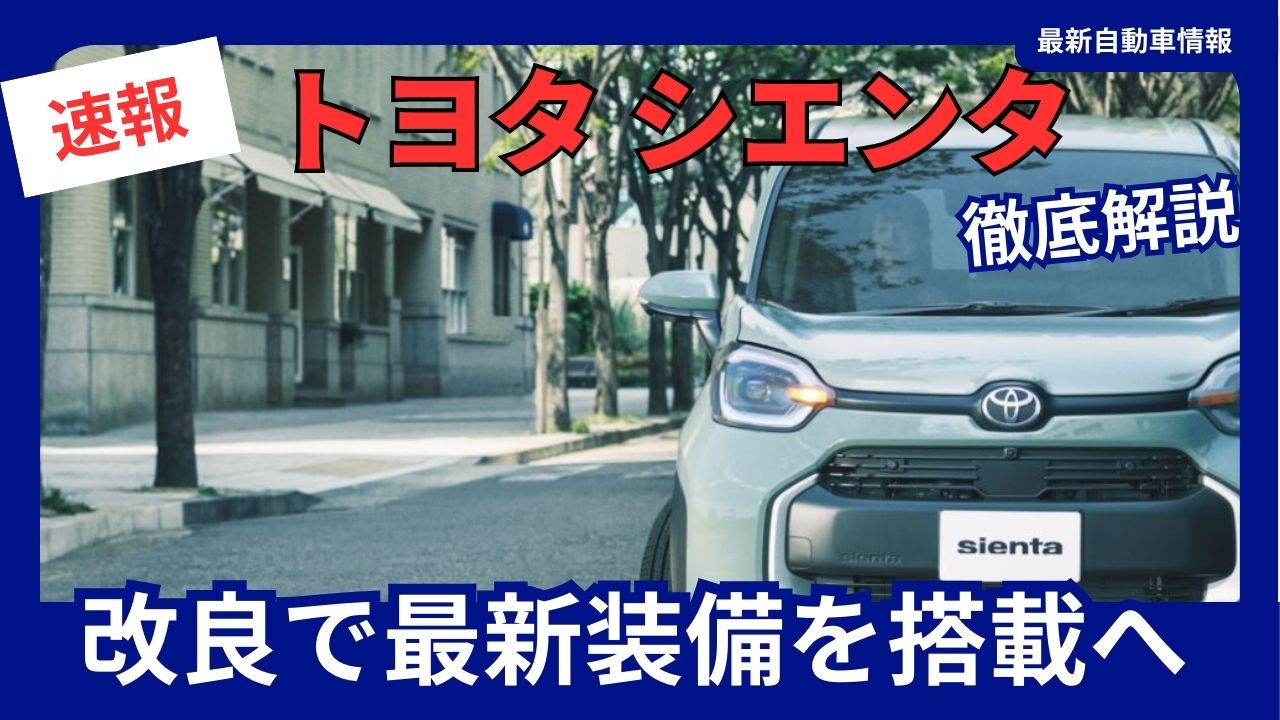
Toyota has made some improvements to its popular compact minivan, the Sienta, and will release it on August 5, 2025. A new grade, the JUNO, will be added, which will be a two-seater, four-number registered vehicle . Prices range from 2,077,900 yen to 3,852,200 yen.
The current model will be released on August 23, 2022, and is scheduled to undergo a minor change three years later. In this article, we will introduce the latest information, including the changes that will be made in the minor change, price, and release date, while taking into account the features of the current model.
Toyota New Sienta Partial Improvements August 5, 2025 Latest Information!
Changes
- The new model, the JUNO, is a two-seater 4-number registered vehicle.
- Electric parking brake and auto brake hold
- Contributes to reducing driver fatigue
- Toyota’s first adoption of memory-type auto brake hold
- Supports adaptive cruise control stop-hold function
- Equipped with the latest “Toyota Safety Sense”
- Expansion of detection targets for pre-crash safety
- Equipped with Proactive Driving Assist (PDA)
- “Driver Abnormality Response System” is standard equipment on all grades
- Improved interior quality
- Automatic air conditioning is standard on all grades.
- The shape of the shift side pocket has been changed.
Lineup
- 3-row seating for 7 people
- 2-row seating for 5 people
- 1-row seating for 2 people
Powertrain
- 1.5L gasoline engine
- 1.5L hybrid system
- 4WD “E-Four” also available
price
- Prices range from 2,077,900 yen to 3,852,200 yen
- Depending on the grade, prices will increase by around 50,000 to 90,000 yen.
release date
- August 5, 2025
Toyota’s new Sienta minor change catches up with rival “Freed”! Equipped with electric parking brake
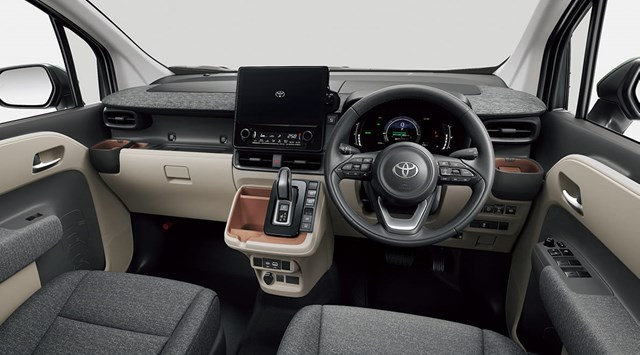
The most notable feature of this minor change is the long-awaited electric parking brake and auto brake hold, which will be standard equipment on all grades. This will be the first time that memory-type auto brake hold has been adopted by the Toyota brand.
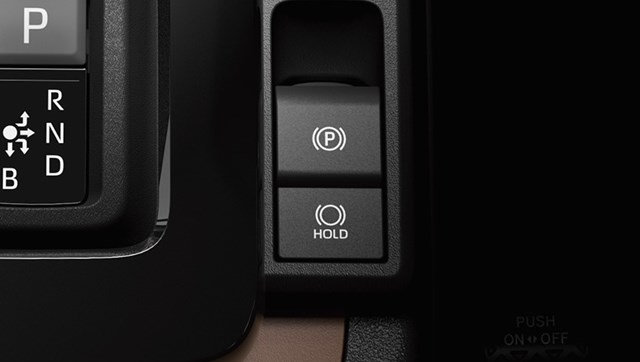
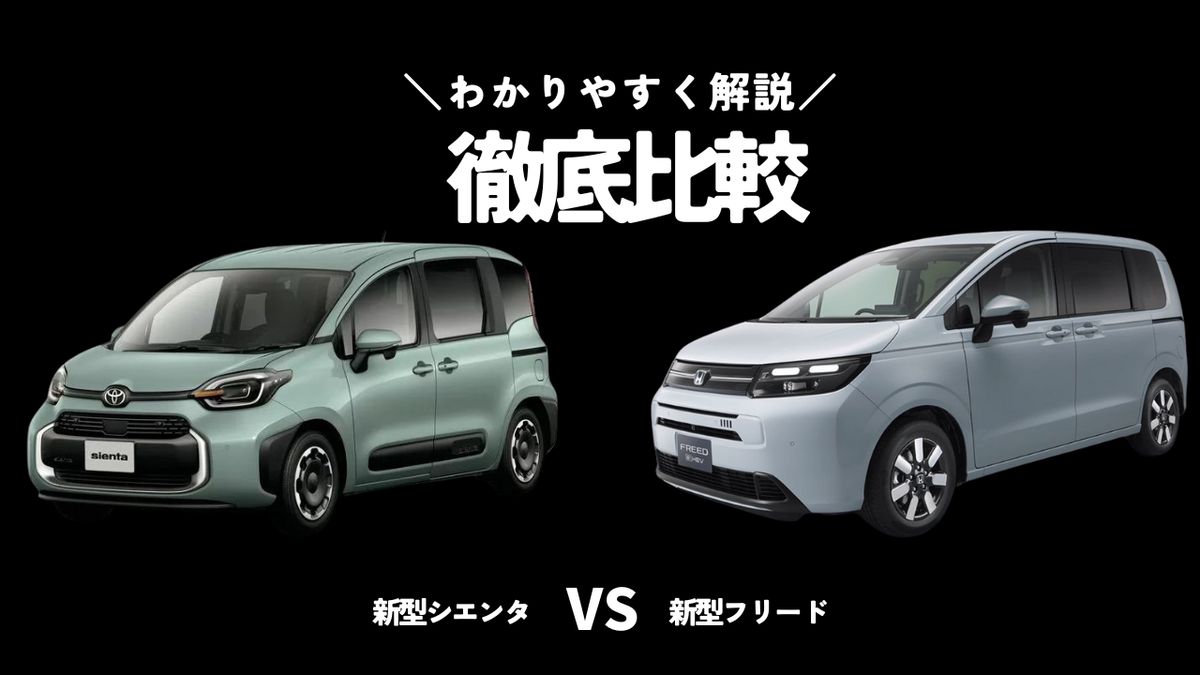
The Sienta will follow suit after its rival, the Honda Freed, is equipped with these features in its full model change in June 2024. This will allow drivers to take their foot off the brake pedal when stopped at traffic lights or in traffic jams, greatly contributing to reducing driver fatigue. It will also be compatible with the adaptive cruise control’s stop-hold function, supporting more comfortable driving.
Automatic air conditioning is standard equipment on all grades. The shape of the shift side pocket has been changed so that it can hold a smartphone.
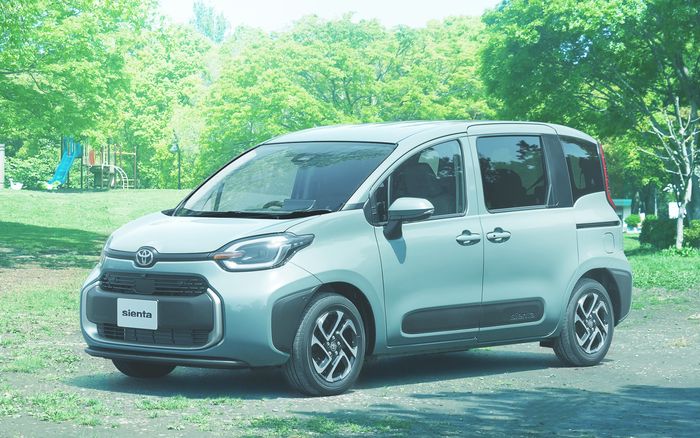
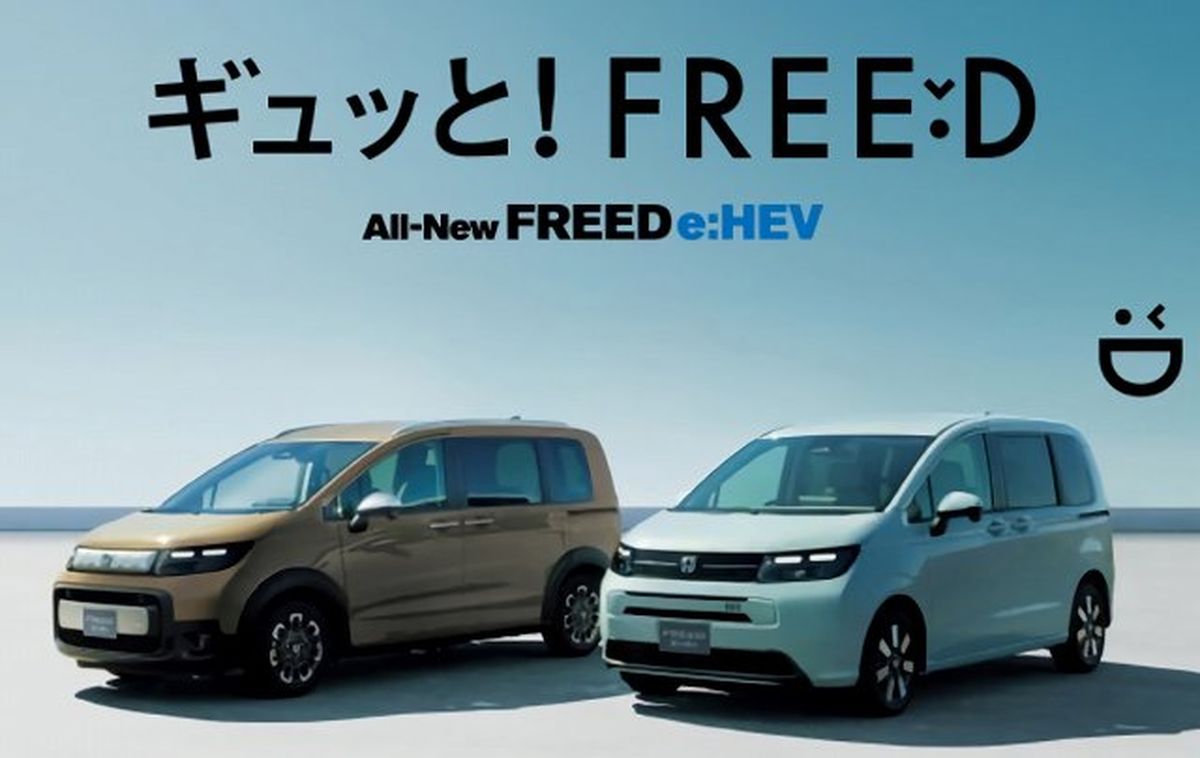
Toyota’s new Sienta undergoes a minor change. Enjoy safe and secure driving with the latest safety features.
In terms of safety equipment, the latest “Toyota Safety Sense” is installed. This expands the detection target of pre-crash safety, and also covers oncoming vehicles going straight when turning right at an intersection and pedestrians crossing after turning right or left.
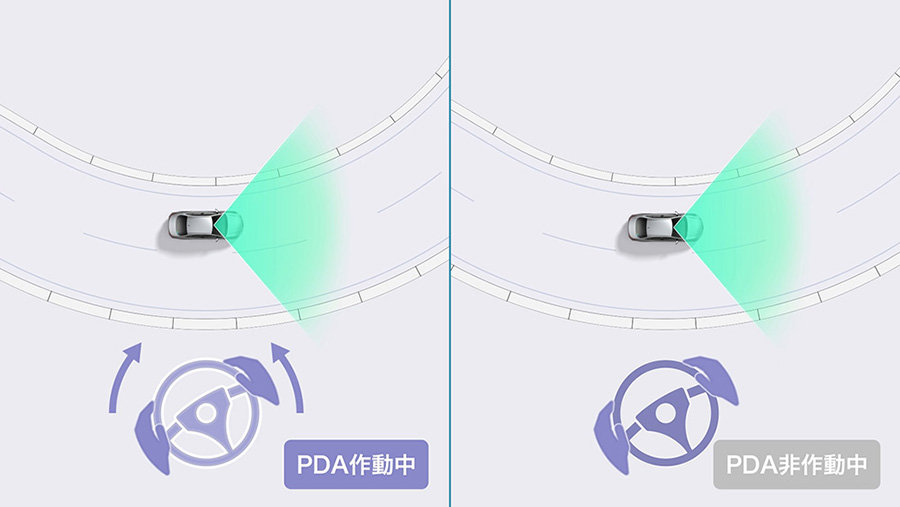
The new system is Proactive Driving Assist (PDA). Unlike conventional safety systems that only activate when danger is imminent, this system predicts danger and subtly supports the driver’s driving operations to prevent the vehicle from getting too close to a dangerous situation in the first place.
For example, if the system judges there to be a potential risk in driving situations such as a pedestrian crossing the street or a vehicle suddenly jumping out into the street, it will provide gentle deceleration and steering assistance at an early stage, encouraging drivers to maintain a safer distance between vehicles and take smooth evasive action. This assistance is provided in a natural way so as not to cause any discomfort to the driver, so while the driver remains in control of the driving, it feels as if the system is heightening their awareness of danger just like an experienced driver. This reduces the mental burden of everyday driving, allowing them to relax and concentrate on driving more.
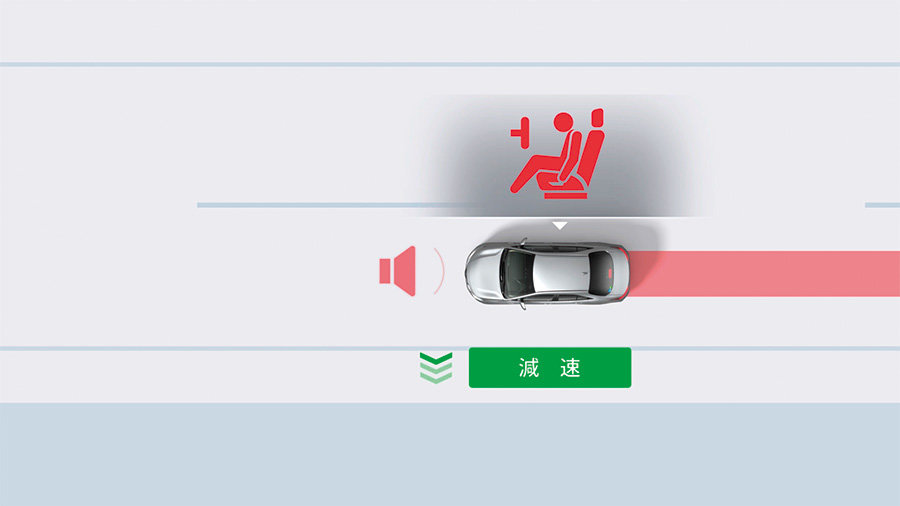
The system employs a driver abnormality response system . If the driver continues to ignore the controls, it will warn the driver with sounds, visuals, and gradual deceleration to prompt the driver to take action, and will also alert the outside world with hazard lights and a horn while decelerating and stopping the vehicle within its lane, helping to avoid accidents involving damage to the vehicle or other parties involved, and reducing the damage caused by such accidents.
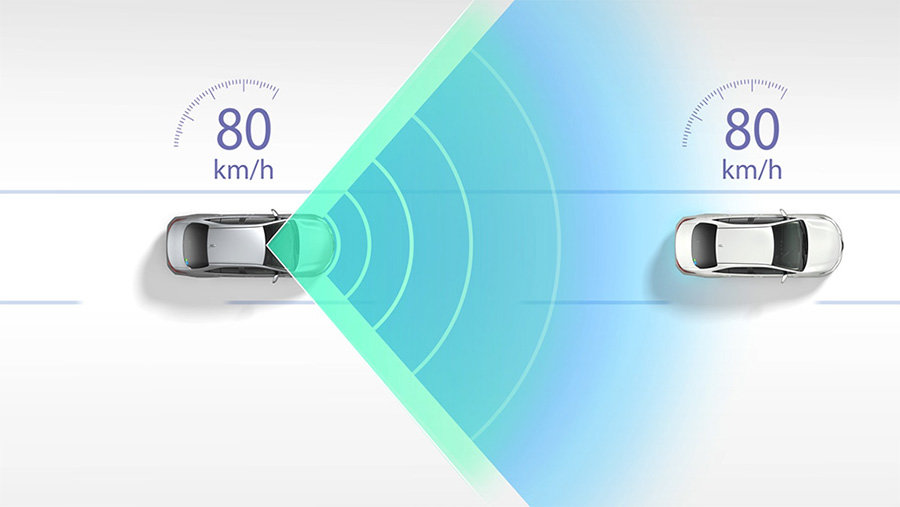
This is radar cruise control (with full-speed tracking function) . It is an advanced driving assistance system that dramatically reduces the burden of driving by assisting the car with accelerator and brake operation on roads and in traffic jams. While conventional cruise control only “maintains a set speed,” this function is a major evolution.
Feature highlights
- The radar and camera mounted on the front of the vehicle detect the vehicle ahead and automatically maintain a safe distance while following it. If the vehicle ahead accelerates, the vehicle will also accelerate, and if the vehicle decelerates, the vehicle will also decelerate smoothly.
- Automatic acceleration and deceleration eliminates the need for drivers to frequently operate the accelerator or brake. In most cases, the distance between vehicles can be set in several stages to suit the driver’s preference.
- [This is important!] All-speed tracking and stop hold: The biggest improvement in this function is that it works at
all speeds .- Even when driving slowly in traffic jams , the system will continue to follow the vehicle in front of you.
- When the vehicle ahead comes to a complete stop, your vehicle will automatically brake and stop (stop hold function).
- When the leading vehicle starts moving again, the driver can smoothly resume following the vehicle by simply operating a switch or lightly pressing the accelerator.
This will free you from the repeated “stop and go” operation that has been one of the most stressful situations in traffic jams .
Toyota’s new Sienta minor change: exterior and interior retain the same concept
The exterior design will inherit the “square” silhouette of the current model, but is expected to give a more refined impression by redesigning the front grille and bumper. The body size is expected to maintain the 5-number size, which emphasizes ease of handling.
The interior is expected to further improve on the spaciousness and ease of use that have been well-received in the current model. The seat upholstery uses fabric material with deodorizing, water-repellent, and oil-repellent properties, achieving both comfort and practicality. There is also ample storage space, which is clearly indicated with pictograms.
Toyota’s new Sienta minor change adds new two-seater 4-number registered vehicle “JUNO”
Toyota’s popular compact minivan, the Sienta, has been joined by a new complete car, the Sienta JUNO. This notable two-seater, four-number registered vehicle is based on the top-of-the-line Z grade (hybrid vehicle) and was jointly developed with MODELLISTA, known for its customization parts.
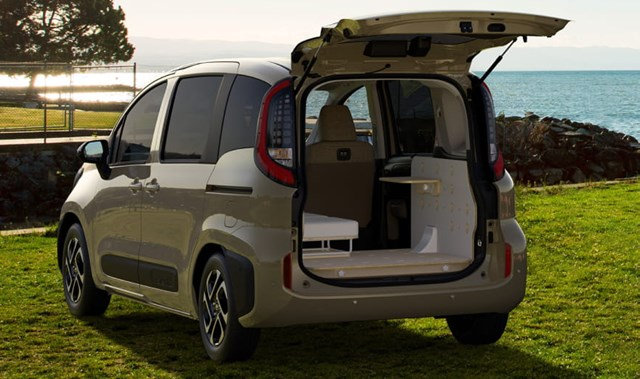
New Sienta minor change: New model, two-seater 4-number registered vehicle “JUNO”
■ Vast cargo space to suit a variety of lifestyles The greatest feature of the Sienta JUNO is its vast luggage space, created by removing the second and third row seats and limiting the vehicle’s seating capacity to two people. This makes it possible to carry an amount of luggage that is incomparable to previous models. From outdoor activities that require large amounts of gear, such as solo camping, fishing, and cycling, to business use such as transporting equipment, the vehicle offers overwhelming cargo capacity to meet the demands of professionals.
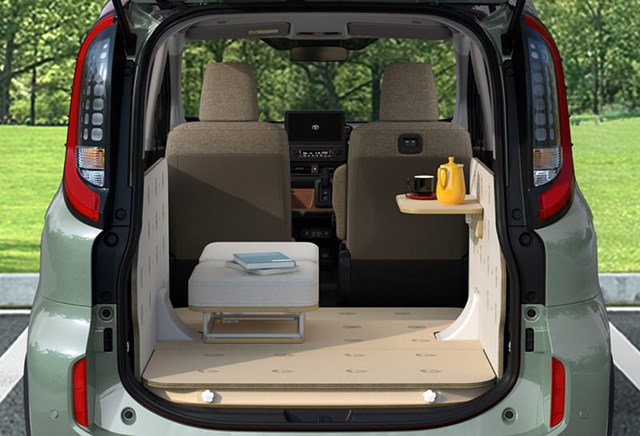
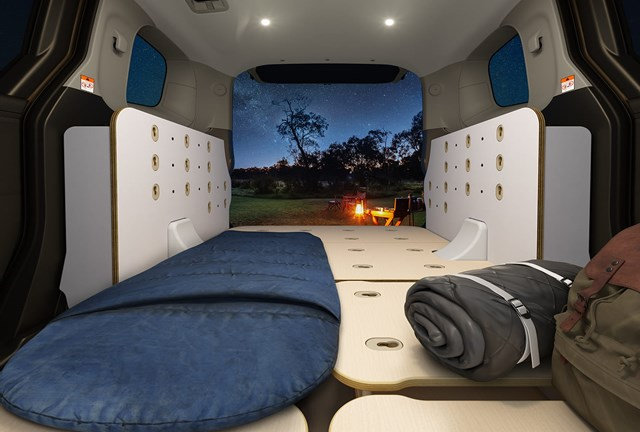
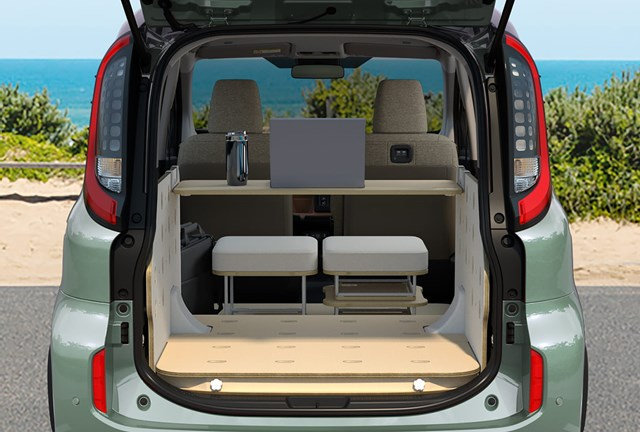
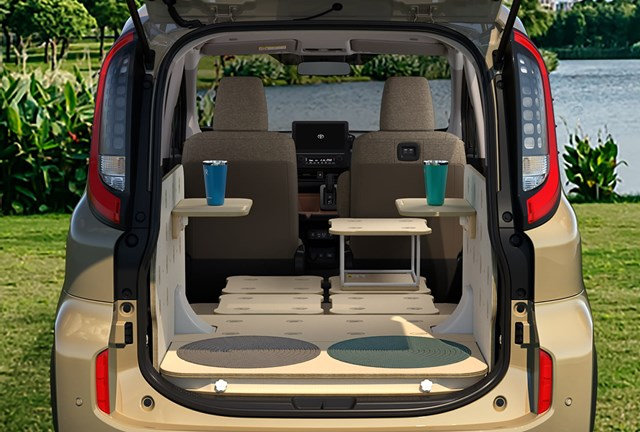
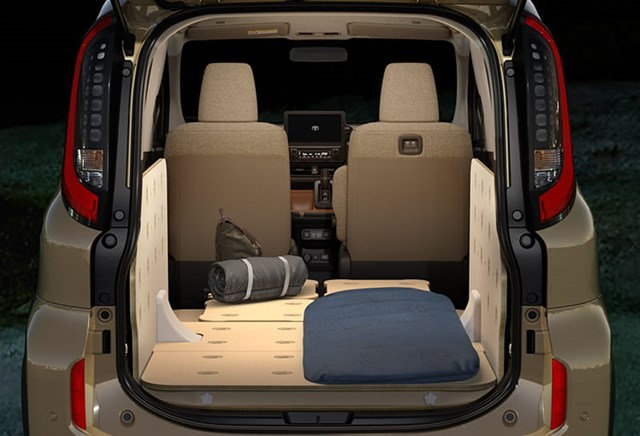
■ The concept is “portable room.” Creating a free space The model name “JUNO” comes from the fact that it “adapts” to the owner’s diverse lifestyles. The concept is “portable room.” Special bodywork has been applied to the rear seats and luggage area, elevating the car from a mere means of transportation to a personal space with new value.
The specially designed trim and floor incorporate a structure that allows furniture modules to be easily attached and detached. By freely combining base modules and cushions, you can create a space that is uniquely yours, with endless possibilities depending on your imagination, such as sleeping in the car, working remotely, or working on a hobby.
Reference: Sienta “JUNO”
Toyota New Sienta Minor Change Lineup and Prices
As with the current model, it is expected to be available in two types: a three-row, seven-seater and a two-row, five-seater. There are two powertrain options: a 1.5L gasoline engine and a 1.5L hybrid system. The hybrid system will also be available with the 4WD “E-Four” option.
Prices may increase slightly from the current model due to improved functionality. Depending on the grade, a price increase of around 50,000 to 90,000 yen is expected, but it will still maintain high cost performance. The newly introduced two-seater 4-number vehicle, the Sienta JUNO, will increase in price by around 570,000 yen from the base grade.
Toyota Sienta price list
Gasoline vehicles
| grade | Drive system | Passenger capacity | Price (tax included) |
| X | FF | 2-row, 5-seater | 2,077,900 yen |
|---|---|---|---|
| FF | 3-row, 7-seater | 2,117,500 yen | |
| G | FF | 2-row, 5-seater | 2,424,400 yen |
| FF | 3-row, 7-seater | 2,464,000 yen | |
| Z | FF | 2-row, 5-seater | 2,733,500 yen |
| FF | 3-row, 7-seater | 2,773,100 yen |
Hybrid vehicles
| grade | Drive system | Passenger capacity | Price (tax included) |
| HYBRID X | FF | 2-row, 5-seater | 2,439,800 yen |
|---|---|---|---|
| FF | 3-row, 7-seater | 2,479,400 yen | |
| E-Four | 2-row, 5-seater | 2,637,800 yen | |
| E-Four | 3-row, 7-seater | 2,677,400 yen | |
| HYBRID G | FF | 2-row, 5-seater | 2,774,200 yen |
| FF | 3-row, 7-seater | 2,814,900 yen | |
| E-Four | 2-row, 5-seater | 2,972,200 yen | |
| E-Four | 3-row, 7-seater | 3,012,900 yen | |
| HYBRID Z | FF | 2-row, 5-seater | 3,083,300 yen |
| FF | 3-row, 7-seater | 3,124,000 yen | |
| E-Four | 2-row, 5-seater | 3,281,300 yen | |
| E-Four | 3-row, 7-seater | 3,322,000 yen |
Sienta JUNO [New setting]
| Base grade | Drive system | Price (tax included) |
| HYBRID Z | FF | 3,654,200 yen |
|---|---|---|
| E-Four | 3,852,200 yen |
Toyota New Sienta Minor Change Specifications
There are no changes to the specifications.
| Specifications | New Sienta Hybrid |
New Sienta gasoline |
|---|---|---|
| full length | 4,280mm | 4,280mm |
| Overall width | 1,695mm | 1,695mm |
| Overall height | 1,695mm (2WD) 1,715mm (4WD) |
1,695mm (2WD) 1,715mm (4WD) |
| Wheelbase |
2,750mm | 2,750mm |
| engine | Inline 3 1.5L + motor M15A-FXE type |
In-line 3-cylinder 1.5L engine M15A-FKS type |
| Maximum power | 67kW (91ps) / 5500rpm |
88kW (120ps) / 6600rpm |
| Maximum torque | 120Nm (12.2kgfm) / 3800-4800rpm |
145Nm (14.8kgfm) / 4,800-5,200rpm |
| Motor maximum output |
Front: 59kW (80ps) Rear: 2.2kW (3.0ps) |
– |
| Motor Max Torque |
Front: 141Nm (14.4kgm) Rear: 44Nm (4.5kgm) |
– |
| WLCT mode fuel economy |
28.2-28.8km/L (2WD) 25.3km/L (4WD) |
18.3km/L |
| Drive system | 2WD/4WD (E-Four) |
2WD |
| Passenger capacity | 5 people/7 people | 5 people/7 people |
| Minimum turning radius |
5.0m | 5.0m |
| Drive system | Electric continuously variable transmission |
Direct Shift- CVT |
| price | 2,380,000 yen to 3,108,000 yen |
1,950,000 yen to 2,560,000 yen |
Toyota’s new Sienta minor change release date is August 2025!
The improved Sienta will be released on August 5, 2025. We will update this page as soon as we have the latest information, so please stay tuned.
About the new Sienta
In developing the new Sienta, the company aims to further refine the “user-friendly interior space” of the first generation, while retaining the attractive features of the “easy-to-handle 5-number size,” “latest safety and security equipment,” “low fuel consumption,” and “affordable price.”
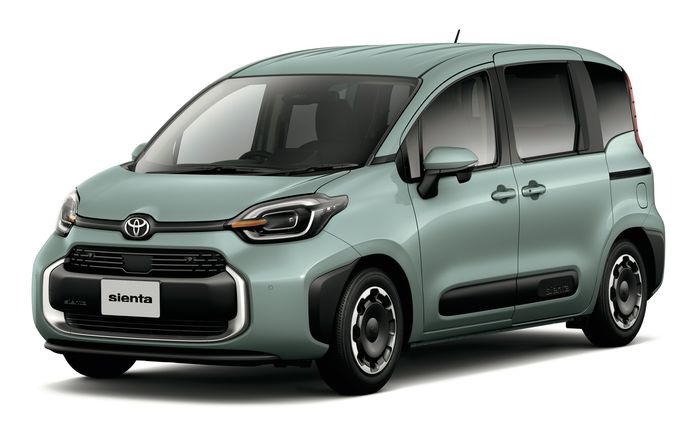
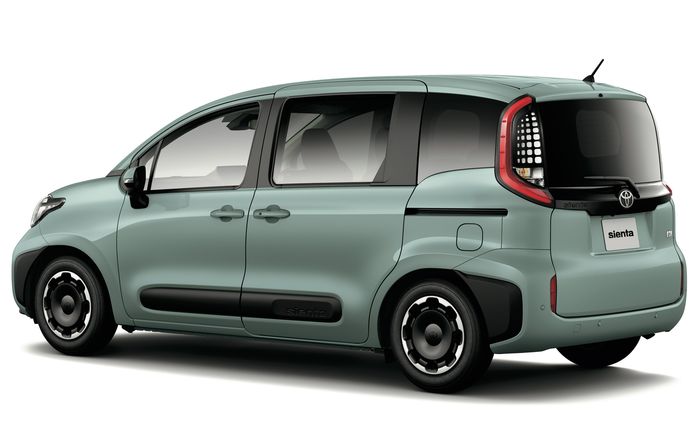
It offers a larger interior space than the previous model. It achieves high aerodynamic performance and adopts a newly developed platform that reduces weight, lowers the center of gravity, and increases body rigidity by more than 30%, making it a significant improvement over the previous model. The suspension employs a MacPherson strut front suspension and a torsion beam coil spring rear suspension. The minimum turning radius is 5.0m, allowing for smooth maneuvering on narrow roads and in parking lots.
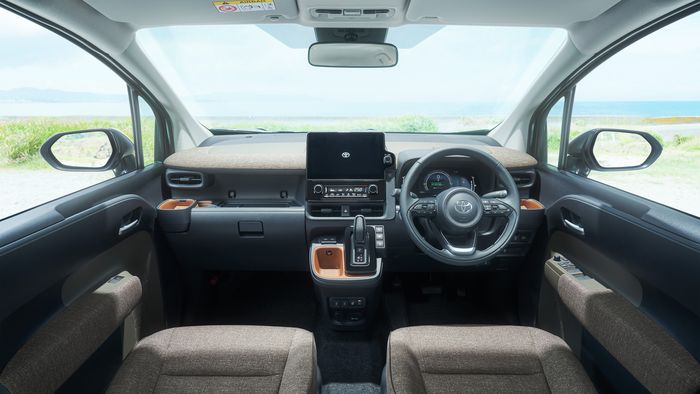
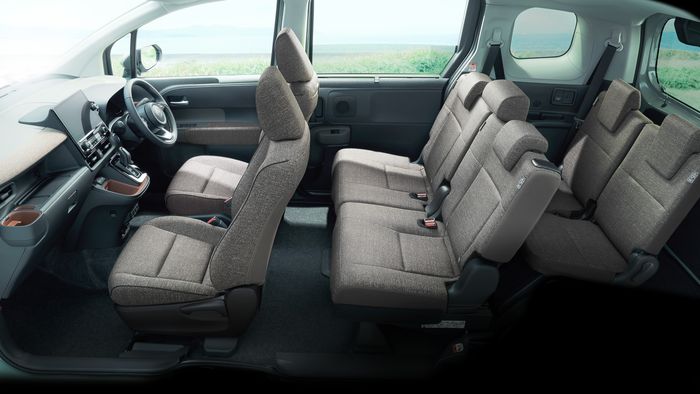
There’s no doubt that this model will evolve into a completely different car. The ride quality will change with more soundproofing and improved body construction. Despite being a 5-number size, the interior space is spacious and the interior is more luxurious than the previous model.
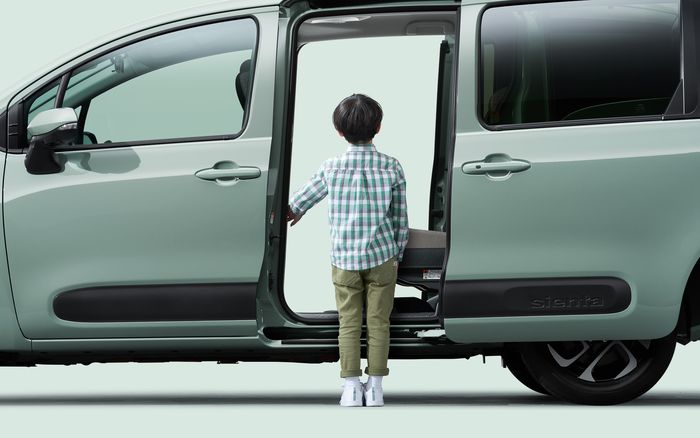
While maintaining the easy-to-handle 5-number size that prioritizes maneuverability in everyday life, the overall height has been increased by 20 mm from the previous model to a low floor ground clearance of 330 mm, and the height of the power sliding door opening has been widened to 1200 mm, an increase of 60 mm from the previous model , making it easier to get in and out. While maintaining the flat floor with no steps, it has achieved excellent ease of getting in and out of the rear seats.
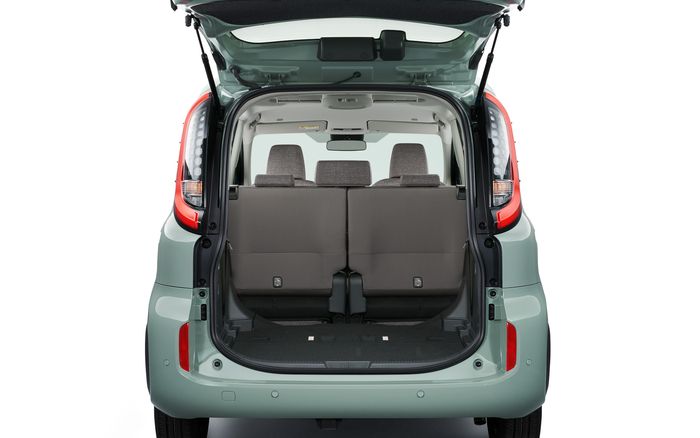
The height of the back door opening has been increased by 15 mm (compared to the previous model), and the luggage compartment height has also been increased by 20 mm (compared to the previous model), making it easier to load and unload luggage.
Adopts ” TNGA (Toyota New Global Architecture) ” and “GA-B platform.”
The new generation ” inline 3-cylinder 1.5L direct injection Dynamic Force Engine M15A type ” employs a new, compact THS II engine. It is combined with a ” Direct Shift-CVT “ with a launch gear .
The hybrid model also features an E-Four (4WD) model . A newly developed double wishbone rear suspension is used exclusively for 4WD. The gasoline 4WD model will be discontinued.
It is equipped with the second-generation Toyota Safety Sense , an advanced preventive safety technology .
The car comes standard with an 8-inch or 10.5-inch display audio , Apple CarPlay, and Android Auto. A DCM in-car communication device is also standard.
It features an external power supply function (optional for hybrid vehicles) that can supply up to approximately 5.5 days’ worth of electricity for an average household.
Differences between the next-generation Toyota Safety Sense and Toyota Safety Sense C
The adoption of “Next Generation Toyota Safety Sense” will significantly add functionality and improve safety.
| system | Next-generation Toyota Safety Sense |
Toyota Safety Sense C |
|---|---|---|
| method | Monocular camera + millimeter wave radar |
Monocular camera + laser radar |
| Automatic high beam |
◯ | ◯ |
Pre-crash safety system with collision avoidance support |
Daytime and nighttime pedestrian and bicycle |
◯ |
Detects oncoming vehicles and pedestrians when turning right at an intersection |
◯ | × |
| Lane Tracing Assist |
◯ | × |
| Lane Departure Alert |
Steering control White/yellow line detection Road edge detection Wandering alarm |
◯ White line/yellow line detection |
| Road Sign Assist | ◯ | × |
| Radar cruise control |
◯ | × |
| Leading vehicle departure notification | ◯ | ◯ |
| Driver emergency response system |
◯ High-grade Z only |
× |
| Proactive Driving Assist |
◯ | × |
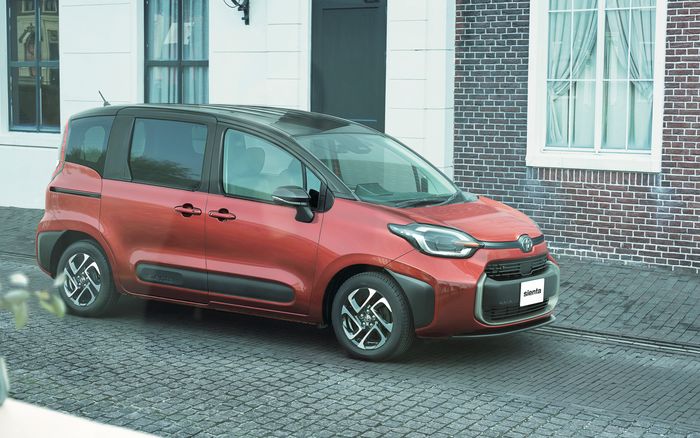
History of the Sienta
The first-generation Sienta was a compact minivan, following the Nissan Cube Cubic, which was on sale at the time. Despite its small body size, it had three rows of seats and could accommodate seven people. It also had sliding doors on both sides of the rear seats. The front of this model was based on the NBC platform for the CP20-series Fun Cargo, which housed the second and third row seats, while the rear, which bears the most weight, used the MC platform for the E120-series Corolla Spacio. In other words, it combined different platforms at the front and rear.
The second generation model was released in 2015 after the first generation in 2003, and has undergone a model change for the first time in 12 years. The second generation was developed as “Toyota’s smallest minivan, universal and cool,” and is sold at Toyota dealerships, Toyopet dealerships, Toyota Corolla dealerships, and Netz dealerships nationwide. Its rival model is the Honda Freed.
The new body size is 135mm longer and the wheelbase 50mm longer than the previous model, with the overall height increased by 5mm for the 2WD model and 15mm for the 4WD model. The overall width is 1,695mm, remaining within the 5-number frame. To achieve a low, flat floor, the hybrid battery is installed under the footwell of the second seat and a thin fuel tank is also installed under the second seat.
The sliding door entry height has been lowered by 55mm to 330mm for 2WD vehicles. The actual door opening width has also been increased by 50mm to 665mm, improving ease of entry and exit. The powertrain employs a 1.5L hybrid system (THS-II with reduction mechanism), combining a 1.5L inline 4-cylinder DOHC engine “1NZ-FXE” with a new “2LM” motor. The front and rear suspension types are the same as the previous model. The front is a MacPherson strut type, while the rear is a torsion beam type for 2WD vehicles and a double wishbone type for 4WD vehicles. In terms of safety features, the collision avoidance support package “Toyota Safety Sense C” is available as a manufacturer option on all vehicles.
The first generation had a minor change about three years later, and the second generation also had a minor change about three years later, so each generation has had a minor change about every three years. Therefore, it is highly likely that this minor change will also occur at a similar time.
| Model | year | date | Content |
|---|---|---|---|
| First generation XP8#G type | 2003 | September 29 | Release date |
| 2005 | August 18 | Some improvements | |
| 2006 | May 16 | Minor changes | |
| 2011 | May 19 | Minor changes | |
| 2013 | September 3 | Partially improved round headlights also adopt projector type |
|
| 2015 | July | Discontinued and discontinued | |
| Second generation XP17#G type | 2015 | July 9 | Full model change |
| September 24 | Added a vehicle with a rotating and tilting passenger seat | ||
| 2017 | August 1st | Special edition vehicle “G “Cuero”” | |
| 2018 | September 11 | Minor changes | |
| 2019 | October 4th | Special edition car “GLAMPER” released | |
| 2020 | January 7th | Special edition vehicles “G”Safety Edition”” and “FUNBASE G”Safety Edition” | |
| 2021 | June 2 | Partially improved, special edition vehicles “G”Safety Edition II”” and “FUNBASE G”Safety Edition II” | |
| 3rd generation MXP1#G type | 2022 | August 23 | Full model change |
| 2024 | May 20 | Partially improved, “Back Guide Monitor” is now standard equipment on all grades. Newly compatible with ” Digital Key “. | |
| 2024 | August | Minor change. |
A word from the editorial department
The new Sienta looks set to become even more attractive with its minor changes! The electric parking brake and improved safety features will be a welcome addition for users. The Sienta is especially popular among families, so these improvements are likely to make it even more popular.
Personally, I’m curious to see how low the price can be. Competition with rival cars is also intensifying, so I hope Toyota will set an attractive price and shorten delivery times.
With this minor change, we hope that the Sienta will become an even more powerful leader in the compact minivan market!
Sienta related articles
Toyota News Release
https://global.toyota/jp/newsroom/toyota/37542166.html
Sienta