
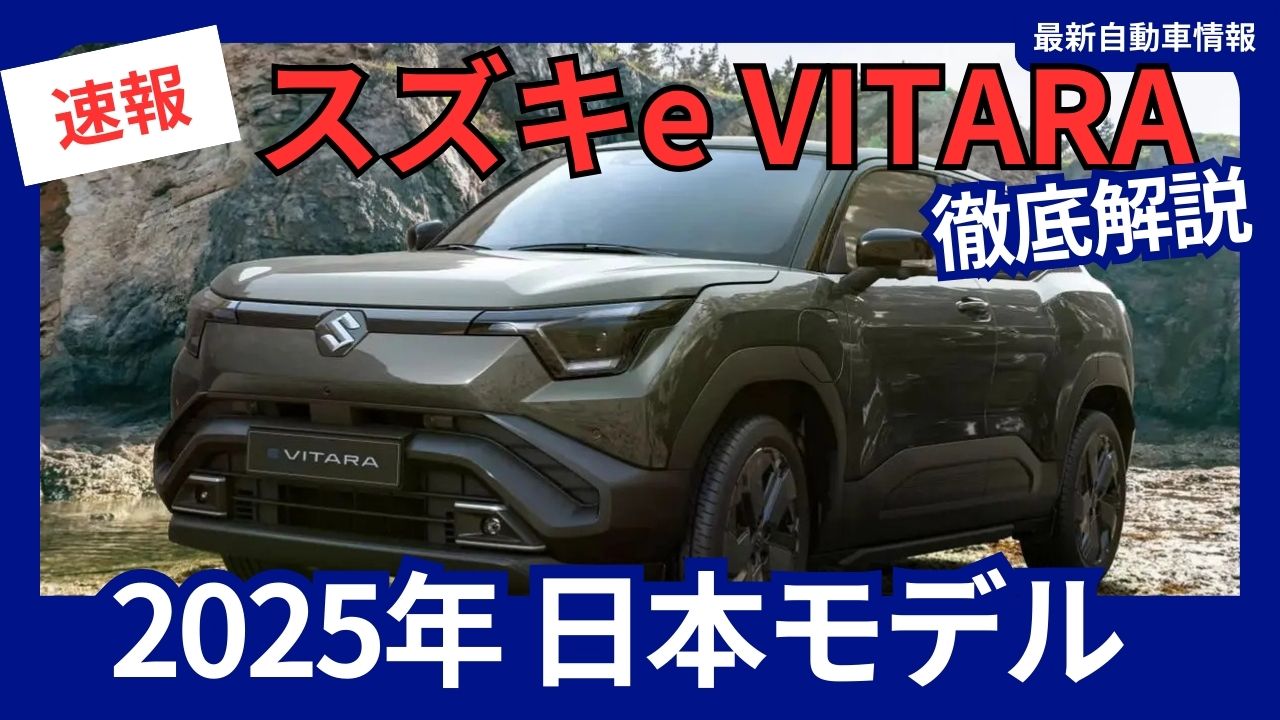
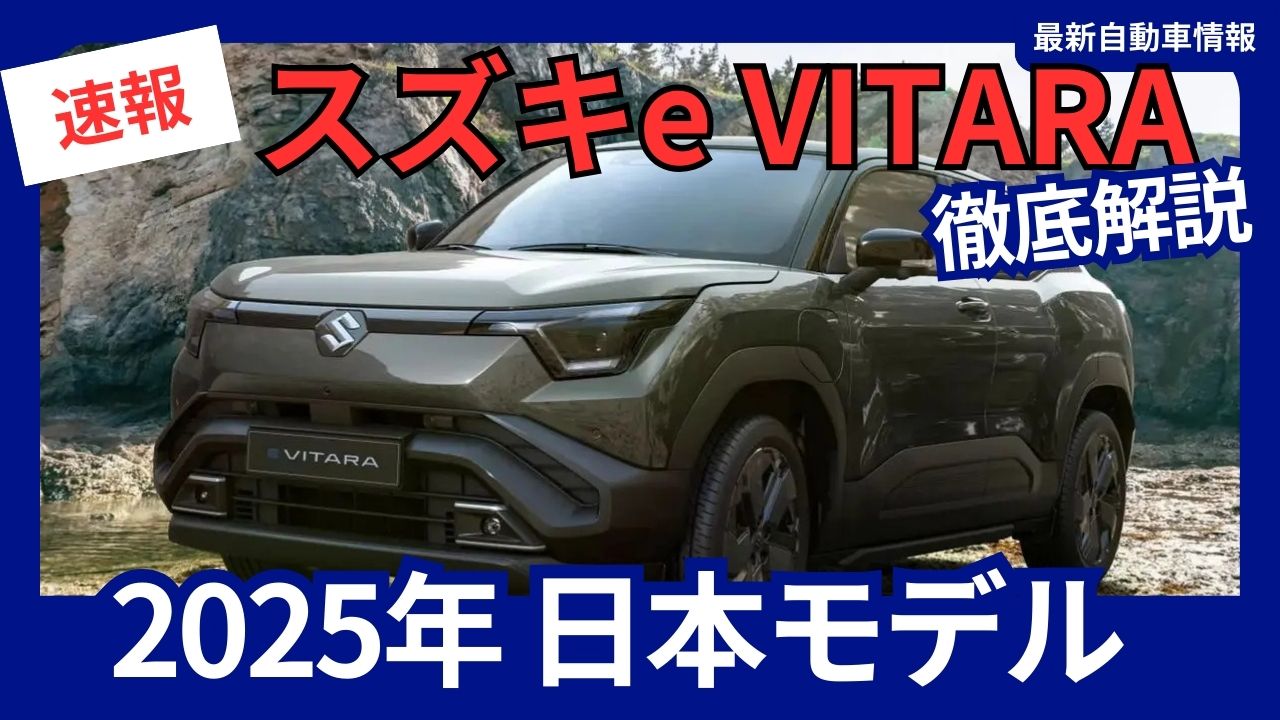
Suzuki will launch its first battery EV (electric vehicle) SUV, the eVITARA, in Japan in October 2025. It has been developed as an electric vehicle version of the Vitara series, which has previously been known in Japan as the Escudo.
Its compact yet condensed design and high-quality feel have been praised as making a “tremendous impact” in the Japanese EV market. This briefing will delve into the appeal of the e-Vitara from multiple angles, including its interior and exterior, driving performance, functionality, and its position in the market.
Main features of the eVitara
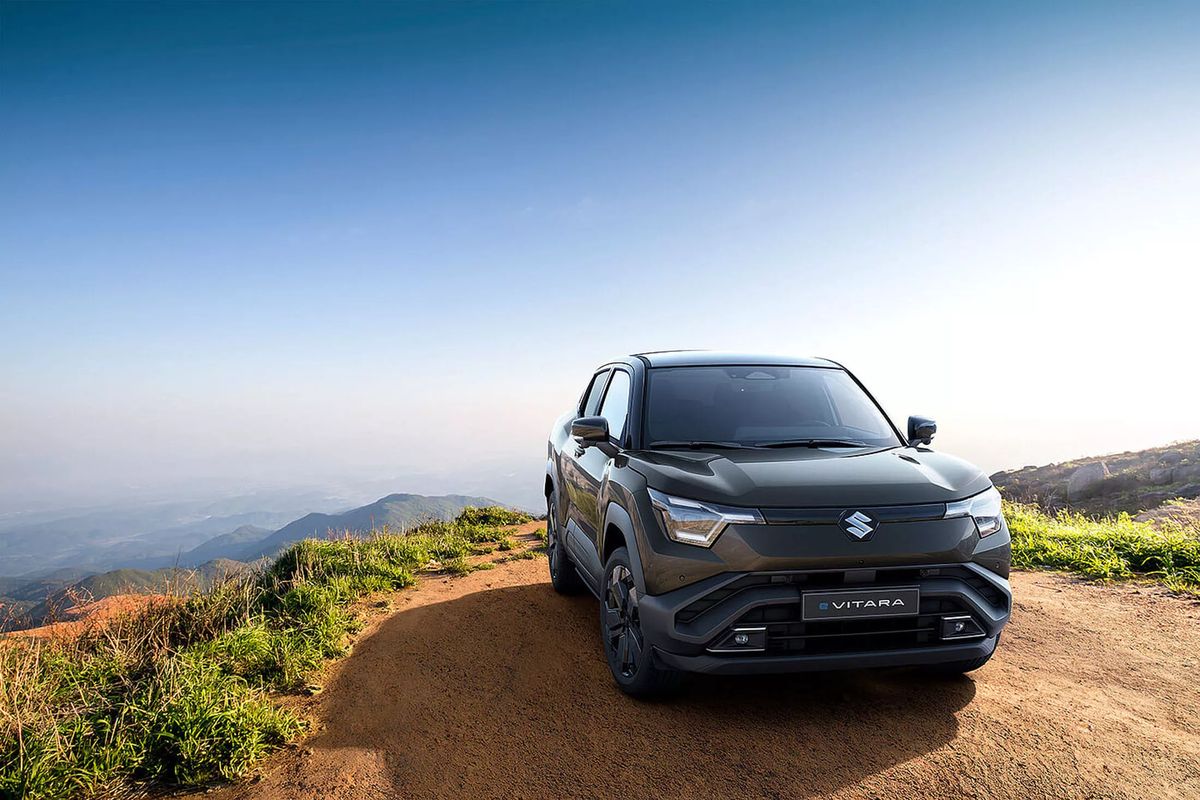
e VITARA
- Designed specifically for electric vehicles : Uses the newly developed “HEARTECT-e” platform
- Practical cruising range : Maximum cruising range of over 500km
- Full-scale 4WD performance : Equipped with the electric 4WD system “ALLGRIP-e”
- Advanced design : SUV style that combines power and sophistication
Release in Japan scheduled for October 2025! Latest information on the eVitara
In November 2024, Suzuki officially announced that it plans to introduce the e-Vitara in Japan in 2025. Production will begin in spring 2025 at the Suzuki Motor Gujarat Plant in India, and the car will be sold in Japan, Europe, India, and other countries.
Release Schedule
- Spring 2025 : Production begins at the Indian factory
- October 2025 : Launch in the Japanese market
- Global expansion : Sequential sales in Europe and India
Reference: Suzuki eVitara
eVitara exterior design: An exterior that combines strength and sophistication
Design concept: “Emotional Versatile Cruiser”
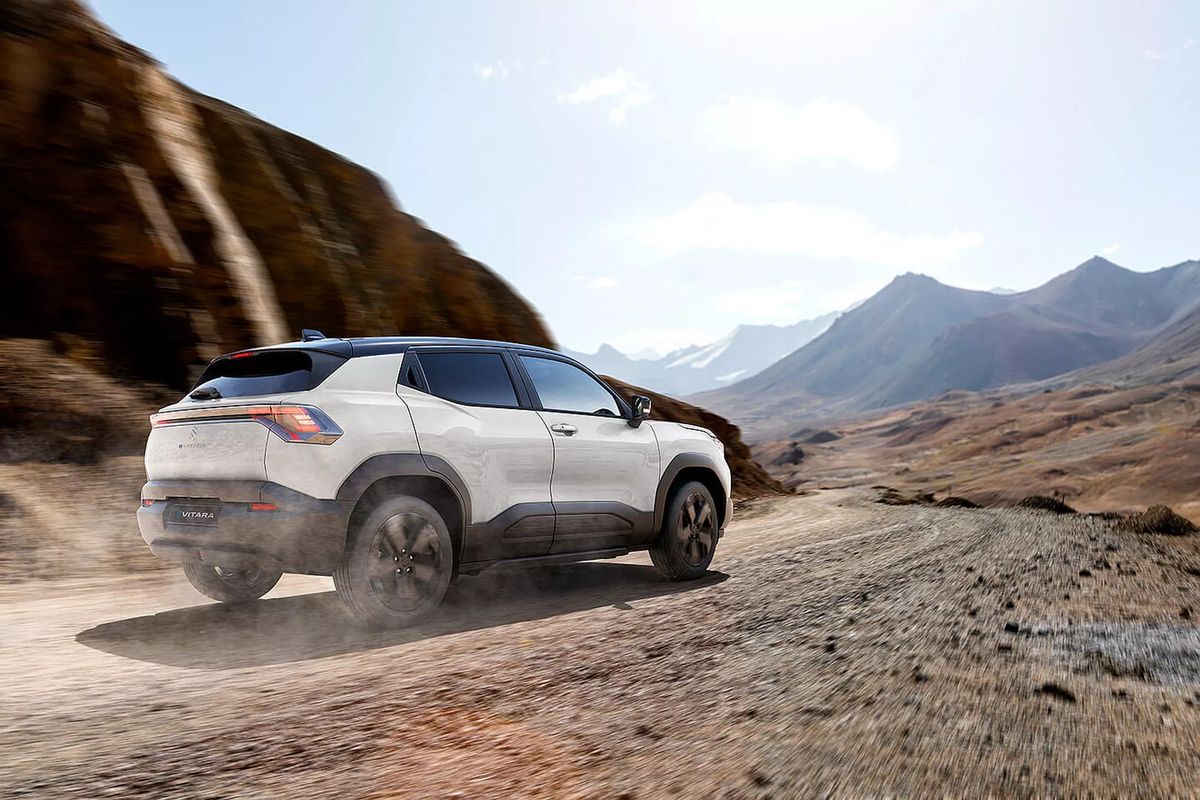
The exterior design of the e-Vitara is based on the concept of an “Emotional Versatile Cruiser,” and is characterized by a design that combines the sophistication and advanced features of an EV with the dynamism of an SUV.
Key design elements
- Front face : Latest LED headlights and wide intakes
- Side view : Volumetric fenders with durable cladding
- Rear design : Left and right linked taillights and roof spoiler
Body size
- Total length x width x height : 4,275 x 1,800 x 1,635mm
- Wheelbase : 2,700mm
- Minimum ground clearance : 180mm
- Minimum turning radius : 5.2m
The exterior of the eVitara is characterized by a “rugged and rugged” SUV style.
- Overall: “It has a compact yet condensed design” and “the texture looks amazing.”
- Front: The front has a powerful look, with a large Suzuki emblem in the center and a gloss black surround. The headlights feature daytime running lights with a three-line design that flashes in reverse when the turn signal is activated. The unpainted resin lower bumper emphasizes the SUV look.
- Side: The car boasts a compact body size of 4275mm in length, 1800mm in width, 1640mm in height, and a 2700mm wheelbase. It’s “slightly larger than the Yaris Cross and slightly shorter than the Vezel,” and its width makes it suitable for Japan’s road conditions and mechanical multi-story parking garages (though caution is advised as the overall height exceeds 1.6m). Ground clearance is 185mm, providing ample approach angles. The minimum turning radius is 5.2m for both 2WD and 4WD, making it highly maneuverable. 18-inch tires and aluminum wheels are standard, suggesting the car was designed with careful consideration of rival vehicles. The charging port on the passenger side supports quick charging, while the one on the driver’s side supports standard charging/200V charging. The rear door handles are hidden, adding to the car’s coupe-like appearance.
- Rear: Features include a powerful fender arch molding and shark fin antenna. The rear combination lamps have a garnish design that connects the left and right sides, but the actual light does not penetrate through them. The turn signals and backup lamps are full LED.
Interior of the eVitara: An interior packed with cutting-edge technology
Suzuki e VITARA interior
Digital Cockpit
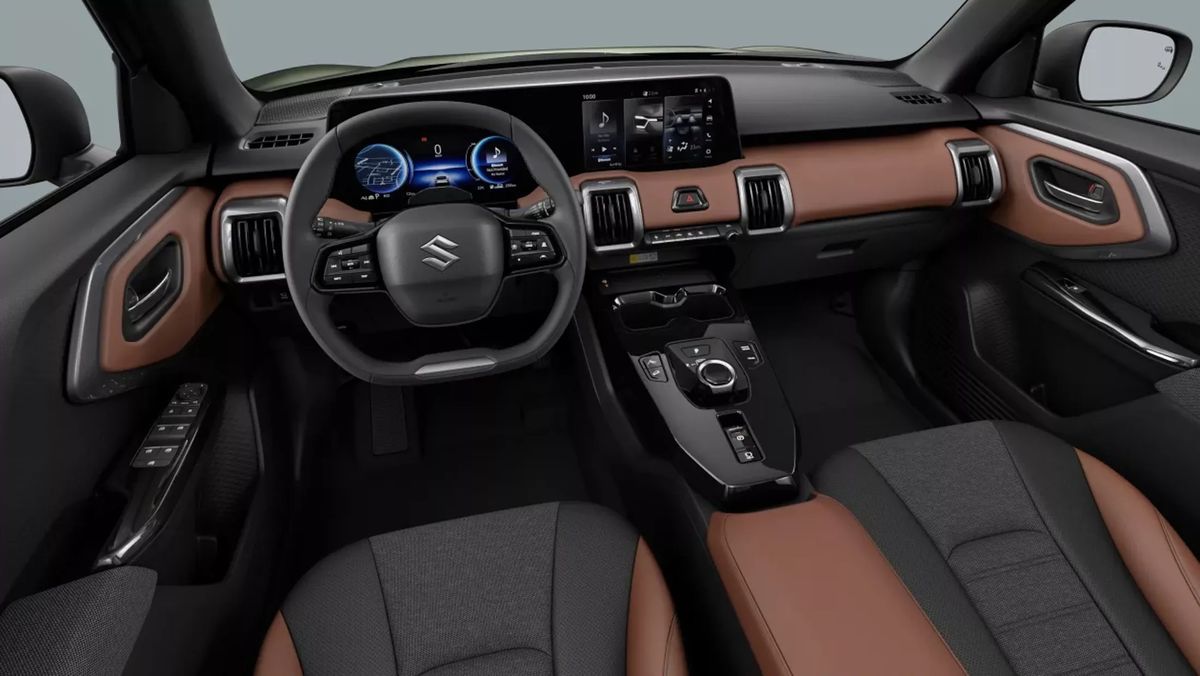
The interior of the eVitara is an advanced space that makes full use of the latest digital technology.
Main equipment
- 10.25-inch digital meter : Displays all the information you need to drive clearly
- 10.1-inch infotainment system : seamless operation with connected displays
- Connected functions : Diverse information display and communication functions
The interior is characterized by its high quality, with people saying, “Suzuki cars these days are incredibly stylish.”
- Color: It is combined with a tan color interior and there is one color variation.
- Texture: Soft padding has been used in the center of the door trim and in parts of the dashboard to enhance the texture. The inner door handles are plated and the armrests are covered in fabric, using soft materials.
- Display: A large center display and full LCD meter are connected in a continuous design. The center display can display three cards, and can display maps, media, fuel economy, drivetrain distribution, etc. Maps can also be displayed within the meter, expressing surprise that “Suzuki has begun to feature maps within the meter.” There are also multiple meter designs to choose from.
- Comfort features: The driver’s seat is equipped with a power seat (with lumbar support), heated seats, a heated steering wheel, and ambient lighting.
- Storage and Convenience: The floating center console has a two-tiered design, with storage space at the bottom. It’s equipped with USB Type-C and Type-A ports, an HDMI port, and a 12V accessory socket. The door pockets are also well-designed, making them convenient for storing tissues and other items.
- Advanced features: The door handles are smart entry compatible (key hole is exposed). All four windows open with one touch. It also appears to be equipped with a 360° camera, adaptive cruise control (all speeds), and lane keeping function. It is also equipped with a driver monitoring sensor that detects distracted driving. It also has an electric parking brake and auto-hold function.
- Rear seats: The rear seats are also tan-colored combination seats. They can slide and recline, ensuring ample luggage space. The floor is completely flat, making it easy to get in. Although there are no air conditioning vents at the rear end of the center console, it is equipped with USB Type-A and Type-C ports, as well as a 1500W external power outlet. It has been praised as “a good thing that an EV for the Japanese market has this kind of external power supply function.” The seats are foldable in a 4:2:4 split, and when the center section is folded down it can be used as an armrest with a drink holder.
- Luggage: There is no power tailgate option, it is manual. The luggage floor is high, but it can be made flat by folding down the rear seats, making it highly practical. A charging kit and other items can be stored under the luggage compartment. It has also been suggested that Infinity speakers may be installed. The luggage lamps are LED.
- Other: The interior lamp is LED. An SOS call switch is also installed, suggesting compatibility with connected services. There is also an optional panoramic roof (which may not be openable).
eVitara specs: Three powertrain configurations
The eVitara is available in three grades, each with different battery capacity and drive system.
49kWh battery FF specification
- Electric motor : 1
- Maximum output : 144ps (106kW)
- Maximum torque : 189Nm (19.3kgm)
- Range : Over 400km
- Vehicle weight : 1,702 kg
61kWh battery FF specification
- Electric motor : 1
- Maximum output : 174ps (128kW)
- Maximum torque : 189Nm (19.3kgm)
- Range : Over 500km
- Vehicle weight : 1,760-1,799 kg
61kWh battery 4WD specification
- Electric motors : one front and one rear (two in total)
- Front motor output : 174ps (128kW)
- Rear motor output : 65ps (48kW)
- Total maximum system torque : 300Nm (30.6kgm)
- Range : Over 450km
- Vehicle weight : 1,860-1,899 kg
- Quietness: Very quiet.
- Acceleration: The car delivers 100% torque the moment you step on the accelerator, accelerating without lag. This is sufficient acceleration performance for a compact SUV.
- 2WD 61kWh model: 0-100km/h in 8.7 seconds.
- 4WD 61kWh model: Acceleration from 0 to 100km/h in 7.4 seconds (more than a second faster than 2WD).
- 2WD 49kWh model: 0-100km/h in 9.6 seconds.
- Handling and body rigidity: High praise was given for its “super quick” and “incredible body rigidity.” The battery is located under the floor, which is said to have made the body extremely rigid. It is analyzed that the extensive use of high-tensile steel plates and consideration of safety in the event of a collision are the factors that contribute to the car’s high driving performance. The car stands out for its “steering stability,” “quietness,” and “absence of unpleasant vibrations.” The steering feel is “heavy,” but not “too heavy,” giving a favorable impression. There is little play, making for brisk handling.
- One-pedal mode: The car is equipped with a one-pedal mode that allows you to adjust acceleration and deceleration by simply pressing the accelerator on and off. Acceleration and deceleration are relatively gentle and not abrupt, so you can “step on the pedal with confidence.” However, to decelerate with one pedal until you’re almost at a stop, you need to set the “regenerative boost” in the vehicle settings to “strong,” and the default setting of “medium” may not be sufficient.
- 2WD vs 4WD: The 4WD model has a “powerful feel” from the start and has a maximum torque of 307Nm, which is greater than the 2WD.
- The 4WD model has a “more cornering” feel, and the rear motor pushes forward, reducing the load on the front and improving cornering force. When accelerating, there is a strong “feeling of going inwards.”
- 2WD is plenty enjoyable for everyday use, but if you’re looking for a faster, more cornering driving experience, 4WD is the better choice.
HEARTECT-e Platform: An innovation designed specifically for electric vehicles
Dedicated platform for electric vehicles
The e-Vitara uses Suzuki’s newly developed electric vehicle platform, HEARTECT-e .
Features of HEARTECT-e
- Lightweight construction : improved fuel efficiency
- High voltage protection : ensuring safety
- Short overhangs : Realizing spacious interior space
- Large-capacity battery placement : Eliminating under-floor members maximizes battery capacity
Lithium iron phosphate battery
The battery uses a lithium-ion iron phosphate battery that prioritizes safety and reliability, reducing the risk of thermal runaway and ensuring a long lifespan.
ALLGRIP-e: Suzuki’s unique electric 4WD system
Electric 4WD system features
The 4WD version of the e-Vitara is equipped with Suzuki’s newly developed electric 4WD system, **ALLGRIP-e**.
ALLGRIP-e Technology
- Independent front and rear control : Uses two independent eAxles at the front and rear
- LSD function : Brakes the spinning tire and distributes driving force to the opposite side
- Trail mode : A dedicated mode that improves driving performance on rough terrain.
- Precise control : Instant response and optimal drive distribution
eVitara price: Expected price from 4 million yen
Expected price range
The price of the Suzuki e-Vitara is expected to start from around 4 million yen , thanks to the use of the latest electric technology .
Price comparison (reference)
- Fronx (internal combustion engine SUV): from 2.54 million yen
- eVitara (electric SUV): from 4 million yen (estimated)
The price difference is expected to be around 1.5 million yen, reflecting the advanced technology and extensive equipment of the electric vehicle.

eVitara safety equipment: latest active safety technology
Extensive safety equipment
The eVitara comes standard with Suzuki’s latest active safety technology.
Key Safety Features
- Blind Spot Monitor : Detects vehicles approaching from behind in adjacent lanes
- Rear Cross Traffic Alert : Detects approaching vehicles from the left and right rear
- Adaptive cruise control : with full-speed tracking function
- Collision mitigation braking : pedestrian and vehicle detection function
- Lane Departure Warning : Lane detection function
Also supplied as an OEM for the Toyota Urban Cruiser
OEM supply to Toyota
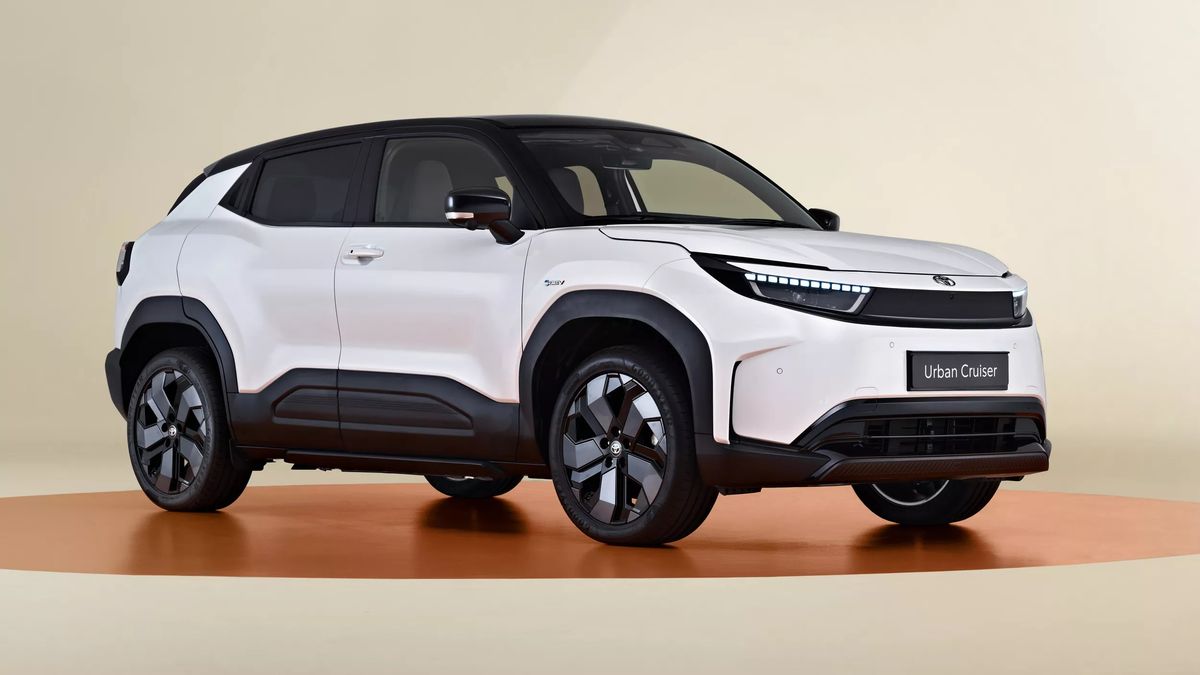
Toyota Urban Cruiser
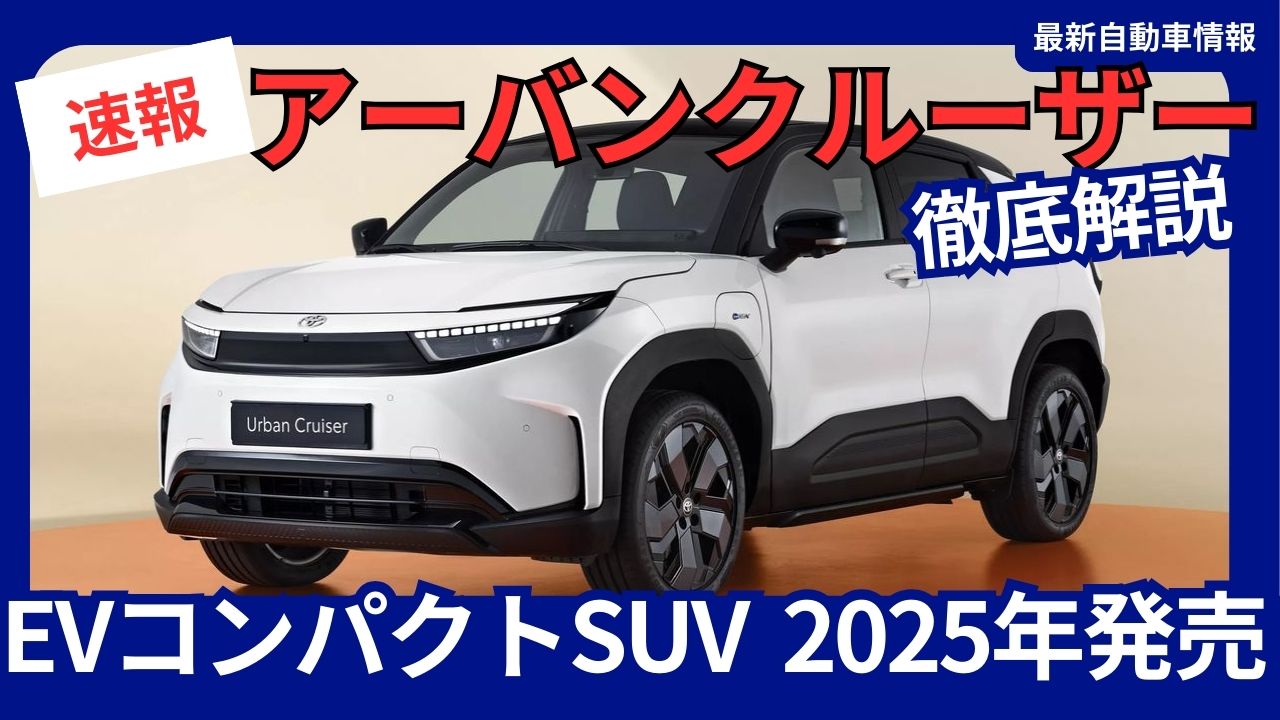
Suzuki has also announced that it will supply the e-Vitara as an OEM for the Toyota Urban Cruiser , as part of its strategy to promote the spread of electric vehicles through both brands.
The significance of OEM supply
- Technology sharing : efficient use of electric vehicle technology
- Market expansion : Utilizing the sales networks of both brands
- Cost reduction : Streamlining development and production costs
summary
The Suzuki e-Vitara is the company’s first fully electric SUV, and is attracting attention ahead of its planned release in Japan in October 2025. The vehicle brings together the best of Suzuki’s electrification technologies, including the HEARTECT-e platform for electric vehicles, the company’s unique electric 4WD system ALLGRIP-e, and a maximum driving range of over 500km.
The eVitara is expected to occupy a unique position in the Japanese EV market.
- Size: Just the right size for Japanese road conditions.
- Range: Models equipped with a 61kWh battery are expected to have a practical range of over 400km, which is considered to be “no shortage.”
- Competition: In the current domestic EV market, there are limited options, such as the Toyota bZ4X/Subaru Solterra (large and expensive), the Nissan Ariya (expensive, in the 10 million yen range), and the Honda e (range concerns). The e-Vitara is expected to be an EV that fills that gap, and some say that “the perfect domestic EV has finally arrived.”
- Price: The price has not been announced at this time, but it has been strongly suggested that its competitiveness will depend on pricing, with the statement that “depending on the price, it will become a very noteworthy Japanese-made EV.”
With a price starting from the 4 million yen range, the car is positioned as a new option in the electric vehicle market, and together with its OEM supply to Toyota, it is expected to make a significant contribution to the spread of electric vehicles in Japan.