
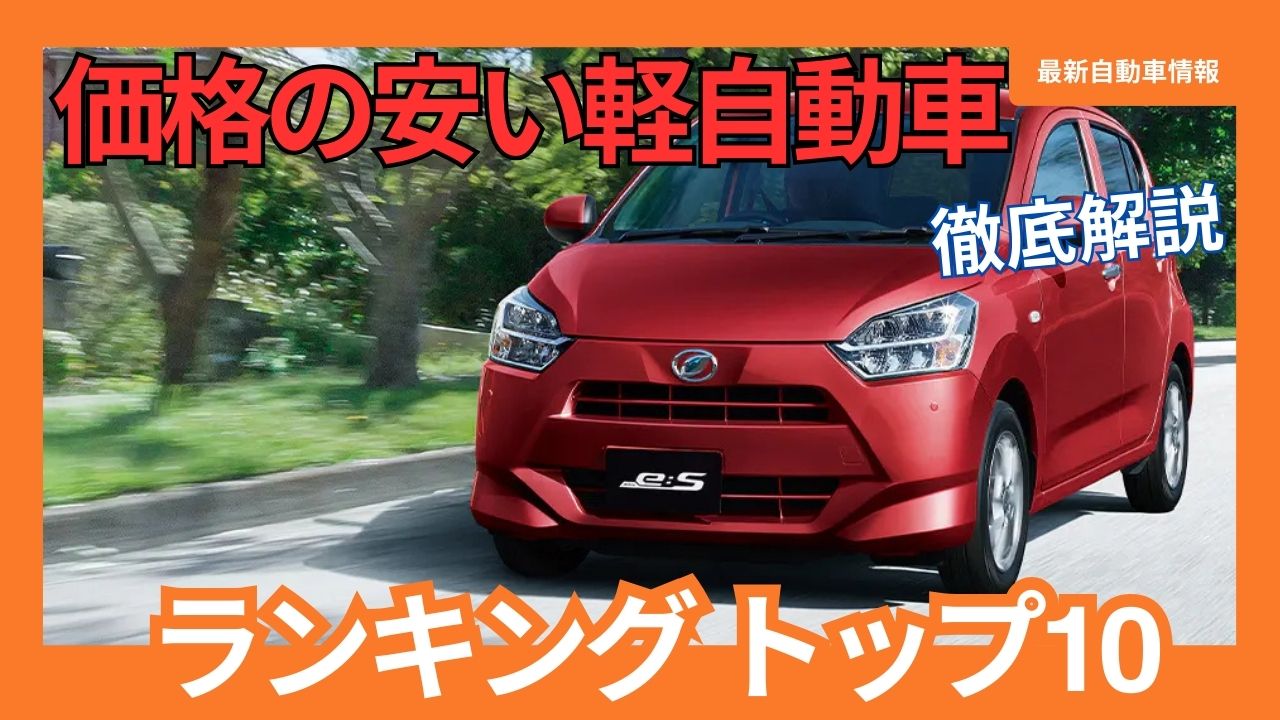
This time, we’ll be presenting a ranking of the cheapest minicars as of 2025 ( Reiwa 7 ). We’ll be presenting models currently available for sale. Compared to standard cars, minicars have lower vehicle prices and taxes, so we hope this ranking will be helpful for first-time car buyers, second-car buyers, and those who absolutely need a new car rather than a used one.
Kei cars are very popular in Japan due to their low maintenance costs and maneuverability. In recent years, the rise in gasoline prices and rising consumer prices have led to increased interest in economical kei cars.
However, even when it comes to minicars, prices, fuel economy, features, and designs vary depending on the model. So, this time, we’re announcing the top 10 rankings for the cheapest minicars in 2025! We’ll thoroughly compare key points to consider when choosing a car, such as maintenance costs, fuel economy, and safety, and explain the features of each model in an easy-to-understand manner.
If you are considering purchasing a minicar, please use this as a reference.
Key points of the article
- Introducing the top 10 cheapest minicars for 2025
- Compare not only vehicle prices but also fuel economy, safety performance, and features
- We also explain the key points to consider when choosing a minicar, maintenance costs, and safety.
The appeal of minicars
The vehicle price is low. (Depending on the model, the vehicle price is less than 1 million yen.)
High resale value. (Light cars are in high demand and tend to have high resale values.)
Low maintenance costs. (Many fuel-efficient models and the lowest automobile tax)
Easy to drive. (Light vehicle standards are 3.4m or less in length, 1.48m or less in width, 2m or less in height, 660cc or less in engine displacement, and a seating capacity of four or less. Therefore, they are smaller and more maneuverable than standard cars, making them easier to drive on narrow roads and for those unfamiliar with driving.)
The benefits of choosing a low-cost minicar
Kei cars have the following advantages over regular cars:
- Low vehicle price: Kei cars are priced lower than regular cars, so initial costs can be kept low.
- Low maintenance costs: Maintenance costs, including taxes (automobile tax, weight tax), insurance premiums, and fuel economy, are lower than for regular cars.
- Maneuverability: The vehicle is small and maneuverable, making it easy to drive on narrow roads and in parking lots.
- Good fuel economy: Light cars tend to have better fuel economy than regular cars, allowing you to save on fuel costs.
Key points for choosing a minicar
When choosing a minicar, keep the following points in mind:
- Use: Think about how you will use your car, such as for everyday use, commuting, or leisure.
- Number of passengers: Consider how many people will be travelling with you on a regular basis and whether you will be using the back seat frequently.
- Mileage: Consider how much you drive each day and whether you drive long distances.
- Design: Choose a car with a design that suits your taste.
- Fuel economy: Fuel economy is also an important point. Be sure to check the actual fuel economy as well as the catalog fuel economy.
- Safety: Make sure the car is well equipped with safety equipment.
- Price: Consider the total cost, including not only the price of the vehicle but also maintenance costs.
- Equipment: Make sure you have all the necessary equipment.
Top 10 cheapest minicars released in 2025
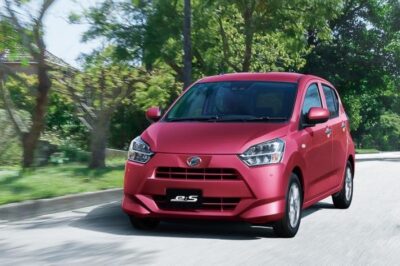
After researching light vehicles on sale as of March 2025, the cheapest models were the Daihatsu Mira e:S and Toyota Pixis Epoch, both priced at 992,200 yen.
Each car manufacturer has adopted its own unique technology, and the interior space is comparable to that of a regular car. Furthermore, fuel efficiency has also improved due to weight reduction and improved engine performance. Considering long-term maintenance, the cost performance is excellent, and there is no doubt that they are very attractive.
Top 10 Lowest Price Kei Cars in 2025
| Ranking | Manufacturer | Car name | grade | Price (10%) |
WLTC mode fuel economy |
Features |
|---|---|---|---|---|---|---|
| 1st place | Daihatsu | Mira e:s | B (2WD) |
992,200 yen | 25.0km/L | No.1 in fuel efficiency! Simple design makes it easy to drive. |
| 1st place | Toyota | Pixis Epoch | B (2WD) |
992,200 yen | 25.0km/L | Mira e:S OEM car. Reliable Toyota brand . |
| 3rd place | Subaru | Pleo Plus | F (2WD) |
1,036,200 yen | 25.0km/L | Mira e:S OEM vehicle. Equipped with EyeSight , a highly safe system. |
| 4th place | Suzuki | Alto | A (2WD) |
1,064,800 yen | 27.7km/L | The best fuel economy among mini sedans! Spacious interior and ample storage space |
| 5th place | Mazda | Carol | GL (2WD) |
1,144,000 yen | 27.7km/L | An OEM Alto car with a stylish design |
| 6th place | Suzuki | Wagon R | FX (2WD) |
1,296,900 yen | 25.2km/L | A popular high-roof wagon with a spacious interior and ease of use |
| 7th place | Suzuki | Lapin | G (2WD) |
1,328,800 yen | 26.2km/L | The cute , rounded design is popular among women. |
| 8th place | Honda | N-WGN | G (2WD) |
1,344,200 yen | 23.2km/L | Simple and sophisticated design. Comfortable ride. |
| 9th place | Mitsubishi | ek wagon | M (2WD) |
1,422,300 yen | 23.2km/L | Spacious interior space, ease of use, and excellent fuel economy. |
| 10th place | Suzuki | Wagon R Smile |
G (2WD) |
1,489,400 yen | 25.1km/L | With a sliding door, it’s extremely easy to use! Unique design |
Top 10 Low-Price Kei Cars in 2024 Latest Automotive Information
The top three cars are all very economical, costing around 1 million yen even when purchased new . The Daihatsu Mira e:S grade B “SA III” is priced at 992,200 yen, which is under 1 million yen, and is packed with safety features, so we recommend considering safety as well as price.
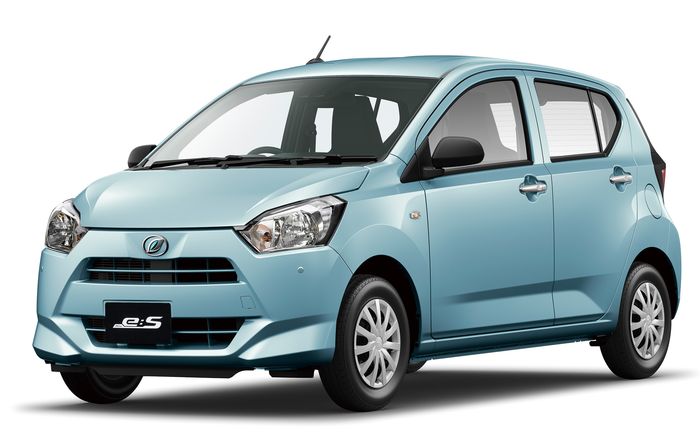
Miraes
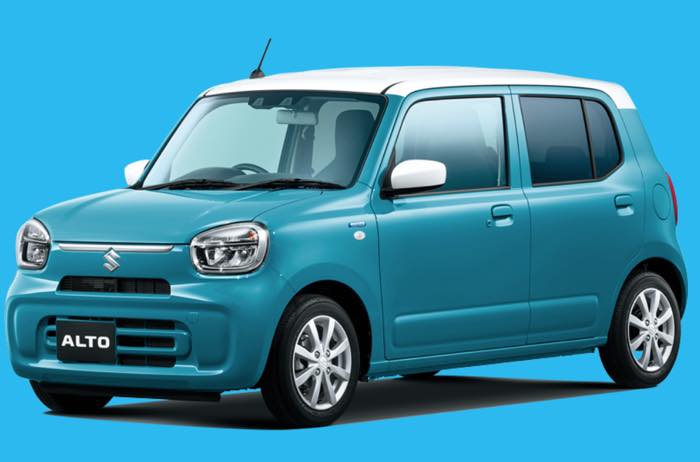
Alto
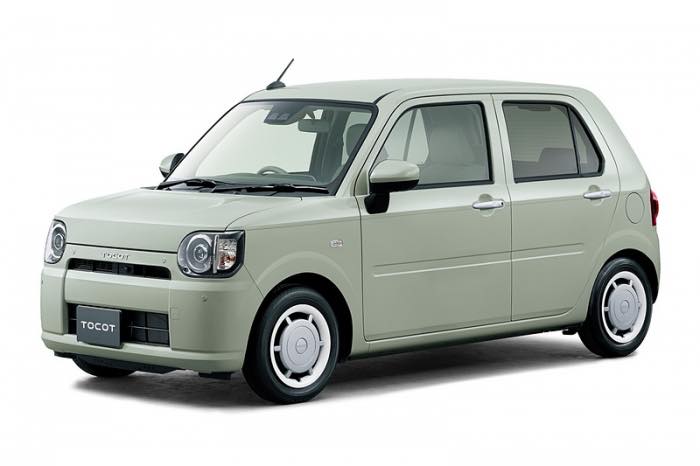
Mira Tocot
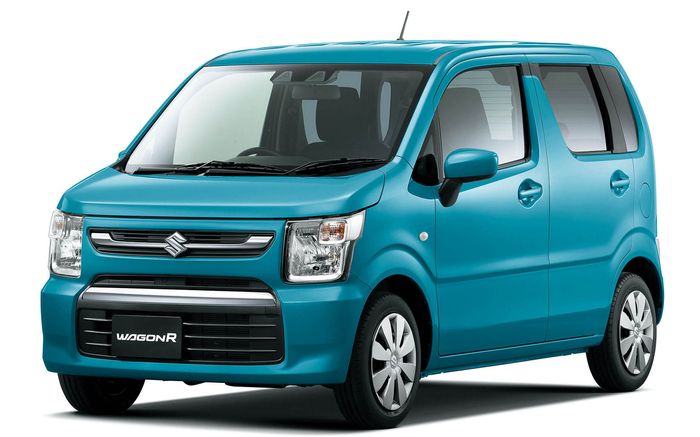
Wagon R
Top 10 Lowest Price Kei Cars of 2023
There will be a price revision in 2024, and many models will be cheaper until 2023.
| Ranking | Manufacturer | Car name | grade | Price (10%) |
|---|---|---|---|---|
| 1st place | Daihatsu | Mira e:s | B (2WD) |
860,200 yen |
| 1st place | Toyota | Pixis Epoch | B (2WD) |
860,200 yen |
| 2nd place | Subaru | Pleo Plus | F (2WD) |
970,200 yen |
| 3rd place | Suzuki | Alto | A (2WD) |
1,064,800 yen |
| 4th place | Mazda | Carol | GL (2WD) |
1,144,000 yen |
| 6th place | Suzuki | Wagon R | FX (2WD) |
1,296,900 yen |
| 7th place | Honda | N-WGN | G (2WD) |
1,317,800 yen |
| 8th place | Suzuki | Lapin | G (2WD) |
1,328,800 yen |
| 9th place | Suzuki | Hustler | HYBRID G (2WD) |
1,387,100 yen |
| 10th place | Mitsubishi | ek wagon | M (2WD) |
1,389,300 yen |
Top 10 Low-Price Kei Cars in 2023 Latest Automotive Information
automobile tax
The consumption tax increase took effect on October 1, 2019, and in conjunction with this , tax reforms were made in October 2019 , resulting in different amounts being taxed depending on when a car was purchased.
Motor vehicle tax rate table for newly registered private passenger cars
| Engine displacement | tax rate |
|---|---|
| 660cc | 10,800 yen |
| 1,000cc or less | 25,000 yen |
| More than 1,000cc but less than 1,500cc | 30,500 yen |
| More than 1,500cc but less than 2,000cc | 36,000 yen |
| More than 2,000cc but less than 2,500cc | 43,500 yen |
| More than 2,500cc but less than 3,000cc | 50,000 yen |
| More than 3,000cc but less than 3,500cc | 57,000 yen |
| More than 3,500cc but less than 4,000cc | 65,500 yen |
| More than 4,000cc but less than 4,500cc | 75,500 yen |
| More than 4,500cc but less than 6,000cc | 87,000 yen |
| Over 6,000cc | 110,000 yen |

About Mira e:S
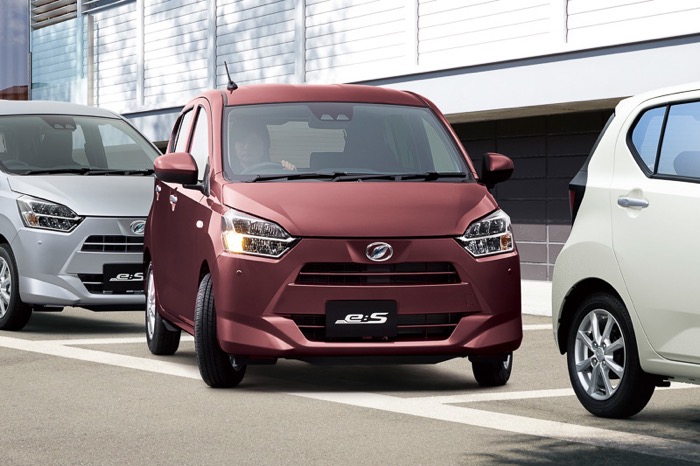
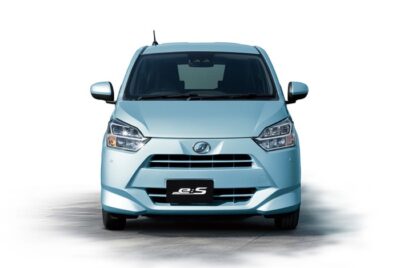
Daihatsu released a fully redesigned version of the Mira e:S on May 9, 2017. It features a D monocoque (lightweight, highly rigid body). The new Tanto/Tanto Custom underwent a minor change and was released on November 30, 2016. The Mira e:S will also be equipped with Smart Assist III, which was first installed on the Tanto. It uses the world’s smallest stereo camera, with a left-right camera spacing of 80mm. It also supports pedestrians and has an expanded operating speed range compared to previous models. It is equipped with two corner sensors on the front and rear of the vehicle.
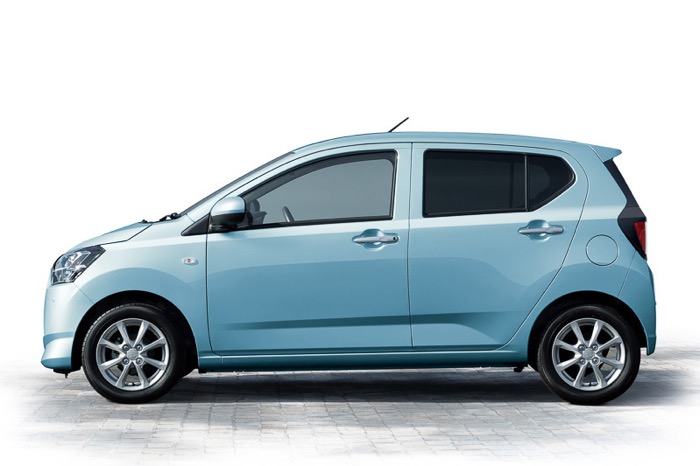
The minimum turning radius is 4.4m, the same as the previous model.
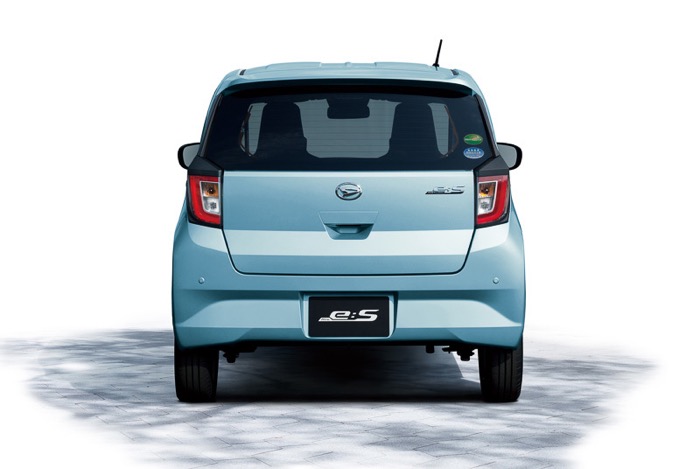
The weight has been further reduced by approximately 80 kg (from 730 kg in the previous model to a maximum of 650 kg). Exterior parts such as the front fenders, back doors, and C-pillar garnish are made of plastic to reduce weight, and the transmission and engine have been improved. JC08 mode fuel economy is 35.2 km/L, which is the same as the previous model, but actual fuel economy has been improved.
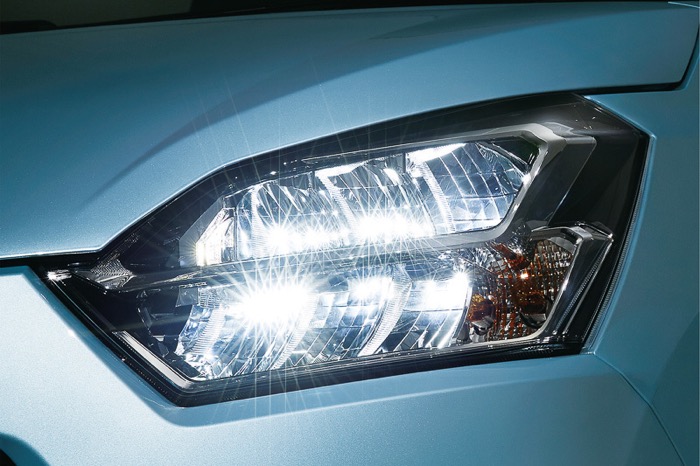
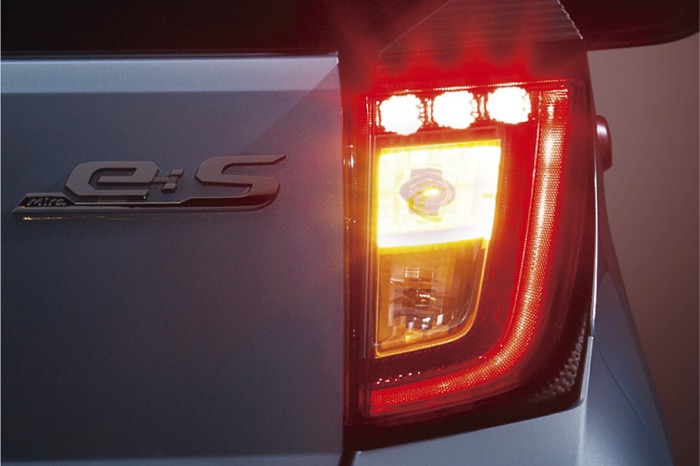
LED headlamps and LED taillamps are standard on the G “SAIII” and X “SAIII” models. Eco power generation control, pre-stop eco idling stop, scroll-type air conditioning compressor
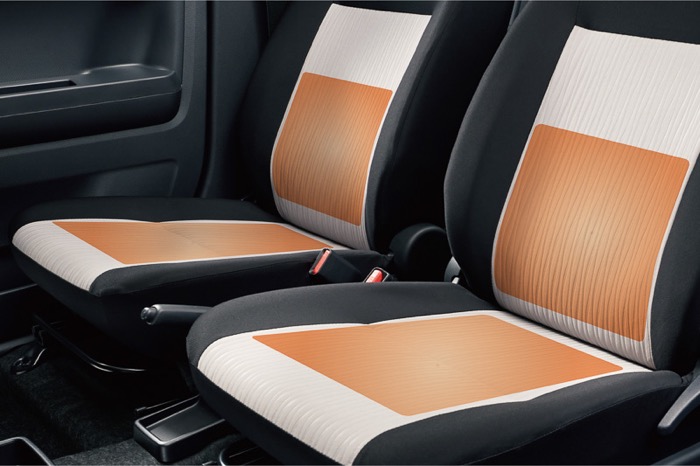
“Seat heater (driver’s seat/passenger seat)” is an exclusive feature for the G “SAIII”
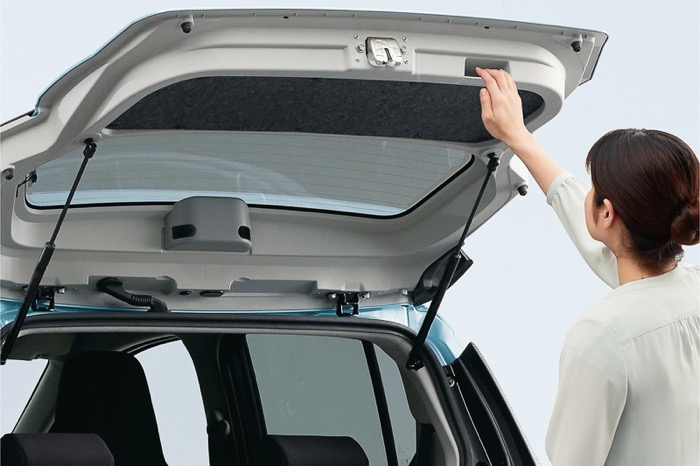
The first minicar to feature a switch-type tailgate opener on its tailgate.
Equipped with advanced technology “Smart Assist III”
Smart Assist II had a single camera, but Smart Assist III is equipped with two cameras.
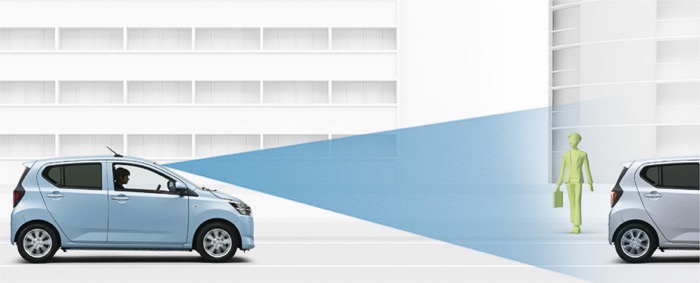
The further evolved Smart Assist III helps you avoid accidents in close calls while driving, supporting your safe driving. In addition to sonar sensors, the car is newly equipped with the world’s smallest stereo camera, which does not obstruct the driver’s field of vision or headroom. It accurately captures a variety of information, including pedestrians, preceding vehicles, and obstacles, and warns the driver or activates the emergency brakes.
Collision warning function/collision avoidance assist brake function (against vehicles and pedestrians)
Collision warning (vehicle, pedestrian) The camera detects vehicles or pedestrians in front of you while driving, and if it determines that there is a risk of collision, it will alert you with a buzzer and a display on the meter.
Primary braking (for vehicles and pedestrians) If the system determines that there is a risk of collision, it automatically applies light brakes (primary braking) to urge the driver to avoid the collision.
Damage Reduction Brake Assist (for vehicles and pedestrians) If the driver applies the brakes while the primary braking function is operating, the brake assist is activated to increase braking force.
Emergency braking (to vehicles, to pedestrians): If the system determines that a collision is unavoidable, it applies strong brakes (secondary brakes) to slow down the vehicle and avoid a collision or mitigate damage.
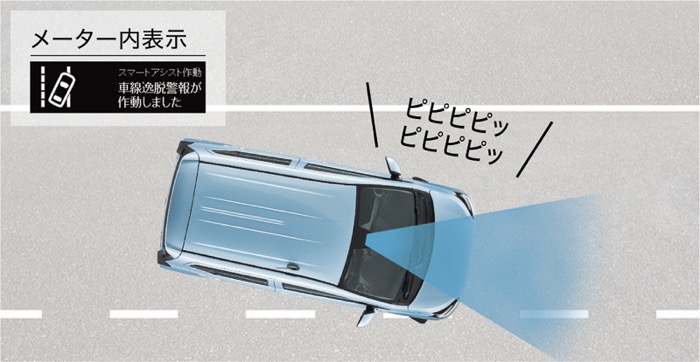
Lane Departure Warning Function: If the vehicle is about to depart from its lane without using a turn signal while driving, the system will warn the driver with a buzzer and a display in the meter, prompting them to take action. Leading Vehicle Departure Notification Function: If the driver does not notice that the vehicle ahead has started moving while stopped and does not move forward, the system will notify the driver with a buzzer and a display in the meter.
Forward false start suppression control function If the stereo camera detects an obstacle such as a vehicle or wall within 4m ahead and the driver depresses the accelerator pedal with the shift position in “forward”, the engine output is limited to prevent sudden acceleration.
Rearward false start prevention control function If the sonar sensor built into the rear bumper detects an obstacle such as a wall within 2 to 3 meters behind the vehicle and the accelerator pedal is pressed with the shift position in “reverse,” the system will limit engine output to prevent sudden acceleration.
High Beam Assist: The stereo camera detects the brightness of oncoming vehicle headlights and automatically switches between high and low beams. This allows you to drive with high beams without having to switch between them, making nighttime driving safer even on roads with few streetlights.
Mira e:S New e:S Technology
On January 29, 2016, Toyota announced that it had made Daihatsu a wholly owned subsidiary. During a discussion between the presidents of both companies, it was also mentioned that Daihatsu would name its platform DNGA (Daihatsu New Global Architecture), a play on the newly developed platform called TNGA (Toyota New Global Architecture) that was adopted in Toyota’s new Prius. Just like Toyota’s Prius, the Mirai-S is a vehicle that forms the basic structure of Daihatsu’s minicars, and it uses this D-monocoque (a lightweight, highly rigid body) to become the origin of DNGA (Daihatsu New Global Architecture).
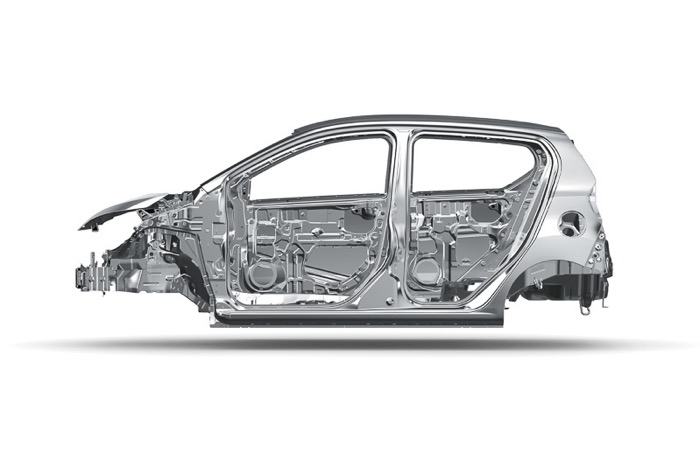
Adopts D Monocoque (lightweight, high-rigidity body) “D Monocoque” (lightweight, high-rigidity body) is a body structure unique to Daihatsu that uses high-tensile strength thick plates on all side outer panels, eliminating structural break points and allowing the entire body to absorb forces.

Daihatsu’s unique resin parts The use of resin parts such as the front fenders and back door contributes to weight reduction. In addition, by using resin
for the back door, it is possible to mold the roof spoiler as a single unit, improving aerodynamic performance without the need for additional parts.
High aerodynamic performance: The bonnet hood hinge cover is fin-shaped, and the door mirrors have a highly streamlined shape. Tire deflectors are installed on all four wheels, and flat blade wipers are used. This aerodynamic design reduces air resistance by 3% compared to the first-generation model. The Cd value is now below 0.30. Reduced rolling resistance
The throttle opening and shift diagram for unit accelerator operation have been revised and shift control during kickdown has been optimized. Furthermore, a new generation ECU with improved performance has been adopted, and the CVT control function has been integrated into the EFI-ECU (engine control computer). By optimizing the cooperative control of the engine and CVT with high precision, linear acceleration has been achieved in response to accelerator operation. Driving quality has been improved by providing a stress-free feeling of acceleration when starting off or overtaking. Acceleration from 40km/h to 80km/h is completed 0.6 seconds faster when accelerating from a stop light with the accelerator half-open after 5 seconds, simulating merging onto a main lane such as a highway where a gap of 3m, nearly the length of one vehicle, can be achieved.
Rolling resistance reduction: Thorough weight reduction of all suspension parts. The lightest 13-inch aluminum wheels in Japan and newly developed lightweight 13-inch tires have been introduced. The entire suspension has been reduced in weight by approximately 15 kg, contributing to improved fuel economy and driving performance.
Mira e:S specs
| Specifications | Mira e:s |
|---|---|
| full length | 3,395mm |
| Overall width | 1,475mm |
| Overall height | 1,500mm |
| Wheelbase | 2,455mm |
| engine | Straight 3 DOHC 660cc |
| Maximum power | 49ps/6,800rpm |
| Maximum torque | 5.8kgm/5,200rpm |
| Drive system | 2WD/4WD |
| JC08 mode fuel economy | 35.2km/L (2WD) 32.3km/L (4WD) |
| WLTC mode fuel economy | 25.0km/L (2WD) 23.2km/L (4WD) |
| Vehicle weight | 650kg |
About Alto
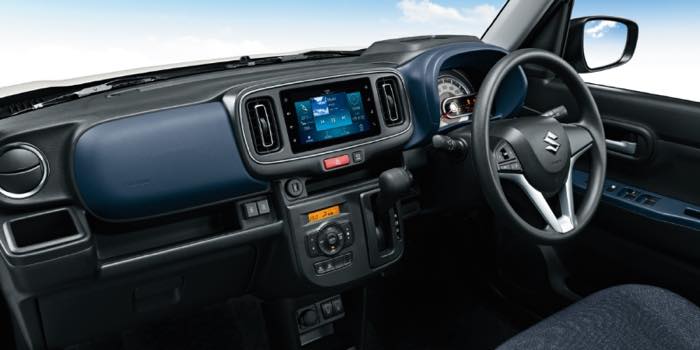
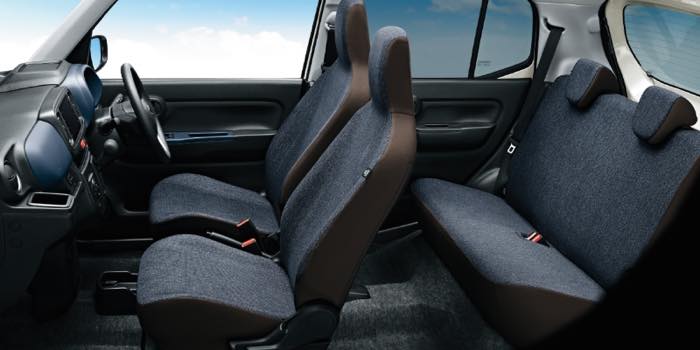
Suzuki will fully redesign the new Alto, announcing the announcement on December 10, 2021, and releasing the model on December 22, 2021. The rival Mira e:S underwent a full redesign on May 9, 2017, and sales have grown significantly. To compete with the Mira e:S, Suzuki is also redesigning the ninth generation model. This time, the Mira e:S also features upgraded advanced safety technology, including Smart Assist III. The eighth-generation Alto also received an upgraded radar brake support, and the Alto underwent a minor change (partial improvement) on December 13, 2018, and is now equipped with Dual Sensor Brake Support. The ninth generation model will also feature Dual Camera Brake Support . Six airbags are standard on all models. A 360° camera package for omnidirectional monitoring (a manufacturer option for vehicles equipped with the safety package and 360° camera package) is included. A head-up display is also included. The Alto, which sells low-cost models, is equipped with a combination of the R06A engine and Ene-Charge, but a new addition to the lineup will be the “S-ene-Charge Model,” a mild hybrid model that combines the R06D engine and motor . The exterior will continue to adopt the same angular design as the previous model, and changes will be made to the body color, such as adopting a ” white 2-ton roof.”
About Alto specs
| Specifications | New Alto | New Alto mild hybrid |
|---|---|---|
| full length | 3,395mm | |
| Overall width | 1,475mm | |
| Overall height | 1,525mm | |
| Wheelbase | 2,460mm | |
| engine | Straight 3 660cc | Inline 3 660cc + motor |
| Maximum power | 36kW (49ps) / 6,500rpm |
36kW (49ps) / 6,500rpm |
| Maximum torque | 58Nm (5.9kgm) / 5,000rpm |
58Nm (5.9kgm) / 5,000rpm |
| Motor maximum output | – | 1.9kW (2.6ps) / 1,500rpm |
| Motor Max Torque | – | 40Nm (4.1kgm) / 100rpm |
| mission | CVT | CVT |
| JC08 mode fuel economy | 29.4km/L (2WD) 28.7km/L (4WD) |
33.1km/L (2WD) 30.2km/L (4WD) |
| WLTC mode fuel economy | 25.2km/L (2WD) 23.5km/L (4WD) |
27.7km/L (2WD) 25.7km/L (4WD) |
lastly
Kei cars are compact and easy to drive, have the lowest automobile tax, many fuel-efficient models, and low maintenance costs. And yet, the vehicle price is low, often between 1 million and 1.5 million yen. While there are many good points, the downside is that in the event of an accident, the body of the car is light and there is a possibility of damage. When choosing a cheap vehicle, it is best to consider the safety features and airbags that are included.