
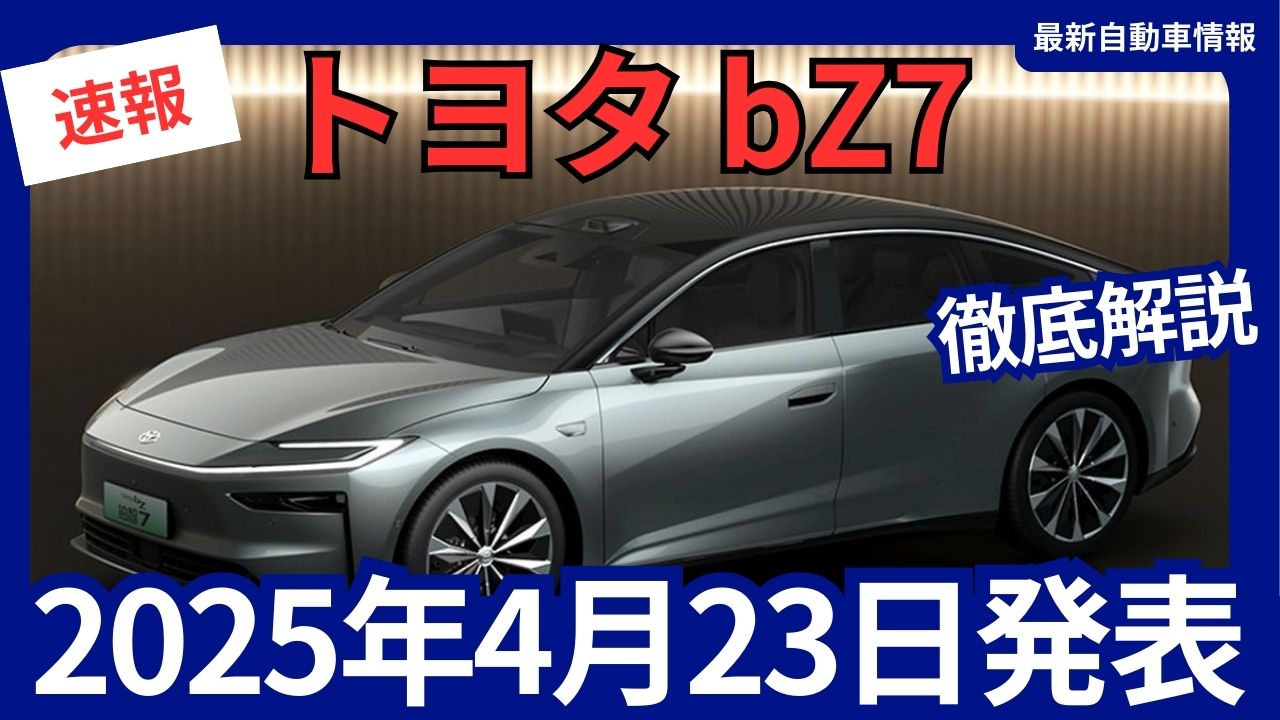
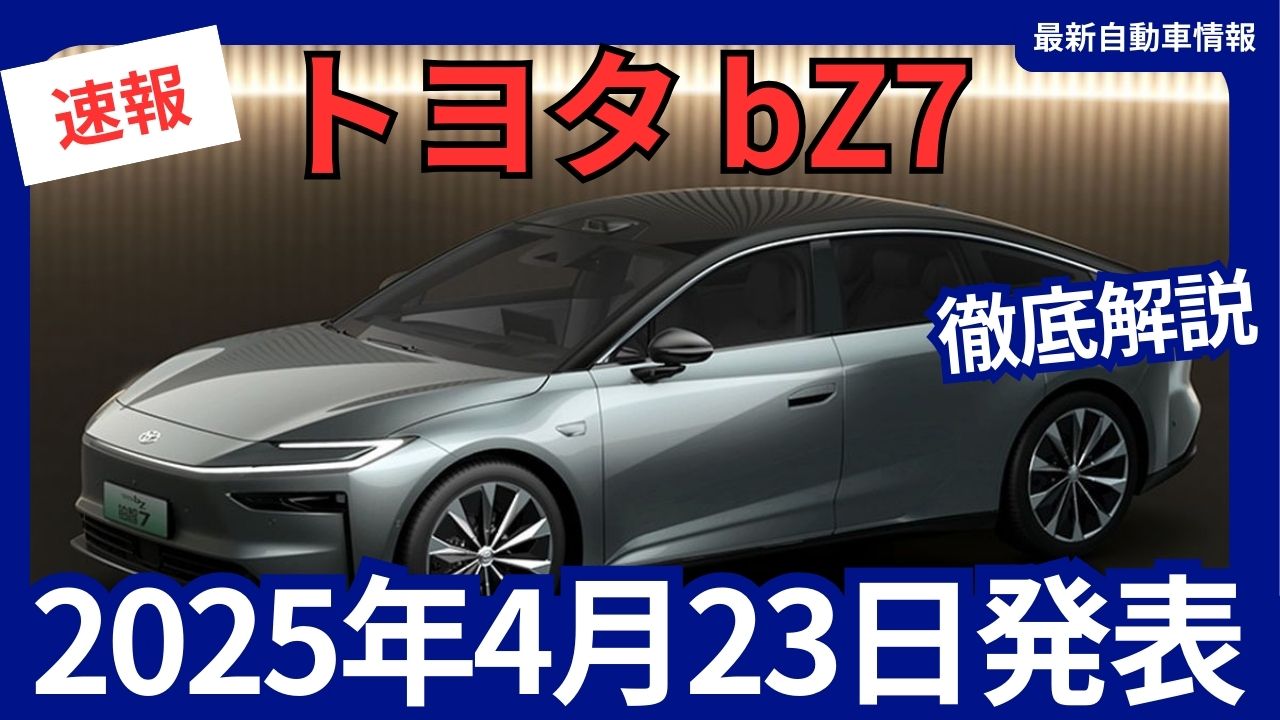
Toyota unveiled its new BEV sedan, the bZ7, at the 21st Shanghai Auto Show, which opened in Shanghai, China on April 23, 2025. Held in China, one of the world’s largest automobile markets, the show is an important stage for manufacturers to unveil their latest technologies and visions for the future. Toyota announced plans to significantly expand its battery electric vehicle (BEV) lineup in the Chinese market, based on its unique “Multi-Pathway” strategy for realizing a carbon-neutral society. The Toyota brand unveiled the new BEV sedan, the bZ7, and the Lexus brand unveiled the new ES , a pioneering next-generation electric vehicle , for the world premiere, demonstrating their strong commitment to the Chinese market, where electrification is rapidly progressing.
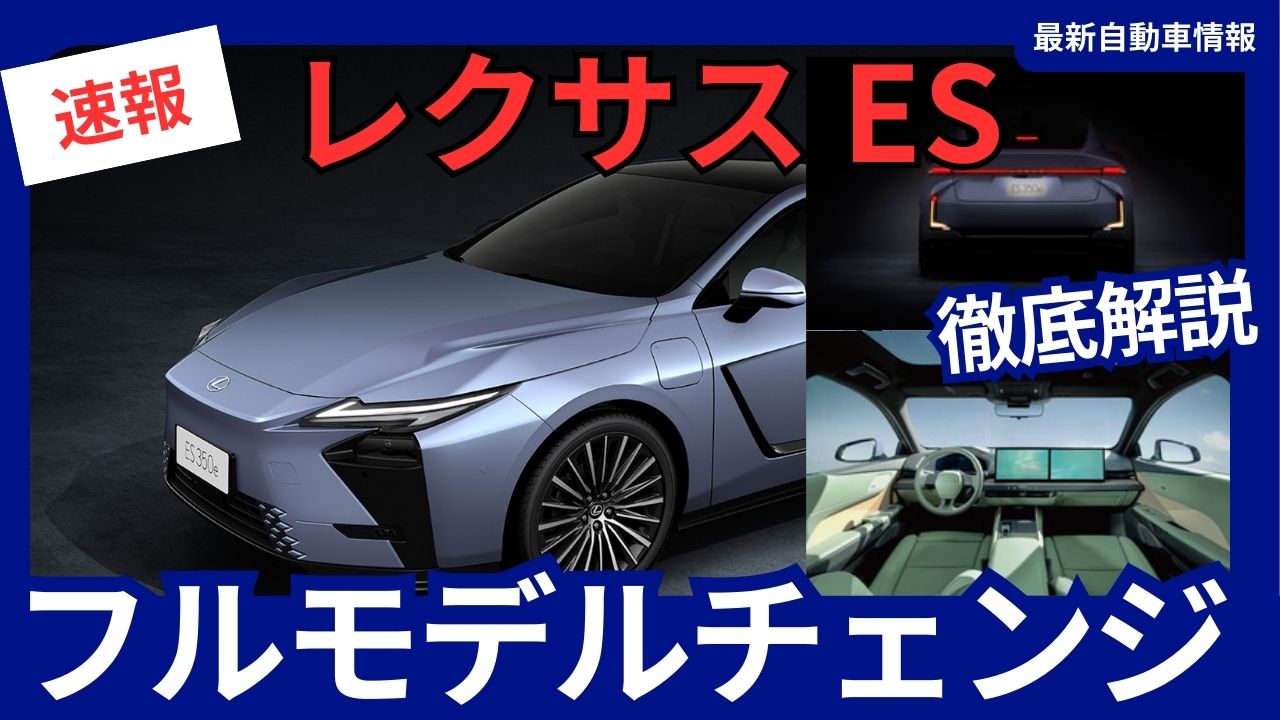
Overview of announcements at the Shanghai Motor Show 2025
- At the 2025 Shanghai Motor Show, Toyota Motor Corporation announced that it will expand its battery electric vehicle (BEV) lineup in the Chinese market based on its “multi-pathway” strategy toward achieving carbon neutrality.
- The Toyota brand has announced the flagship sedan “bZ7” as a new BEV following the existing bZ series (bZ4X, bZ3, bZ3X, bZ5).
- The Lexus brand has announced the new “ES,” which will be available in both BEV and HEV (hybrid) versions as a follow-up to the existing BEVs (UX, RZ).
Toyota’s Basic Strategy “Multi-Pathway”
- Toyota’s fundamental philosophy is to “make ever-better cars,” and it promotes management centered on products and regions.
- To achieve carbon neutrality, we are promoting a “multi-pathway” strategy that offers a wide range of electrified vehicle options, including not only BEVs but also HEVs, PHEVs, and FCEVs (fuel cell vehicles), and provides optimal mobility tailored to each region, customer needs, and infrastructure conditions.
Focus on the Chinese market
- China has an extremely high proportion of BEVs in new car sales, positioning it as a cutting-edge market leading the way in electrification.
- Toyota plans to further accelerate its “Multi-Pathway” initiatives in China in order to better meet the needs of local customers.
Features of the new BEV “bZ7”
- This is the flagship model in Toyota’s BEV lineup in China.
- This is a locally developed model jointly developed with Guangzhou Automobile Group (GAC), Guangzhou Toyota Motor Corporation (GTMC), and the Toyota Intelligent Electric Vehicle Research and Development Center (IEM by TOYOTA).
- It combines Toyota’s quality and safety with China’s cutting-edge technology.
- It is a large sedan-type BEV with a total length of over 5 meters.
- It is planned to be equipped with the latest intelligent technologies, including a smart cockpit, driver assistance, and advanced safety technologies.
- Development is underway with the aim of releasing it within a year.
Toyota’s future electrification strategy
- Based on the “multi-pathway,” we will continue to promote the development of a variety of options, including HEVs, PHEVs, and FCEVs.
- We will also accelerate BEV development, expanding the bZ series and developing next-generation technologies such as all-solid-state batteries.
- We will strengthen our support for software-defined vehicles (SDVs) and promote connected services and over-the-air updates.
- We will also work to achieve carbon neutrality not only for our products but throughout our entire supply chain.
Toyota’s new flagship: details of the new BEV sedan “bZ7”
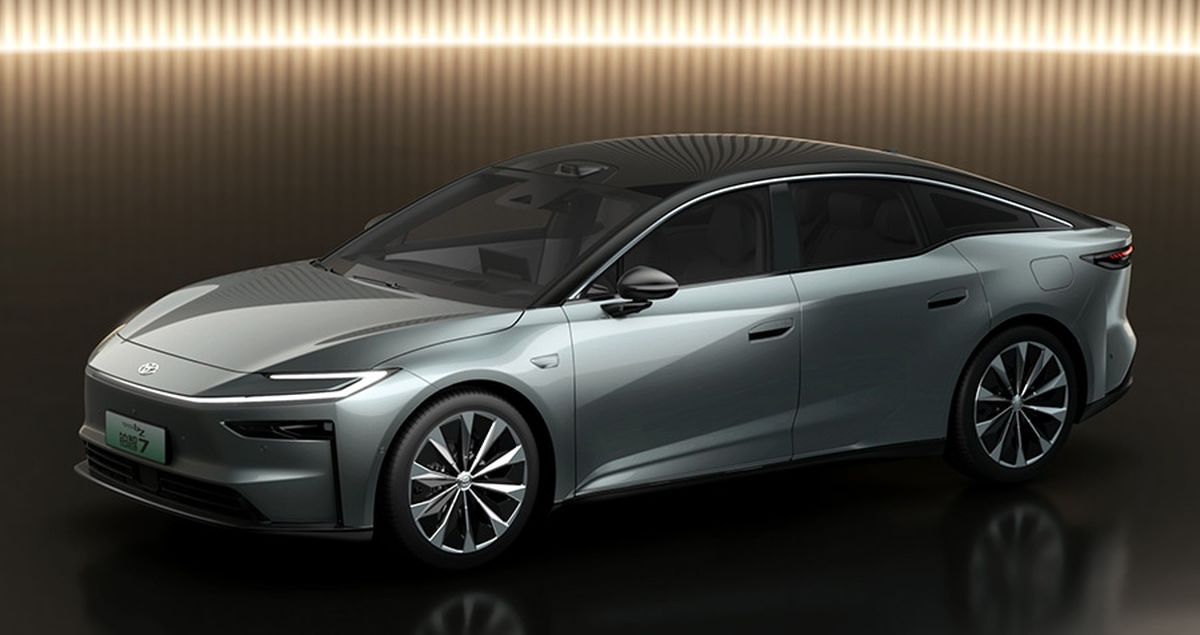
The newly announced “bZ7” was developed as a flagship model at the top of Toyota’s BEV lineup in China. Its most distinctive feature is that it was not developed solely by Toyota, but through joint development with leading local partners Guangzhou Automobile Group Co., Ltd. (GAC), GAC Toyota Motor Co., Ltd. (GTMC), and Toyota Intelligent Electric Vehicle R&D Center (China) Co., Ltd. (IEM by TOYOTA), Toyota’s research and development base in China. This collaborative structure aims to combine Toyota’s long-cultivated know-how in safe, secure, and high-quality manufacturing with the cutting-edge electrification and connectivity technologies of Chinese companies such as GAC. This is expected to accurately capture the needs of the Chinese market and establish a strong presence in the highly competitive BEV segment.
The vehicle’s outline is that it is an imposing sedan-type BEV with a total length of over 5 meters, and appears to combine a spacious interior with striking styling. The exterior design that has been released incorporates the cutting-edge and clean motif common to the bZ series, while expressing a sense of freedom and solidity befitting a flagship. As for the interior, the image suggests that an advanced digital cockpit centered around a large display will be used, suggesting that a space that combines a high level of comfort and functionality has been pursued.
As befits the flagship model of China’s BEV lineup, the bZ7 will be equipped with the latest intelligent technologies. Specifically, the vehicle will include a “smart cockpit” for intuitive and seamless operation, a driver assistance system utilizing advanced sensing technology and AI, and advanced safety technologies to minimize the damage caused by accidents. These technologies not only improve convenience and safety, but also aim to provide a high-level experience in the connectivity and entertainment features that are particularly important to Chinese consumers. For example, voice recognition systems that enable natural dialogue, integration with real-time traffic information and online services, and over-the-air (OTA) software updates are essential elements of modern BEVs, and the bZ7 is expected to be packed with these features.
Although detailed specifications of the powertrain (battery capacity, driving range, motor output, etc.) have not yet been revealed, as a flagship sedan, it is certain to have a practical driving range sufficient for long-distance travel and smooth, powerful acceleration. Toyota’s accumulated knowledge of electrification technology, particularly battery safety and durability, will be fully utilized in the bZ7.
Toyota is currently continuing development of the new bZ7, aiming to launch it in the Chinese market within a year. Pricing, grade configuration, and more detailed technical specifications are yet to be officially announced. There is considerable interest in how the bZ7 will compete in the Chinese premium BEV sedan market, which is crowded with strong rivals such as the Tesla Model S, NIO ET7, and Xpeng P7. Combining Toyota’s quality and reliability with China’s advanced technology, this model has the potential to elevate Toyota’s BEV strategy in China to a new level.
The path to achieving carbon neutrality: Deepening the “multi-pathway” strategy
For many years, Toyota has upheld the philosophy of “making ever-better cars” and has aimed to improve customer satisfaction and contribute to a sustainable society. At the heart of its management have always been two axes: “products” and “regions.” The company believes that providing optimal mobility, taking into account diverse customer needs, infrastructure conditions, and energy situations around the world, leads to true customer satisfaction. This philosophy is also reflected in its efforts to achieve carbon neutrality, a global challenge. Toyota’s “Multi-Pathway” strategy does not rely on a single powertrain, but instead offers a variety of electrified vehicle options, including hybrid electric vehicles (HEVs), plug-in hybrid electric vehicles (PHEVs), fuel cell electric vehicles (FCEVs), and battery electric vehicles (BEVs), with the aim of providing optimal solutions tailored to each region and customer situation.
While some argue that a shift to BEVs is the only solution, Toyota recognizes the significant differences between countries and regions in terms of energy supply, infrastructure development, vehicle usage, and customer financial capacity. For example, even if BEVs are introduced in large numbers in regions with low renewable energy utilization, their overall lifecycle CO2 reduction effect may be limited. Furthermore, for users who frequently travel long distances or who live in apartment complexes where charging is difficult, HEVs and PHEVs will likely remain viable options. Furthermore, fuel cell electric vehicles (FCEVs), which anticipate the use of hydrogen energy, also hold promise for the future, particularly in the commercial vehicle sector. “Multi-Pathway” is a realistic and comprehensive approach that recognizes these complex realities and promotes diverse technological development to open up the path to carbon neutrality for more customers and effectively reduce CO2 emissions across society.
Toyota’s Challenge in China, the Cutting-Edge Market for Electrification
China, where this announcement was made, is not only the world’s largest automobile market, but also has an extremely high proportion of BEVs in new vehicle sales, establishing itself as a cutting-edge market that is a strong leader in electrification. This rapid shift to electrification is being driven by a number of factors, including the government’s aggressive EV promotion policies, rapid technological innovation by domestic manufacturers, and growing environmental awareness among consumers. In this dynamic market environment, Toyota recognized the need to further accelerate its “Multi-Pathway” initiatives while sincerely addressing the needs of local customers.
Toyota has been promoting environmentally friendly vehicles, primarily HEVs, in the Chinese market through joint ventures with local partners. In recent years, the company has launched its global BEV series, the “bZ” brand, with models such as the “bZ4X” and “bZ3.” At the Shanghai Motor Show 2025, Toyota unveiled the new flagship “bZ7,” a new BEV model for the Toyota brand, following the existing “bZ4X,” “bZ3,” “bZ3X,” and “bZ5.” Furthermore, Lexus, the premium brand, announced the launch of a BEV version of its flagship “ES” model, spearheading its next-generation electrified vehicle lineup, in addition to the existing BEVs “UX300e” and “RZ.” This clearly demonstrates Toyota’s deep understanding of the importance of the Chinese market, its positioning as a core region for its electrification strategy, and its full-scale offensive.
The Future of Toyota’s Electrification Strategy: The Challenge of Diversity and Evolution
The announcements by Toyota and Lexus at the Shanghai Motor Show 2025 are not just the unveiling of new vehicles, but an important milestone that signals a new phase in the electrification strategy of the entire Toyota Group. In particular, the unveiling of the Toyota brand’s flagship BEV, the bZ7, and the Lexus brand’s flagship ES BEV in China, the world’s largest electric vehicle market, clearly demonstrates Toyota’s seriousness about this market.
However, Toyota is not solely focused on BEVs. Based on its “Multi-Pathway” philosophy, the company reiterated its policy of continuing to develop a variety of electrified vehicles, including HEVs, PHEVs, and FCEVs, to provide optimal options tailored to each region’s energy situation and customer needs. HEVs remain a realistic and effective means of reducing CO2 emissions in many regions, and further improvements in efficiency and performance are being pursued. PHEVs are expected to continue to play an important role due to their convenience, allowing them to be driven as EVs for short-distance daily travel and as hybrids for long-distance travel. Research and development of FCEVs will continue, with the aim of utilizing them in commercial vehicles such as large trucks and buses, and as a key technology for realizing a hydrogen society in the future.
Meanwhile, the development of BEVs will undoubtedly accelerate. The “bZ” series lineup will continue to expand, catering to a variety of segments and needs. Furthermore, Toyota is focusing on the development of next-generation battery technologies, such as “solid-state batteries,” which have the potential to significantly improve driving range and shorten charging times, and there are high expectations for future improvements in the performance of BEVs.
Additionally, software is essential to modern automotive development. Based on the concept of “Software-Defined Vehicles (SDV),” Toyota aims to define vehicle functions through software and continue to evolve the value of cars even after purchase through over-the-air updates. The “intelligent technology” installed in the “bZ7” and new “ES” is part of this initiative, and advances in connected services and advanced driver assistance systems will likely become increasingly important in future Toyota and Lexus vehicles.
Achieving carbon neutrality requires efforts not only for individual products, but also across the entire supply chain, from parts procurement to production, transportation, use, disposal, and recycling. Toyota is actively working to reduce the environmental impact throughout its value chain, including by introducing renewable energy into its production processes and working with suppliers to reduce CO2 emissions.
A word from the editorial department
The new bZ7 and ES, unveiled at the 2025 Shanghai Motor Show, demonstrate Toyota and Lexus’ strong commitment to further increasing their presence in the Chinese market, where electrification is accelerating. These models will serve as symbols of the Toyota Group’s advanced technological capabilities, commitment to quality, and adaptability to meet market needs.
However, at the heart of this is a comprehensive strategy known as “Multi-Pathway.” By accelerating the development of BEVs while continuing to offer a variety of options, including HEVs, PHEVs, and FCEVs, Toyota is creating a path that allows all customers around the world to contribute to carbon neutrality. This realistic and steady approach is exactly the kind of sustainable mobility society Toyota aims for.
As the automotive industry enters a once-in-a-century period of great change, Toyota continues to take on the future with its long-cultivated spirit of “making ever-better cars” and its “Multi-Pathway” strategy. We’ll be keeping a close eye on what innovative mobility Toyota and Lexus will create and surprise us in the future.
Lexus news release