
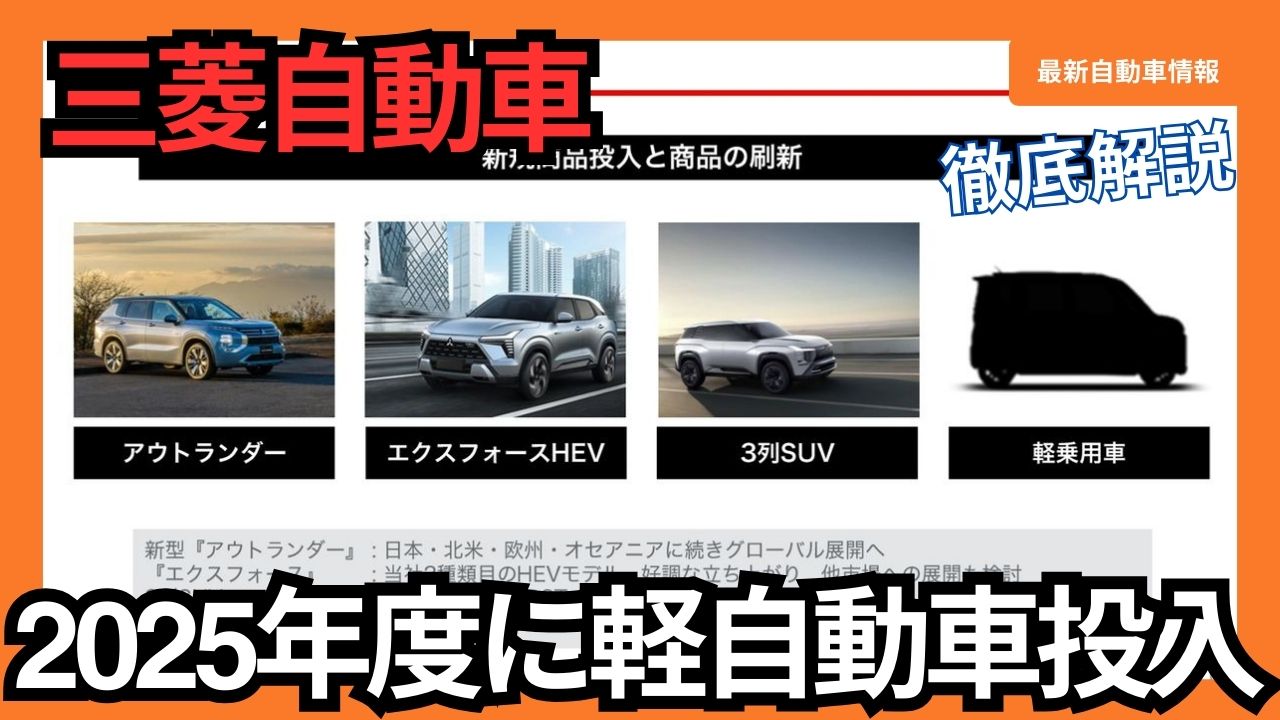
On May 8, 2025, Mitsubishi Motors Corporation announced its full-year financial results for fiscal year 2024. This announcement was not merely a summary of the company’s financial performance over the past year, but also presented a number of ambitious business strategies that will likely shape the company’s future. While the announcement covered management issues such as its ongoing response to the tariffs introduced under the former Trump administration, which are closely watched as a factor in the economic environment, and its plan to share a factory with Nissan Motor Co. in the US market in order to improve production efficiency, what particularly attracted the most attention was the specific roadmap the company laid out for “new product launches and product renewal.”
The highlight of the event was the announcement of plans to introduce a new minicar to the Japanese minicar market in fiscal year 2025, with the first public release of an exciting silhouette image. Considering the shape of this silhouette and the length of time since the current model was introduced to the market, speculation and expectations are rising rapidly among automotive industry insiders and enthusiasts that this new car will essentially be a completely revamped version of Mitsubishi’s popular eK Space model, in other words, the New eK Space.
This article provides detailed forecasts for this long-awaited new minicar, as well as delves into the core of Mitsubishi Motors’ global electrification strategy, and the full picture of the multifaceted, strategic collaboration that goes beyond the existing Renault-Nissan Alliance and involves companies from other industries, such as Honda and Taiwanese technology giant Foxconn. It also provides a detailed analysis and commentary on how Mitsubishi Motors envisions the future and aims for sustainable growth in the rapidly changing automotive industry.
Key points of Mitsubishi Motors’ future strategy and new vehicle plans
- Financial Results Announcement and Overall Policy:
- On May 8, 2025, Mitsubishi Motors announced its full-year financial results for fiscal year 2024 and unveiled its plans for future “new product launches and product renewal.”
- The company outlined a policy of aiming for sustainable growth centered on electrification and global collaboration.
- Domestic market strategy: Launch of new minicars
- We plan to launch a new light passenger vehicle for the Japanese market during fiscal 2025.
- Based on the silhouette that has been released, it is believed to be a super high-roof wagon type and is likely to be the successor model to the current “eK Space.”
- This new minicar is a next-generation model that will be jointly developed and produced through NMKV, a joint venture with Nissan Motor Co., Ltd., and in addition to ICE (internal combustion engine vehicle), the development of BEV (battery electric vehicle) is also being considered.
- Global market strategy: Strengthening and expanding SUV lineup
- New Outlander : As a flagship SUV, we will expand sales to further global markets, following Japan, North America, Europe, and Oceania, focusing particularly on the PHEV model.
- X-Force : The X-Force hybrid electric vehicle (HEV) compact SUV is selling well in the ASEAN market, and we are considering expanding it to other markets.
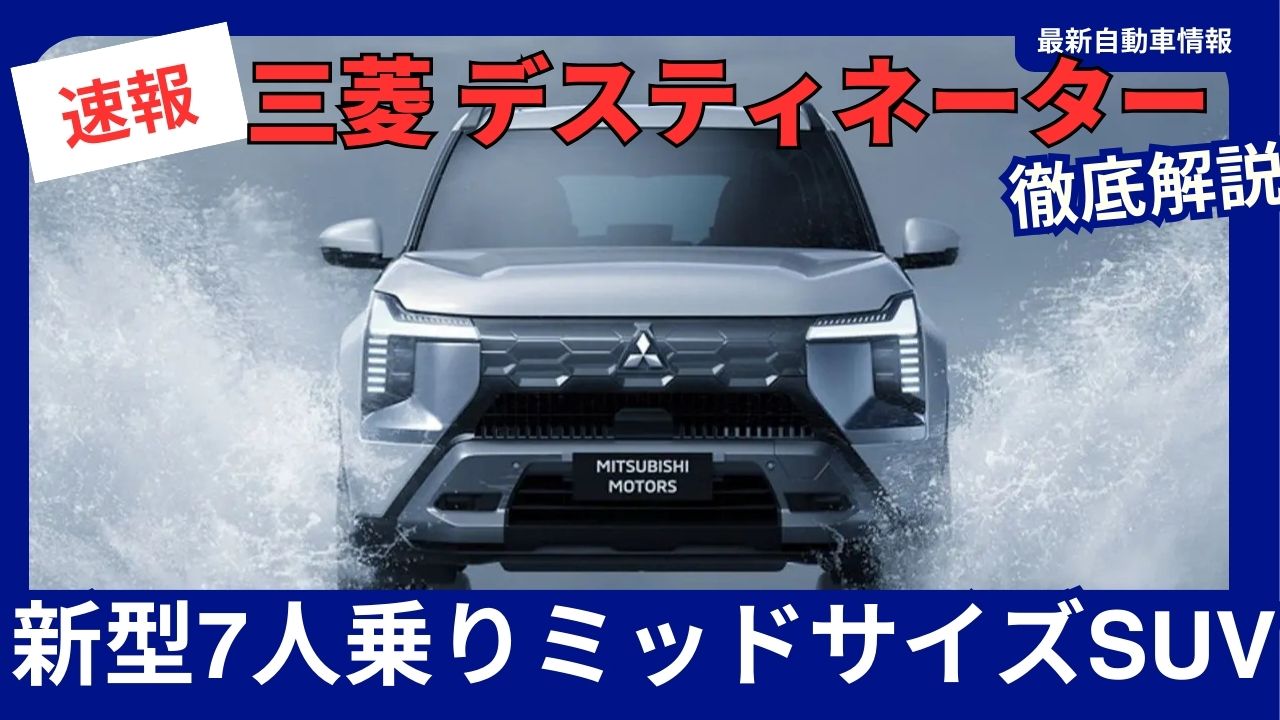
- “MITSUBISHI DST CONCEPT” mass-production model : A mass-production model of the “MITSUBISHI DST CONCEPT,” a three-row SUV concept car that meets the needs of the ASEAN market, is scheduled to be introduced in the region.
- Electrification strategy: Strengths of PHEVs, expansion of BEVs, and industry collaboration
- Mitsubishi Motors will further evolve its strength in PHEV technology and place it at the core of its electrification strategy.
- Expanding our BEV lineup is also an urgent priority, and we will utilize alliances and collaborations with other companies.
- In the North American market, we will supply the Rogue PHEV to Nissan on an OEM basis in 2025.
- In the North American market, Nissan will supply a derivative BEV model based on the next-generation Leaf on an OEM basis in 2026.
- Through joint investment in Nissan’s US plant, we will consider joint production of next-generation SUVs (including electric vehicles).
- With Nissan, we will also consider collaborating on next-generation pickup trucks, expanding the regions and vehicle models in which we collaborate in the electrified vehicle field, and standardizing batteries.
- Aiming to strengthen the competitiveness of Japan’s automobile industry, Mitsubishi Motors, Nissan Motor, and Honda Motor Co., Ltd. have begun discussing a strategic partnership regarding the “intelligence” and “electrification” of automobiles.
- Multifaceted collaboration strategy: Deepening collaboration both within and outside the alliance
- This will build on the existing Renault-Nissan-Mitsubishi Alliance and create a broader partnership.
- European market : Renault Group will supply SUV models (HEV/ICE) and BEV models to the Group on an OEM basis from 2025.
- Philippine market : Nissan will supply the company with van models on an OEM basis in 2025.
- Oceania Market :
- We will supply pickup models to Nissan on an OEM basis in 2025.
- The company also announced a partnership with another industry, receiving OEM supply of BEV models from Taiwan’s Foxconn in 2026.
- Conclusion:
- Mitsubishi Motors will use the launch of a new minicar in Japan as a catalyst to accelerate its SUV strategy and electrification in global markets.
- To achieve this, in addition to strengthening existing alliances, we will actively promote multifaceted collaboration with new partners such as Honda and Foxconn, and aim to overcome this once-in-a-century period of great change in the automotive industry and achieve sustainable growth.
Domestic Market Strategy: Launch of long-awaited new minicar – Will the successor to the eK Space hold the key to revitalizing domestic sales?
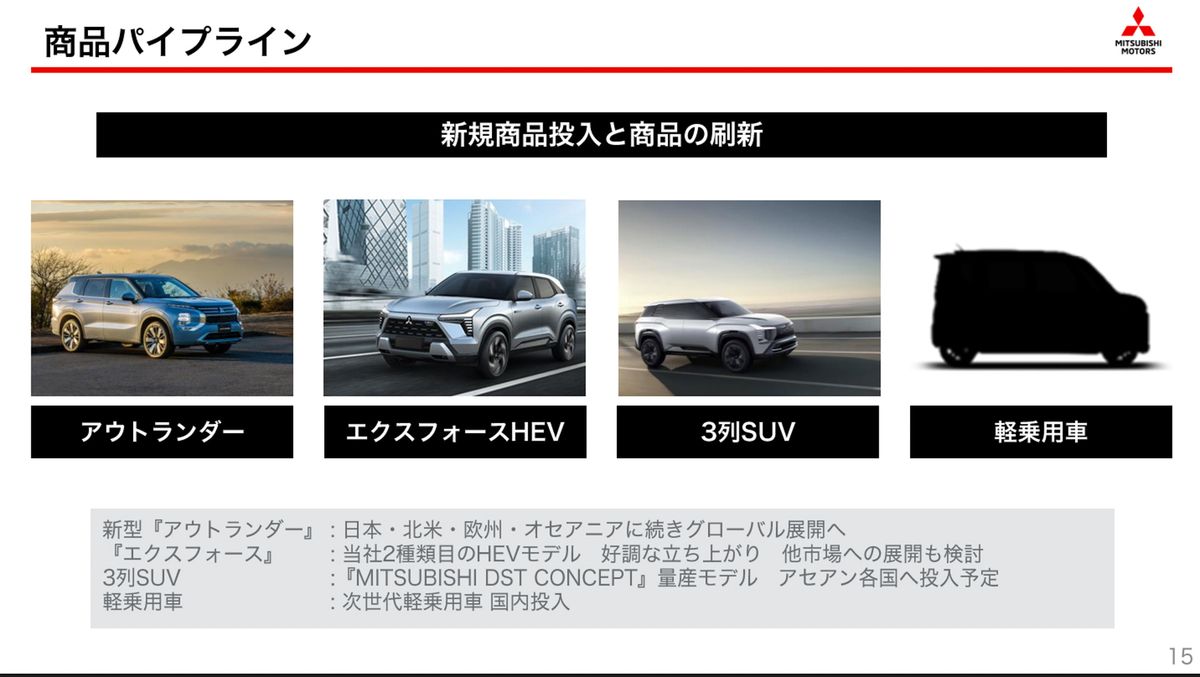
New product launches and product renewal initiatives for fiscal 2025
The new minicar that Mitsubishi Motors plans to launch as its trump card in the Japanese market in 2025 is positioned as an extremely important step in the company’s domestic sales strategy to revive its domestic sales. The silhouette image released suggests a high roof and a spacious interior, strongly suggesting that it will be a super high-roof wagon-type minicar, similar to the current eK Space and eK Cross Space.
This category is the most competitive and highest-selling core segment in Japan’s minicar market, and success here will directly contribute to improving the brand’s overall image. Mitsubishi Motors has operated NMKV, a joint venture with Nissan Motor Co., Ltd., for many years to jointly develop and produce minicars, and through this scheme has brought to market a number of successful models, including the eK Wagon and Dayz. This new minicar is the latest result of this joint venture through NMKV, and is expected to be a next-generation model that will be launched on the market alongside its Nissan-branded sister models.
Importantly, this collaboration extends beyond conventional internal combustion engine (ICE) models powered by gasoline engines, and also includes a deep commitment to battery electric vehicles (BEVs), for which market demand is growing. By combining the development resources and production know-how of both companies, we expect to create a competitive kei car that offers excellent cost performance, advanced safety technology, and environmental performance. The eK Space, in particular, has long been a pillar of Mitsubishi’s kei car lineup, attracting strong support, primarily from families, thanks to its spacious interior and user-friendly sliding doors, even since its predecessor. A full model change will not only revamp the design, but also include advances in advanced driver assistance systems (ADAS), enhanced connected features, and, above all, the extent to which it supports electrification. The silhouette suggests a more modern and dynamic exterior design, which will undoubtedly bring new options and vitality to the Japanese kei car market. The success of this new minicar will serve as a litmus test for revitalizing Mitsubishi Motors’ domestic sales network and rebuilding its brand image.
Global Market Strategy: Mitsubishi’s SUV lineup competing globally – Expanding the Outlander and targeting emerging markets
In parallel with its minicar strategy in the domestic market, Mitsubishi Motors is also vigorously promoting strategic product development tailored to regional needs and enhancing brand value in global markets. The core element driving this global strategy is the new Outlander, the company’s flagship SUV, a product that embodies the company’s technological capabilities. The Outlander has already been highly praised in Japan and other major developed markets, including North America, Europe, and Oceania, for its outstanding driving performance, sophisticated design, and, above all, its world-renowned PHEV (plug-in hybrid EV) system. Going forward, the company plans to further expand sales areas and solidify its position as a global model that truly represents the Mitsubishi brand.
In particular, the Outlander PHEV model is expected to see further growth in demand in environmentally conscious countries as the transition to electrification accelerates. It will also serve as a global showcase for Mitsubishi Motors’ advanced electrification technologies. Meanwhile, the company is also focusing on rapidly growing emerging markets. Following the Outlander PHEV, the new compact SUV “X-Force,” the brand’s second HEV (hybrid electric vehicle) model, will be a key pillar of its electrified lineup. Introduced primarily to the ASEAN market, the X-Force has shown extremely strong sales immediately after its launch, garnering praise for its stylish design, compact yet practical packaging, and excellent balance of fuel economy and driving performance. Building on this success in the ASEAN region, Mitsubishi Motors is actively considering gradually expanding the X-Force into other promising markets, aiming to increase sales and expand market share in the global compact SUV segment.
Furthermore, as part of a strategy to respond precisely to the unique needs of the ASEAN market, concrete plans are underway to introduce a mass-production model of the concept car unveiled as the “MITSUBISHI DST CONCEPT,” a three-row, multi-passenger SUV, in countries within the region. Demand for three-row SUVs, ideal for families and large groups, remains strong in the ASEAN region, and this new model is expected to make a significant contribution to strengthening Mitsubishi Motors’ sales base and improving brand loyalty in the region. This series of new vehicle launch plans is a clear manifestation of Mitsubishi Motors’ meticulous and ambitious global strategy, formulated with deep insight into the market characteristics and consumer needs of each region.
Electrification Strategy: Maintaining the strengths of PHEVs while strengthening BEVs – Mitsubishi Motors’ electrification roadmap and alliances
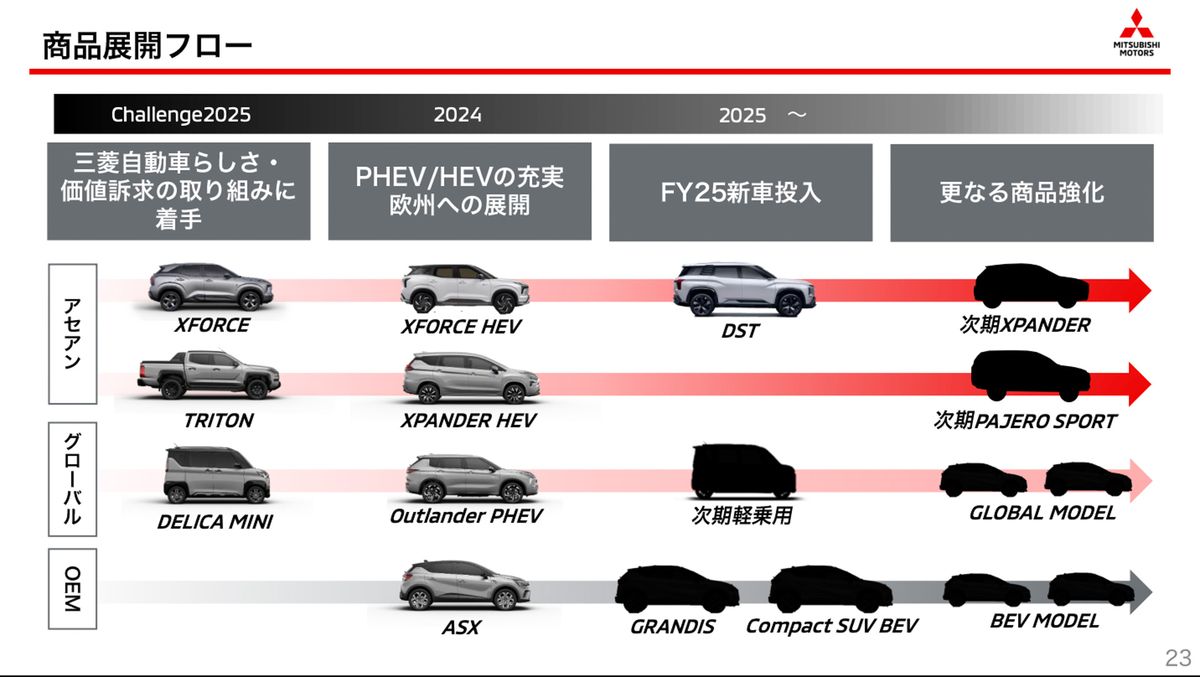
Product development roadmap for fiscal 2025 and beyond
Undoubtedly, the most important pillar of Mitsubishi Motors’ strategy for sustainable future growth is an aggressive shift toward electrification. The company has a long history of pioneering development in the field of PHEV technology, resulting in the development of a unique PHEV system that combines high reliability and superior driving performance. The Outlander PHEV, a prime example of this, combines the smooth, powerful acceleration of an electric motor with the peace of mind of a gasoline engine for long-distance driving. Furthermore, combined with Mitsubishi’s proprietary Super All-Wheel Control (S-AWC) integrated vehicle dynamics control system, it achieves high handling stability in all road conditions, earning it acclaim globally. Mitsubishi Motors’ initiatives beyond fiscal year 2025 clearly demonstrate a further evolution of its electrification strategy, maximizing the advantages of this PHEV technology. One example is its plan to supply a PHEV version of Nissan’s popular SUV, the Rogue, to the North American market as an OEM starting in 2025, as part of its collaboration with its alliance partner, Nissan. This is clear evidence that the technological superiority and market competitiveness of Mitsubishi Motors’ PHEV system are highly regarded within the Alliance, demonstrating the progress being made in efficient technology sharing and optimization of development resources within the Group. While maintaining and developing its strengths in PHEVs, Mitsubishi Motors is also accelerating the development and lineup expansion of zero-emission battery electric vehicles (BEVs) as a matter of urgency. In particular, in North America, one of the world’s largest automobile markets and subject to strict environmental regulations, Mitsubishi Motors has agreed to receive OEM supply of a BEV model derived from Nissan’s next-generation Leaf by 2026. This will effectively re-enter the increasingly competitive North American BEV segment. Furthermore, the Alliance also announced a policy to deepen collaboration with Nissan on production, exploring joint production of next-generation SUVs with an eye toward electrification through joint investment in Nissan’s U.S. plant. This is a strategic move to address rising development and production costs in the era of electrification and secure price competitiveness by pursuing economies of scale. From a global perspective, we plan to collaborate with Nissan on next-generation pickup truck models, an area of expertise for both companies, and to further expand the geographical areas and vehicle lineup of our electrified vehicle collaboration. Furthermore, we are deeply exploring the possibility of standardizing, jointly developing, and jointly procuring drive batteries, a critical component that determines the performance and cost of electrified vehicles. Battery technology is evolving rapidly, and stable procurement and cost management are unavoidable challenges for the success of electrification strategies. Particularly noteworthy in this announcement was the news that three of Japan’s leading automakers—Mitsubishi Motors, Nissan Motor, and Honda Motor Co.—have begun exploring a strategic partnership in the next-generation technology fields of automotive intelligence and electrification. This represents a search for a new, truly “all-Japan” collaborative framework that transcends the boundaries of individual companies and existing alliances. It could be a crucial step toward Japanese companies taking the lead in the international development race in areas such as software, AI, and advanced electric powertrains. As the paradigm shift in the automotive industry known as CASE (Connected, Autonomous, Shared & Services, Electric) accelerates, this type of broad and flexible collaboration is essential from the perspectives of improving research and development efficiency, diversifying risks, and exerting influence on international standardization.
Multifaceted collaboration strategy: The full picture of flexible partnerships centered on the Renault-Nissan Alliance, including collaboration with Foxconn and other companies in other industries
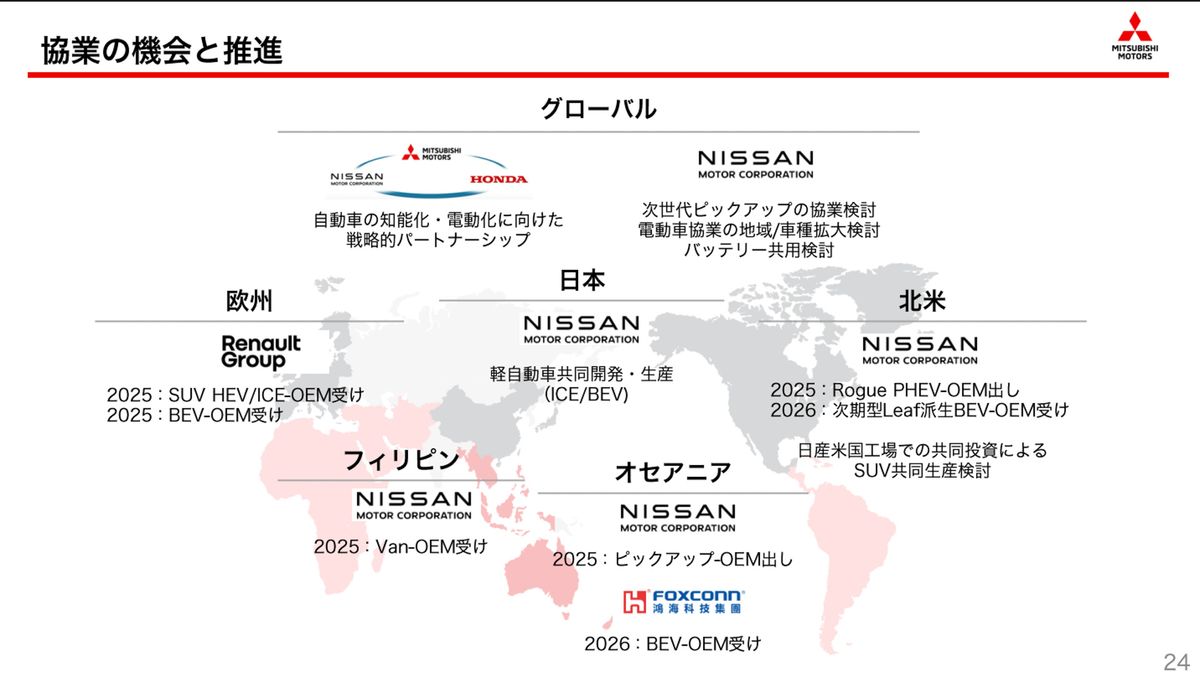
Collaborative relationships in Europe, North America, Japan, the Philippines, Oceania, and globally
Mitsubishi Motors’ collaborative strategy is distinctive in that it effectively utilizes the long-standing framework of the Renault-Nissan-Mitsubishi Alliance while boldly expanding its scope and evolving it into a more diversified and flexible partnership. This is a highly strategic and necessary choice to ensure sustainable growth while responding to the rapid pace of technological innovation and maintaining and strengthening global competitiveness amid a once-in-a-century period of transformation in the automotive industry. In the European market, Mitsubishi Motors has clearly stated its intention to further strengthen its collaboration with Groupe Renault, an important Alliance partner. Specifically, by 2025, the company plans to receive OEM supply of hybrid and internal combustion engine (ICE) versions of its SUV models. Furthermore, Renault will also supply battery electric vehicle (BEV) models, for which demand is rapidly expanding in Europe. This will enable Mitsubishi Motors to efficiently provide a wide range of powertrain options to meet diverse customer preferences and needs, while accurately complying with strict CO2 emissions and environmental regulations led by the European Union (EU). As mentioned above, Mitsubishi Motors’ collaboration with Nissan in the North American market is extremely diverse, including OEM supply of the Rogue PHEV to Nissan, OEM supply of a next-generation Leaf-derived BEV model to Mitsubishi Motors, and joint production of a next-generation electric SUV through joint investment in Nissan’s U.S. plant. These efforts reflect a clear strategy to leverage the complementary technological strengths and production capabilities of both companies to reduce the cost of the electrification transition, which requires significant investment, while shortening the lead time to market and strengthening Mitsubishi Motors’ presence in the highly competitive North American market. Looking to the rapidly growing ASEAN region, in the Philippines, Nissan plans to OEM supply a van model in the LCV (light commercial vehicle) category, thereby expanding Mitsubishi Motors’ commercial vehicle lineup and expanding sales opportunities in the region. Additionally, in the Oceania market, Mitsubishi Motors will supply Nissan with its specialty pickup truck model on an OEM basis in 2025, while also receiving an OEM supply of BEV models from Hon Hai Technology Group (Foxconn), a global Taiwanese electronics manufacturing services (EMS) company, in 2026. This represents a new partnership with a different industry that goes beyond conventional automotive industry conventions. Foxconn, known for producing Apple’s iPhones, has been actively developing the MIH electric vehicle platform in recent years and is aiming to enter the automotive industry on a full scale. This partnership with Foxconn means that Mitsubishi Motors will have a new BEV procurement option in addition to its traditional supply routes from automakers, and holds great potential for significantly shortening development times and further streamlining production costs. These diverse OEM supply and purchase relationships are a clever strategic move that allows Mitsubishi Motors to focus its valuable development resources on key areas where it can demonstrate true competitive advantage, such as PHEV technology and certain strategic vehicles, while also responding quickly and efficiently to the needs of diverse segments in global markets. The deepening of its global collaboration with Nissan on next-generation pickup trucks, the expansion of collaboration regions and vehicle lineups in the electrified vehicle field, and the consideration of battery standardization, which will have a significant impact on cost structure, all demonstrate the Renault-Nissan-Mitsubishi Alliance’s strong commitment to maximizing economies of scale and enhancing its competitiveness. Furthermore, the strategic partnership that has begun to be considered between domestic rivals Nissan and Honda is noteworthy as a historic move based on a larger perspective in which the entire Japanese automotive industry seeks collaboration to survive in international competition. This deepening and diversification of collaboration is Mitsubishi Motors’ clear and proactive response to the complex and difficult challenges facing the modern automotive industry, such as the ever-accelerating race for technological development, the resulting exponential rise in development costs, and supply chain instability due to geopolitical risks.
Conclusion: Overcoming a period of change and achieving sustainable growth – Mitsubishi Motors’ challenge to pave the way to the future with electrification and global collaboration as its two pillars
Mitsubishi Motors’ FY2024 financial results briefing held on May 8, 2025, was not simply a chance to reflect on past performance; it was an important opportunity to demonstrate to both internal and external parties a clear path forward, a concrete strategy for achieving that path, and, above all, an unwavering commitment to transformation. Particularly noteworthy was the company’s planned launch of a new vehicle (highly likely the new eK Space) in the kei car segment, a key market in Japan, in FY2025. This demonstrates Mitsubishi Motors’ strong commitment to revitalizing its domestic sales business and restoring its brand. At the same time, in global markets, the company aims to secure a global growth trajectory by strategically introducing attractive products optimized for regional characteristics, such as the further expansion of the flagship Outlander SUV, which incorporates the best of PHEV technology; the X-Force HEV compact SUV, which holds the key to capturing emerging markets; and the mass-produced MITSUBISHI DST CONCEPT three-row SUV, which meets the needs of the ASEAN market. Fundamental to these ambitious product strategies is a company-wide shift to electrification. Mitsubishi Motors will continue to maintain and strengthen its unwavering leadership in PHEV technology, which it has cultivated for many years, while rapidly expanding its BEV lineup in line with the market trend. To accelerate and successfully navigate this challenging transition to electrification, Mitsubishi Motors is not only making the most of its existing strong collaborative foundation within the Renault-Nissan-Mitsubishi Alliance, but is also demonstrating a highly flexible and bold approach, open to collaboration with powerful domestic rival Honda and new partners such as electronics giant Foxconn. This will be a key to not only surviving but also continuing to create new value in today’s automotive industry, which is constantly changing at an unprecedented pace. Mitsubishi Motors aims to improve profitability and return to a sustainable growth trajectory by steadily implementing planned new product launches and strategic renewal of its existing product lineup, while responding precisely and swiftly to unavoidable changes in the external environment, such as the impact of tariffs under the Trump administration and the establishment of a cooperative framework with Nissan at its U.S. production base. With the automotive industry widely recognized as undergoing a once-in-a-century transformation, Mitsubishi Motors will continue to explore new horizons in the global market through these broad strategies, and its challenges and evolution will be closely watched. Mitsubishi Motors’ next move, which combines its tradition and innovative DNA to forge ahead with the demands of the times—electrification—and global collaboration as its strategic tool, continues to garner significant attention and expectations from both within and outside the automotive industry.