
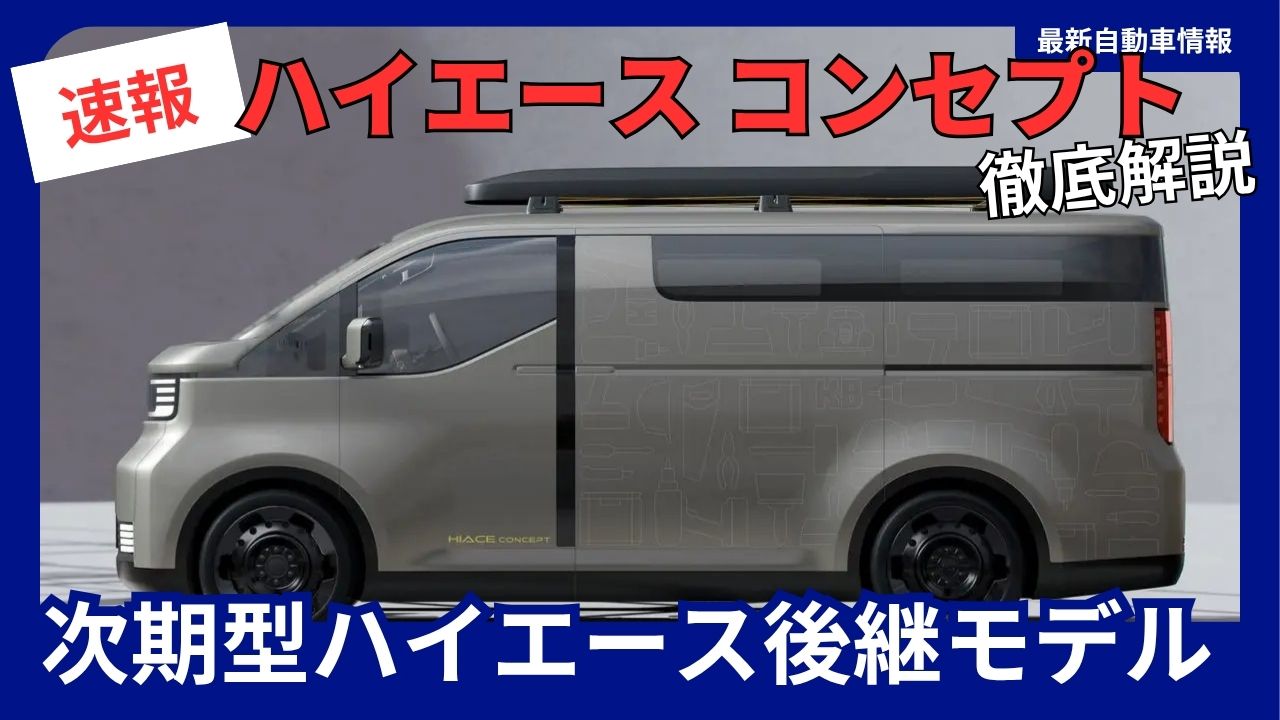
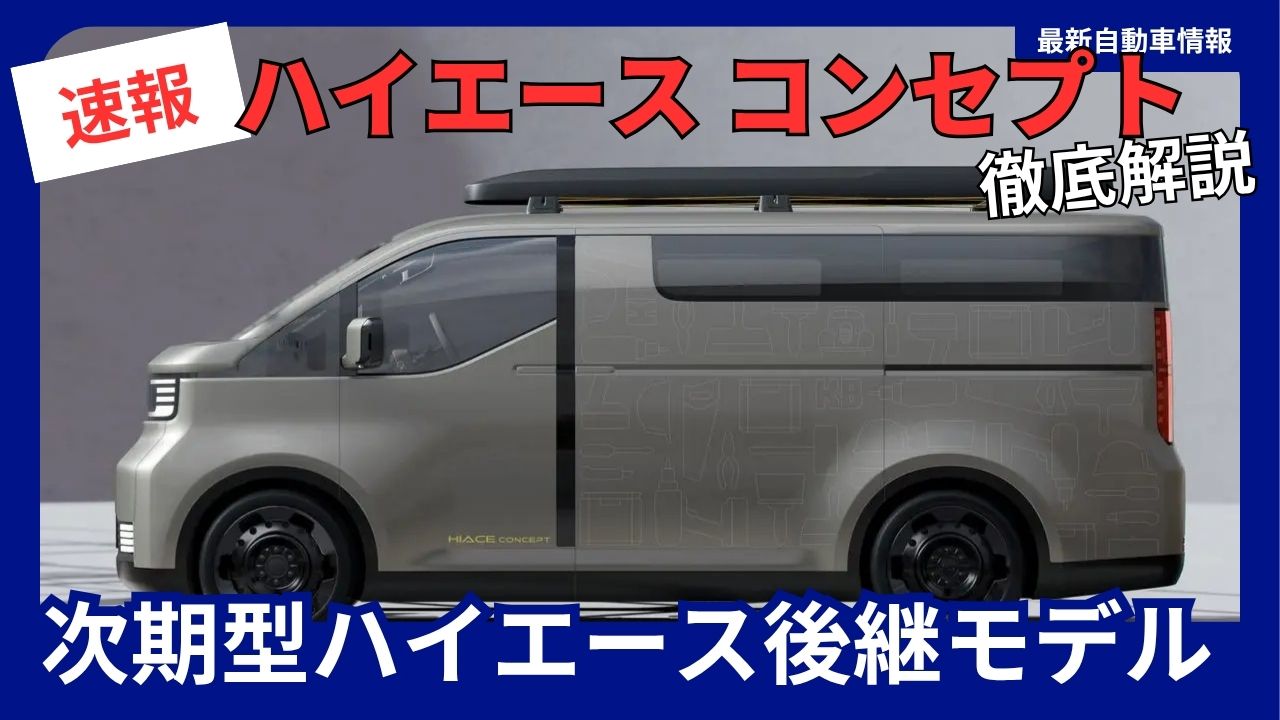
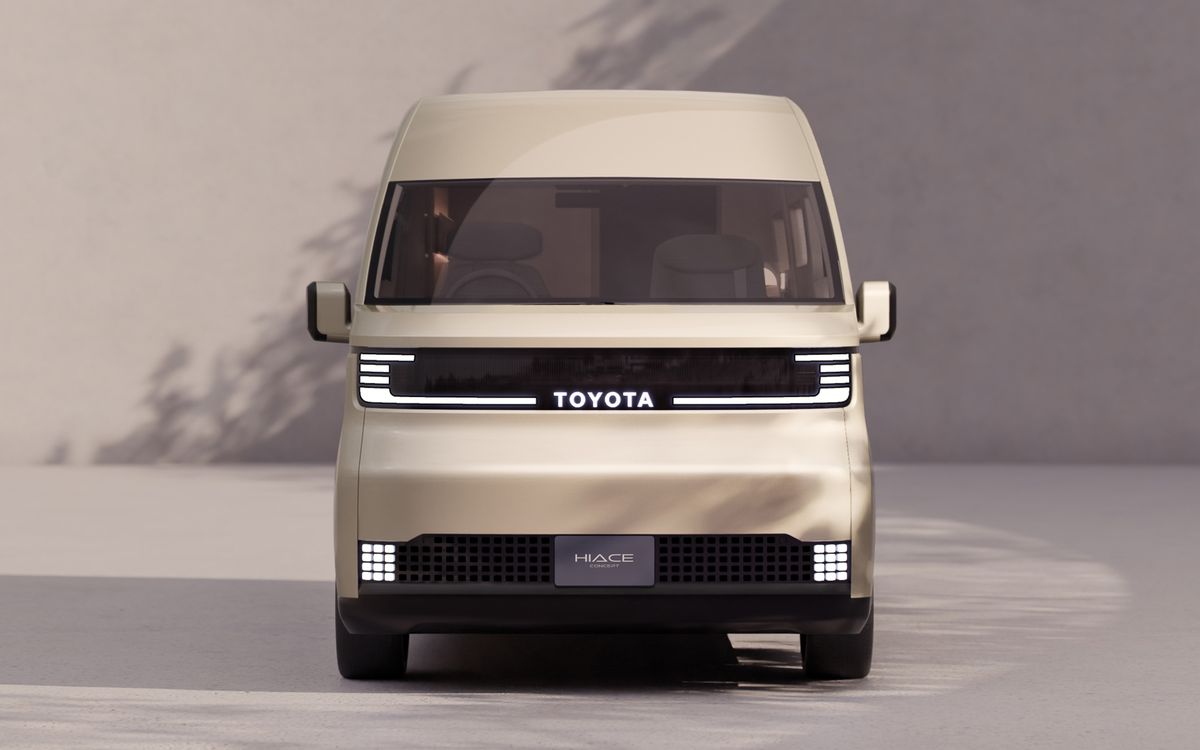
On October 29, 2025, Toyota Motor Corporation unveiled the “Hiace Concept,” a preview of the next-generation Hiace, for the first time in the world at the Japan Mobility Show 2025 (JMS2025), currently being held at Tokyo Big Sight. The car is attracting a great deal of attention as the successor to the current 200-series Hiace, which has been in production for over 20 years.
Next-generation commercial van unveiled for the first time at Japan Mobility Show 2025
Overview of the released Hiace concept
At this year’s JMS2025, two body types were exhibited.
Standard roof type
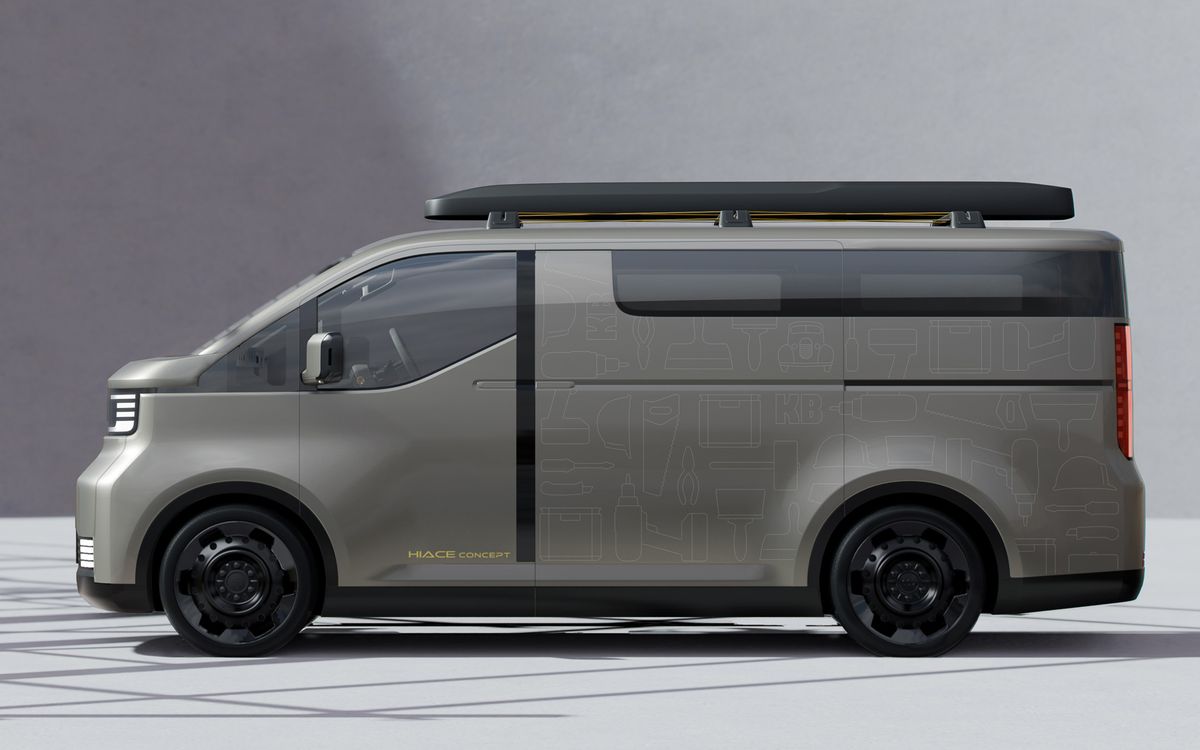
- Standard specification with short wheelbase
- Proposal with roof rails
- Simple and functional design
High roof type
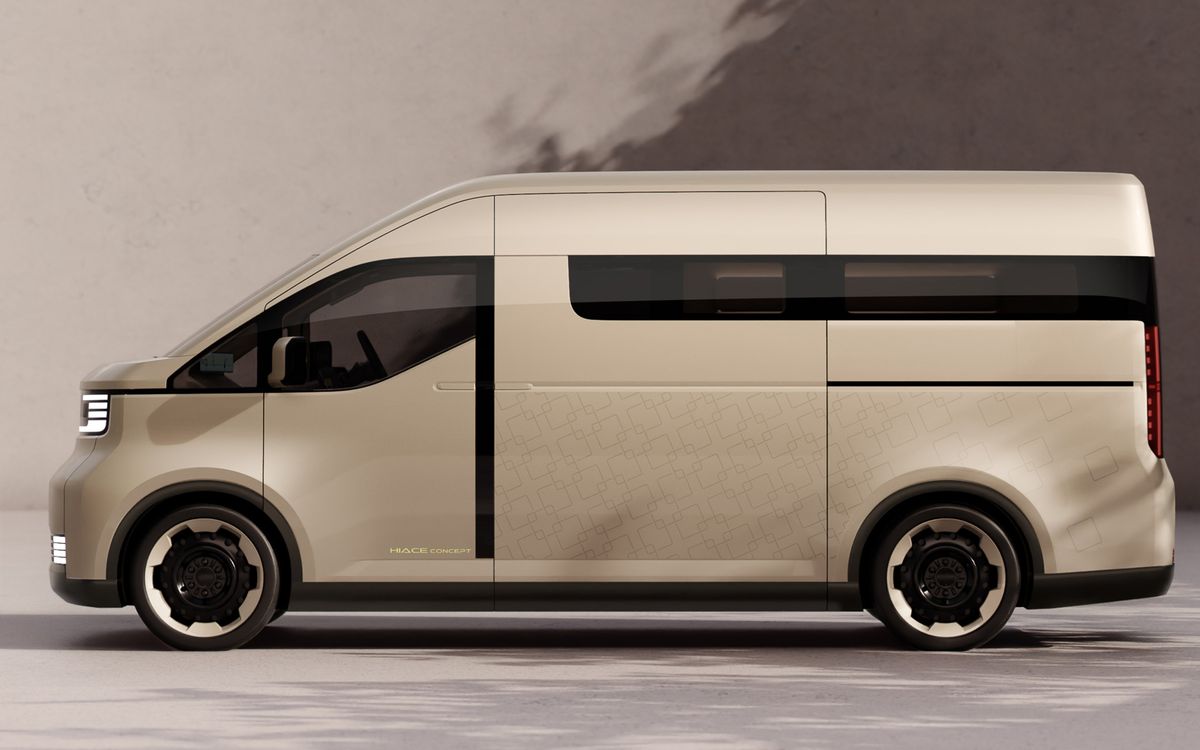
- Model with a high overall height
- The wheelbase has also been extended
- Achieves larger luggage space
This variation is expected to inherit the diverse body types offered by the current 200 series Hiace, such as the “long body” and “super long body.”
Evolution from the KAYOIBAKO concept
What is the KAYOIBAKO concept for 2023?
The Hiace Concept unveiled this time adopts a design that can be considered an evolution of the “KAYOIBAKO” concept announced at JMS2023 in 2023.
KAYOIBAKO Features:
- BEV (battery electric vehicle) commercial van
- Compact body size (length 3990mm x width 1790mm x height 1855mm)
- The luggage compartment length of 3127mm is the same as that of the Hiace
- A design concept with ultra-scalable performance
Unified design concept
At a press briefing, Toyota President Tsuneharu Sato explained, “Just as there are different sizes of cardboard boxes, KAYOIBAKO also comes in several sizes. From XL to S, the small boxes are made by Daihatsu and the large boxes are made by Toyota.”
The Hiace Concept shares a common design with KAYOIBAKO in all aspects, from the front face to the side and rear, embodying Toyota’s unified brand image as a “new work vehicle.”
What will change from the current Hiace 200 series?
History and features of the current 200 series Hiace
The fifth-generation Hiace (200 series) currently sold in Japan is a long-selling model that was introduced in 2004.
Main features of the 200 series:
- Highly efficient one-box body shape
- Large luggage space
- Multiple body types available (long, super long, wide, etc.)
- Continuous safety feature updates
Since the first model was released in 1967, the Hiace has been a popular commercial van brand loved around the world, including Japan, Asia, the Middle East, Oceania, Africa, and Central and South America.
Relationship with the 300 series for overseas markets
Meanwhile, the model for overseas markets was updated to the 6th generation (300 series) semi-bonnet type in 2019. This body was also sold in Japan as a passenger wagon model called the GranAce from 2019 to 2024.
The Hiace concept unveiled this time has a one-box style with a short nose, reminiscent of the globally available 300 series (GranAce), but the side view retains the traditional image of the Hiace.
Expectations and possibilities for electrification
Suggestions for EV and hybridization
The lower rear of the Hiace Concept features a clean, streamlined form, which suggests that the car may be considering electrifying its powertrain.
Possible electrification scenarios:
- Battery EV (BEV)
- Hybrid (HEV)
- Plug-in Hybrid (PHEV)
- Multi-powertrain deployment
Since KAYOIBAKO was introduced as a BEV concept, it is highly likely that electrification technology will also be incorporated into the Hiace Concept.
Challenges in commercial vehicle electrification
The electrification of commercial vans presents several challenges:
It is necessary to ensure a large luggage space while also equipping the vehicle with a large-capacity battery.
Ensuring driving range
: Sufficient battery capacity is required to accommodate long-distance travel when fully loaded.
Cost Considerations:
For commercial vehicle users, the balance between initial cost and running cost is important.
Toyota may be trying to solve these challenges by introducing thinner batteries and new battery technologies.
Required features for the next-generation Hiace
Essential elements for modern commercial vehicles
The next-generation Hiace is expected to undergo significant evolution from the current 200 series, which has not undergone a model change in over 20 years, and will be required to have the following features:
Enhanced safety equipment
- The latest active safety technology
- Advanced Driver Assistance Systems (ADAS)
- Blind Spot Detection System
- Advanced automatic braking
Improved environmental performance
- Improved fuel and electricity efficiency
- Cleaner exhaust gases
- Introduction of electrification technology
Comfort and convenience
- Improved comfort around the driver’s seat
- Latest connectivity features
- Improving the efficiency of cargo handling operations
Meeting diverse needs
- Various body types available
- Improved customizability
- Dedicated specifications for different applications
Hiace’s market position
Presence in the domestic commercial vehicle market
The Hiace enjoys overwhelming support in the Japanese commercial vehicle market.
Main usage scenarios:
- Delivery/logistics industry
- Construction and engineering
- Camper van base
- Welfare vehicles
- Shuttle cart
It is especially popular as a base vehicle for camper vans, and the customization market is also booming.
Competition with rival models
In the domestic commercial van market, it competes with the following models:
- Nissan NV350 Caravan
- Honda N-VAN
- Suzuki Every
- Daihatsu Hijet Cargo
The Hiace is particularly notable for its competition with the NV350 Caravan in the medium and large class.
Time of commercial release and expected price
Release date prediction
There has been no official announcement as to when the Hiace Concept will be released to the market, but we can make the following predictions:
Early scenario: Late 2026 to 2027
Realistic scenario: 2027 to 2028
Conservative scenario: 2028 and beyond
As the current 200 series is now in its 21st year, it is hoped that it will be put on the market as soon as possible.
Expected price range
The introduction of electrified technology is likely to increase the price compared to the current model.
Current 200 series price range: Approximately 2.4 million to 4 million yen
Estimated price of the next model: Approximately 3 million to 5 million yen
However, the actual purchase price of BEV models may be reduced due to the application of subsidies.
User expectations and reactions
Reaction on social media
Following the unveiling of the Hiace concept at JMS2025, there have been a variety of reactions on social media:
Positive comments:
- Finally, signs of a full model change are emerging
- The design is modern and impressive
- Expectations for improved environmental performance through electrification
Concerns:
- Concerns about increased costs due to electrification
- Won’t the traditional Hiace look be lost?
- Concerns about range and charging infrastructure
Needs of commercial vehicle users
Here are some of the requests we hear from users who use it for commercial vehicles:
- Maintaining and improving loading capacity
- Durability and reliability
- Reduced maintenance costs
- Designed to last
- Freedom of customization
Toyota’s commercial vehicle strategy
Carbon Neutral Initiatives
Toyota is accelerating the electrification of commercial vehicles in order to achieve carbon neutrality by 2050.
Key Initiatives:
- Development of BEV commercial vehicles
- Hybrid Technology Applications
- Hydrogen fuel cell vehicle research
- Multipathway Strategy
The Hiace Concept is considered to be an important part of this strategy.
Development through group collaboration
As President Sato’s remarks made clear, Toyota plans to work with group companies such as Daihatsu to develop a lineup of commercial vehicles ranging from small to large.
KAYOIBAKO Family Concept:
- S size: Daihatsu is in charge
- M-XL sizes: Toyota
- Unified design concept
- Optimal sizes available for various applications
Summary: Expectations for the next-generation Hiace
The Hiace Concept, unveiled at the Japan Mobility Show 2025, is attracting great expectations as the successor to the 200 series Hiace, which has been in production for over 20 years.
Key points of the next-generation Hiace:
- Two body types available – meeting diverse needs
- Introducing electrification technology – Achieving both environmental performance and economy
- Unified design with KAYOIBAKO – Toyota’s new commercial vehicle brand
- Influence of the Global 300 Series – Adoption of a semi-bonnet design
- Ultra-scalable performance – Ease of customization and development of derivative models
At this stage, it is still a concept model, and no details have been revealed about its commercialization, but it has the potential to mark the beginning of a new era for the Hiace, which has been loved by users for many years.
We look forward to hearing more from Toyota in the future. The Japan Mobility Show 2025 will be open to the public until November 9th, where you can see the actual vehicle. Be sure to come and experience the next generation of work vehicles for yourself.