
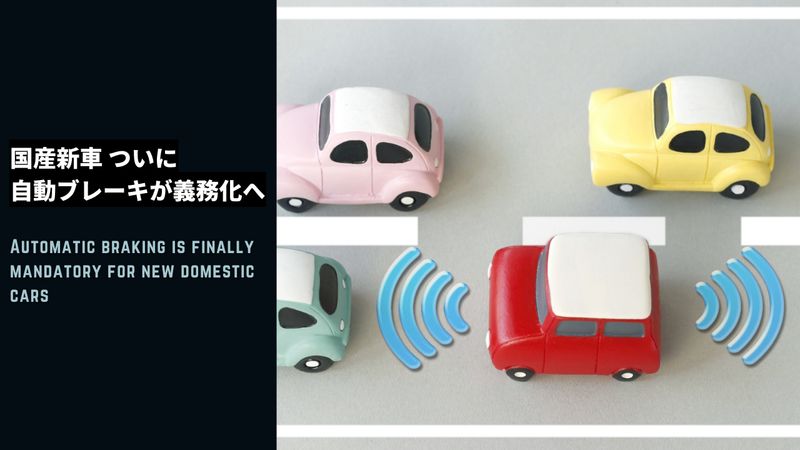
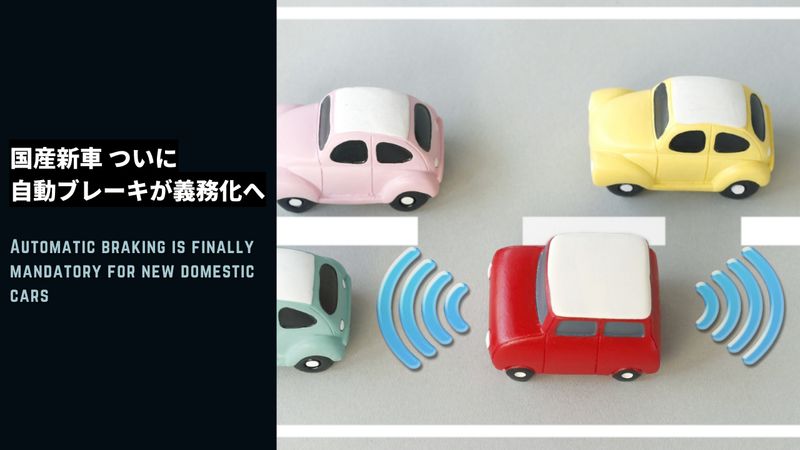
Currently, automatic braking (collision mitigation braking) will be mandatory for new domestically produced cars from November 2021, and for new imported cars from July 2024. It is scheduled to become mandatory for continued production domestic cars (excluding light trucks*1) from December 2025, and for continued production imported cars from July 2026. Automatic braking is a system that avoids or reduces damage from a collision with a vehicle ahead. It has contributed to a reduction in the number of traffic accident fatalities in recent years, and expectations for safe driving are rising.
What is Automatic Braking System (AEBS)?
Automatic braking, also known as Advanced Emergency Braking System (AEBS), is a system that automatically applies the brakes to avoid a collision with a vehicle or pedestrian in front. With advances in technology in recent years, automatic braking has become available in many vehicle models, contributing to a reduction in traffic accidents.
Background to the mandatory automatic braking
In recent years, the number of fatalities from car accidents has been on the decline, but more than 3,000 lives are still lost each year. Of these, rear-end collisions account for approximately 40% of all accidents, posing a major issue.
Automatic braking is a system that prevents collisions with vehicles ahead or reduces damage. In recent years, advances in technology have improved its performance, and it is believed to be effective in reducing accidents.
Automatic braking (collision mitigation braking) will become mandatory when
(1) Motor vehicles used exclusively for passenger use (excluding two-wheeled motor vehicles, two-wheeled motor vehicles with sidecars, three-wheeled motor vehicles, light motor vehicles with tracks and sleds, and towed motor vehicles) with a passenger capacity of less than 10 people and motor vehicles used for transporting goods (excluding three-wheeled motor vehicles, light motor vehicles with tracks and sleds, and towed motor vehicles) with a gross vehicle weight of 3.5 tons or less must be equipped with a collision damage mitigation braking control device for passenger cars, etc. that complies with the requirements set forth in Agreement Regulation No. 152.
| Domestic cars | Imported cars | |
|---|---|---|
| new model car | November 2021 (Reiwa 3) | July 2024 (Reiwa 6) |
| Continued production vehicles * 2 | December 2025 (Reiwa 7) *1 | July 2026 (Reiwa 8) |
Ministry of Land, Infrastructure, Transport and Tourism
All domestically produced vehicles that have undergone a full model change will be equipped with automatic braking from November 2021 onwards, but vehicles that have not undergone a full model change will only be equipped with automatic braking from December 2025 onwards, meaning that all domestically produced vehicles*1 will finally be equipped with automatic braking when purchased new.
*1 Light trucks: September 2026 (Reiwa 9)
*2 A model that has not undergone a full model change but continues to be improved and produced.
Key Requirements
- Tests are conducted on stationary vehicles, moving vehicles and pedestrians to ensure that the specified braking requirements are met.
- The system should automatically start up and be on standby every time the engine is started.
- The system must issue an alert 0.8 seconds before emergency braking (or when emergency braking begins in the case of a pedestrian).
Do existing vehicles need to be adapted?
Even if your current car does not have a collision damage mitigation brake, there is no problem in continuing to drive it. There is no need to buy a new car right now, so there is no problem in continuing to drive it with peace of mind.
Types of automatic braking
There are three main types of automatic braking:
- Millimeter-wave radar system : Detects the distance and speed of the vehicle ahead using radio waves
- Camera method : Recognizes vehicles ahead using a camera
- Millimeter-wave radar + camera system : A model that combines both systems.
In Japan, the names and packaging of the systems vary from company to company: Toyota ” Toyota Safety Sense ,” Lexus ” Lexus Safety System+ ,” Honda ” Honda SENSING ,” Nissan ” 360° Safety Assist, ” Subaru “EyeSight , ” Mazda ” i-ACTIVSENSE ,” Mitsubishi ” e-Assist , ” Daihatsu ” Smart Assist ,” and Suzuki “Dual Sensor Brake Support.”
For more details, please refer to this article.
→ [2023] Comparing safety equipment and advanced technologies from each company
Benefits of mandatory automatic braking
- Fewer rear-end collisions : Automatic braking can prevent or mitigate a collision with the vehicle ahead.
- Reduced driver burden : Automatic braking can reduce the risk of accidents caused by driver fatigue or distraction, especially in poor visibility conditions such as traffic jams or at night (compatible models).
- Protecting vulnerable road users : Automatic braking is also effective in reducing the damage caused by collisions with pedestrians and cyclists.
Issues with mandatory automatic braking
Automatic braking is a very effective safety feature, but it is not a panacea. Please be aware of the following points:
Automatic braking is not a panacea
- Increased costs : Vehicles equipped with automatic braking are more expensive than those without.
- System malfunction : Automatic braking can malfunction.
- Dangers of overconfidence : There is a risk of overconfidence in automatic braking, leading to a decrease in awareness of safe driving.
- Performance differences: Automatic braking performance varies depending on the vehicle model.
summary
The mandatory implementation of automatic braking systems is expected to have a major effect on reducing traffic accidents. However, there are also issues such as overconfidence in the system and malfunctions. Automatic braking systems are merely auxiliary systems, so overconfidence in them is important. It is important to drive safely. Going forward, further evolution of the system and improved education on safe driving will be required.
For more details, please refer to this article.
→ [2024] Top 25 Safe Cars Ranking, NASVA Highest Rating, Five-Star Award
→ [2024] Top 5 Safest Minivans
Ministry of Land, Infrastructure, Transport and Tourism